
Matcha tastes different every shift? Standardise the recipe
2026-11-24
Matcha tastes different from one shift to the next because three numbers move without anyone noticing: the dose of powder, the temperature of the water, and how much ice or milk ends up in the cup. Pin those three down and the drink lands within a few per cent of the same cup every time, whoever is on bar. Leave them loose and the same written recipe produces anything from 70 % to 130 % of the strength you signed off on.
In short
- A heaped bamboo scoop holds about 1.3 g, so two of them give 2.6 g instead of 2.0 g. That is plus 30 % matcha before the water is even poured.
- Ippodo Tea, the Kyoto tea house founded in 1717, sets usucha at 2 g of sifted matcha to 60 ml of water at 80 °C, whisked for about 15 seconds.
- Whisking longer does not make a better drink. Ippodo states plainly that matcha can be over-whisked and that more time in the bowl brings out more bitterness.
- A base poured at room temperature instead of fridge temperature melts roughly 58 g of ice in a 400 ml cup rather than 23 g, which thins the finished drink by about 12 %.
- Milk hides the difference rather than fixing it: in laboratory testing, skimmed milk cut the recovery of free catechin by about 95 % and dropped measured astringency by 58 to 65 %.
- Cost per 2 g serving runs from about 1.20 € from a 40 g tin down to about 0.19 € per serving at the 5 kg wholesale tier.

Why does matcha taste different every shift?
Matcha drinks drift between shifts because matcha is a suspension, not an infusion. With coffee you can hide a lot behind extraction time and a grinder that holds its setting. With matcha, everything you put in the cup stays in the cup: every milligram of powder, every millilitre of melted ice, every degree of water. There is no filter and no discard. That is why two baristas working from the same card can hand over two different drinks.
The second reason is that most matcha recipes are written in objects rather than numbers. “One scoop, hot water, oat milk, ice” is not a recipe, it is a reminder. A bar that writes “2.0 g, 60 ml at 80 °C, 15 seconds, 180 ml oat milk, 160 g ice” has something a new starter can repeat on day one.
Here is the honest part. You will never hold matcha to the tolerance of an espresso machine with a volumetric pump. What you can do is cut the spread from roughly two-fold down to a few per cent, which is the difference between a guest who says “it tastes different today” and a guest who orders the same thing twice a week.
The six places where a matcha recipe leaks
Before changing anything, find out which of these is actually costing you. On most bars it is the first two, and they are also the cheapest to fix.
| What drifts | Typical range on a busy bar | What the guest notices | What fixes it |
|---|---|---|---|
| Dose of powder | 1.6 g to 2.6 g for a “2 g” drink | Thin and milky, or harsh and drying | 0.1 g scale, or pre-weighed portions |
| Water temperature | Anything from 70 °C to full boil | Flat and dull, or sharp at the back of the tongue | Kettle with a set temperature, one number on the card |
| Base temperature before ice | 4 °C from the fridge to 25 °C from the counter | Watery iced drinks in the afternoon | Chill the base, date it, keep it in the fridge |
| Whisking time | 8 seconds in a rush, 40 seconds when quiet | Grainy at the bottom, or bitter on the finish | Timer on the bar, 15 seconds, stop |
| Milk and volume | 160 ml to 220 ml in the same glass | Matcha disappears behind the milk | Jug with a line, or weigh the milk |
| The powder itself | Opened bag sitting warm and lit for weeks | Duller colour, flatter aroma, more bitterness | Smaller working tin, cool and dark, one lot at a time |
Weigh the dose, because the scoop lies
A bamboo chashaku is a lovely object and a poor measuring tool. Ippodo gives both measures side by side in its usucha recipe: 2 g of matcha equals 1.5 heaping tea ladles or 1 level teaspoon, and 4 g for koicha equals 3 heaping ladles or 2 level teaspoons. Do the arithmetic and one heaped scoop lands around 1.3 g, not the round 1 g that most guides repeat.
| Measure | Weight of matcha | Against a 2.0 g recipe |
|---|---|---|
| 1 level teaspoon | about 2.0 g | on target |
| 1 heaped chashaku | about 1.3 g | minus 35 % |
| 1.5 heaped chashaku | about 2.0 g | on target |
| 2 heaped chashaku | about 2.6 g | plus 30 % |
| 3 heaped chashaku | about 4.0 g | koicha, double strength |
Two heaped scoops is what a new starter does when a guest asks for it strong, and what a tired barista does at 16:00. Thirty per cent more powder is thirty per cent more cost, thirty per cent more caffeine, and a noticeably more drying drink. The cheapest fix in this whole article is a 0.1 g jeweller’s scale on the bar, kept next to the tin rather than in a drawer.
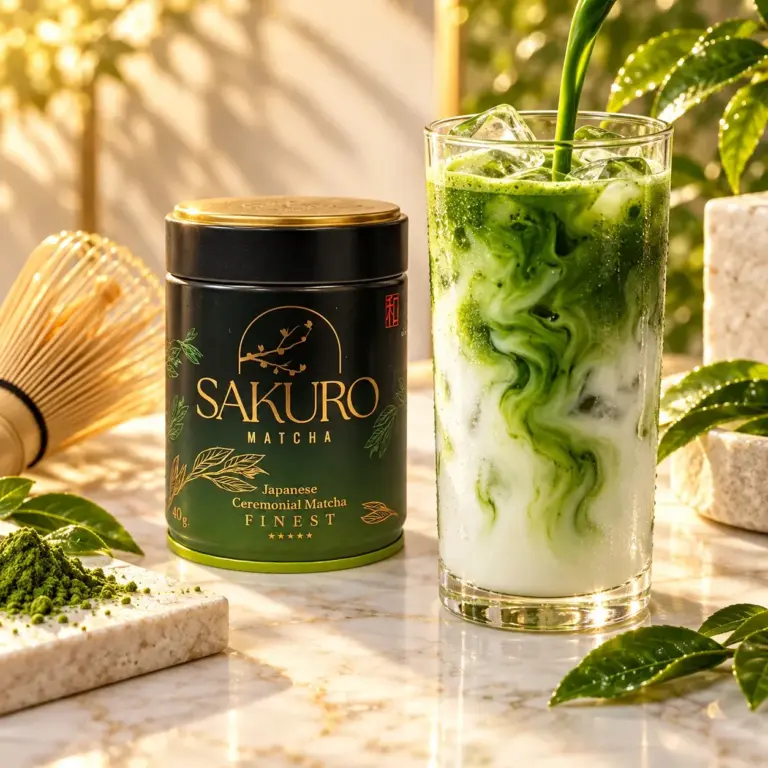
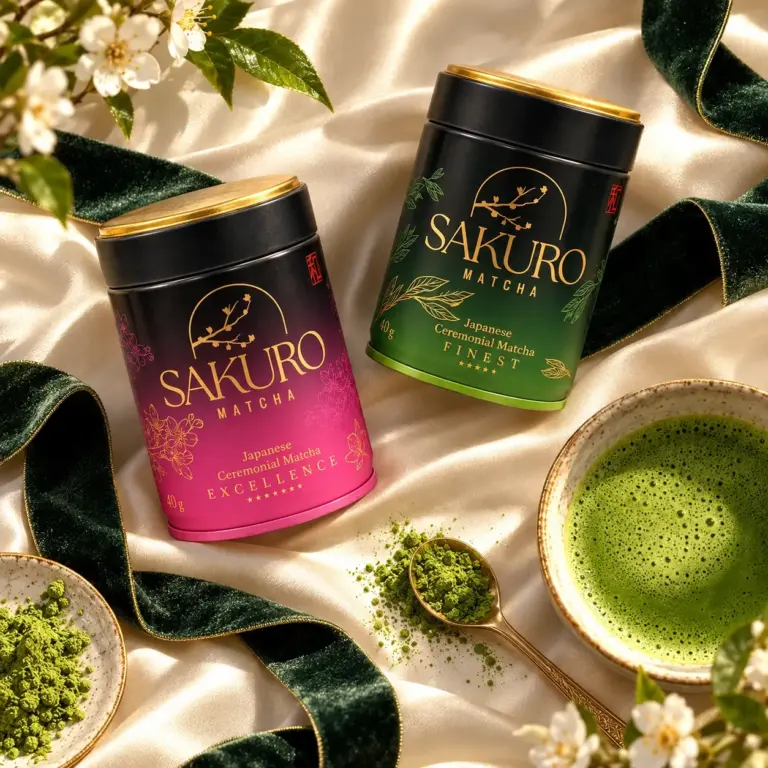
If a scale slows your service, portion instead. Weighing 2.0 g into small lidded pots during the quiet hour gives the morning rush a dose that cannot drift, and it keeps the main bag closed. Portions are also the only way we have seen bars keep two grades apart without mistakes: Sakuro Matcha Finest 40 g for drinking bowls and milk drinks, Sakuro Matcha Excellence 40 g where you want the sweeter, rounder cup on the menu.
Water: one temperature, one volume, and the filter nobody changes
Water is the ingredient you buy by accident. Ippodo brews usucha at 80 °C, and the method they suggest without a thermometer is to pour boiling water into the cup first and let it drop before it goes into the bowl. Hot water is not neutral here. Research published in Food Chemistry in 2026 by Mika and Wikiera found that brewing with boiling water increases catechin extraction with a preferential increase in the gallated catechins, and those are exactly the ones that read as bitter on the tongue.
The same study produced a number that explains a complaint we hear from bars with hard water: EGCG retention after one hour at 80 °C fell from 38.4 % in distilled water to 1.4 % in mineral water. Hard water does not make matcha bitter. It makes it flat and short, which is worse, because nobody can point at what is wrong.
Three practical consequences for a bar:
- Set the kettle to 80 °C and write that number on the recipe card. A kettle that holds temperature pays for itself in consistency long before it pays for itself in energy.
- Measure the water for the concentrate. Ippodo warns that too much water makes it hard for thick foam to develop, and the fix they suggest is the one that suits a bar: whisk a small, strong concentrate first, then top up.
- Put the filter cartridge on the cleaning rota with a date, not a feeling. A cartridge that is three months past its change date quietly moves every drink on your menu.
Fifteen seconds of whisking, not “until it foams”
Whisk time is the variable baristas invent for themselves, because nobody writes it down. Ippodo is unusually direct about it: “It’s possible to over-whisk matcha. Since matcha is essentially just fine tea leaves combined with hot water, the longer we whisk it, the more bitterness will emerge.” Their recommendation is to stop at around 15 seconds no matter how much foam there is.
That one line kills the most common bar habit: whisking until the foam looks right for the photo. Foam is a by-product. The drink under it is the product.
What to standardise around the whisk:
- Sift every time. Ippodo sifts straight into the bowl they whisk in, because the powder clumps naturally and sifting is what lets you whisk quickly and consistently. A clump that survives into the glass is a pocket of undissolved matcha that one guest gets and the next does not get.
- Pick one tool and keep it. A bamboo chasen and an electric frother do not produce the same drink. The frother is more repeatable across a team and faster during a rush; the chasen gives a finer foam and more control. Decide which one your menu is built on, then buy a second one so a broken tine never forces an improvised method mid-service.
- Replace the chasen before it falls apart. Tines snap, splay and lose their curve. When half the inner ring is gone, the same 15 seconds is doing a different job.
- One jug, one line. If the recipe says 180 ml of milk, the jug needs a line at 180 ml, not a barista’s eye at the end of a double shift.
Milk and ice move the drink more than your dose does
Here is the result that surprises most café owners. Milk does not simply dilute matcha, it binds it. In work published in Milk Science in 2010, Miura and Akuzawa mixed a catechin solution with milk components and measured both taste and chemistry: astringency suppression was about 58 to 65 % in the samples without lactose, and HPLC showed skimmed milk reducing the recovery of free catechin by about 95 %. Laboratory work on the human bitter receptor points the same way, with beta-casein cutting EGCG activation of the hTAS2R39 receptor by around 93 % in cell assays.
Two things follow for a menu. First, switching from cow’s milk to a low-protein plant drink such as almond, or back again, changes the perceived strength of your matcha more than a 10 % change in dose would. Second, the advice to “use skimmed milk so you can taste the matcha” is only half true: skimmed milk carries slightly more protein than whole milk, so it binds at least as much. If a guest wants the matcha to come forward, raise the dose or change the milk type, and write the new number on the card as a separate drink.
Ice is the other hidden ingredient, and it is pure arithmetic. Melting a gram of ice absorbs 334 J, and cooling a millilitre of water by one degree releases about 4.19 J, so a base that arrives warm melts its way to a weaker drink. For a 400 ml cup built on 230 ml of base:
| Base temperature | Ice melted to chill it | Liquid in the glass | Strength against a base at 8 °C |
|---|---|---|---|
| 4 °C (fridge, back) | about 12 g | about 242 ml | 105 % |
| 8 °C (fridge, door) | about 23 g | about 253 ml | 100 % |
| 12 °C (left out briefly) | about 35 g | about 265 ml | 96 % |
| 20 °C (room temperature) | about 58 g | about 288 ml | 88 % |
| 25 °C (counter in summer) | about 72 g | about 302 ml | 84 % |
That table is a minimum, because it assumes ice at exactly 0 °C, no heat from the room and a guest who drinks immediately. Put it together with the dose and you get the spread a café actually serves.
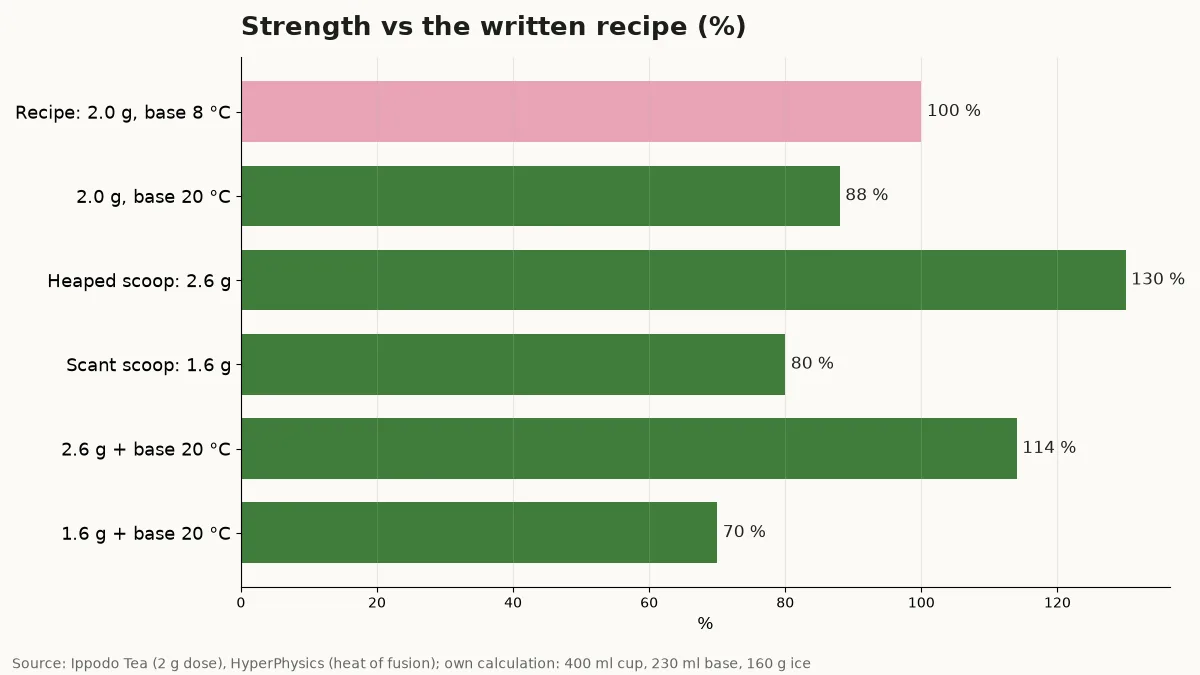
A spread of 70 % to 130 % is nearly a factor of two between the weakest and the strongest drink you sell under one name and one price.
Hot and iced are two different drinks, even from one recipe
Cold suppresses taste. The channel TRPM5, which sits downstream of the sweet, umami and bitter receptors, is heat-activated: in work published in Nature in 2005, Talavera and colleagues showed inward TRPM5 currents increasing steeply between 15 and 35 °C, and the authors suggest cautiously that this may underlie the familiar effect of temperature on taste in people.
In practice, a base that tastes correct warm will taste thin over ice, and a base built for ice will taste heavy and bitter served hot. This is why a single “matcha base” for the whole menu is a trap. Either build two doses, or accept that one of the two drinks is a compromise and say so on the card.
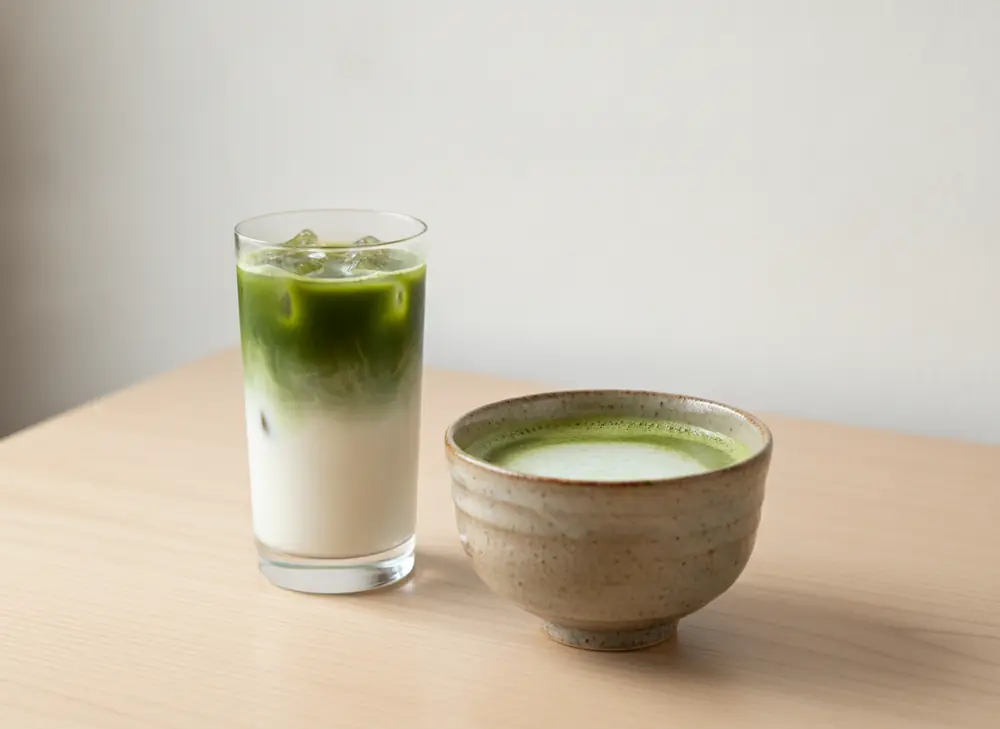
A useful habit when you calibrate: taste the base at room temperature, not straight off the kettle and not over ice. Room temperature is where the differences between two batches are easiest to catch, and where a weak dose has nowhere to hide.
The powder changes while it sits on your bar
A kilogram bag opened on the first of the month is not the same ingredient on the twenty-eighth. A 2026 review of post-harvest tea quality in Foods makes the mechanism plain: once the package is opened, the inert atmosphere is gone and deterioration continues regardless of how the bag was packed. The same review reports that each 10 °C rise in ambient temperature increases the rate of quality loss by a factor of three to four, that continuous exposure to 1700 lx of fluorescent light for 30 days at 25 °C completely eliminates the green hue of tea, and that 4 °C is a suitable temperature for long-term matcha storage.
Translate that into bar rules:
- Decant into a small working tin that holds two or three days of trade. The big bag stays sealed, cool and dark.
- Keep the working tin out of the window and away from the display spotlights. Light, not heat, is what strips the colour.
- Never top up an old tin with new powder. You lose the ability to tell which lot a complaint belongs to.
- Tea picks up moisture and odours. Dry tea sits safely at around 4 to 6 % moisture, so no open containers next to the cleaning cupboard or the lemon slices.
Then there is the supplier question. Matcha from different harvests is genuinely a different ingredient: in data compiled by Unno and colleagues in Molecules in 2026, theanine falls from 20.4 mg/g in the earliest first-flush leaf to 3.3 mg/g in autumn leaf, while EGCG rises from 67.5 to 82.4 mg/g, and the catechin-to-theanine ratio climbs from 2.1 to 14.6. A bar that buys whatever is cheapest each month is re-writing its own recipe four times a year without meaning to.
The four-minute check at the start of every shift
This is the routine we would put on a laminated card by the scale. It takes about four minutes and it catches most of what goes wrong.
- Scale on, tare, weigh one dose. Confirm the number on the card, 2.0 g for a standard drink. If the scale is drifting, it shows up here rather than in a complaint.
- Kettle to 80 °C. Check the display, not the sound. If the kettle has no setting, boil and leave it for roughly two minutes in an open jug, then write that into the card as a step.
- Whisk one reference bowl, 15 seconds. Sift, whisk, stop on the timer.
- Taste it at room temperature. One spoonful, no milk, no ice. You are checking for two things: sharp bitterness that suggests the water was too hot or the whisking too long, and a flat, cardboard note that suggests the powder is tired or the filter is spent.
- Look at the colour against a white cup. Colour differences of more than about two units on the standard colour scale are already visible to the eye, which is roughly where a guest starts asking questions.
- Write the lot number and the date on the working tin. Thirty seconds now, and a complaint three weeks later becomes answerable.
If the reference bowl is wrong, do not open the bar on it. Re-weigh, re-whisk, and if it is still wrong, change the working tin and keep the suspect one for your supplier. Wholesale customers who do this send us a photo and a lot number instead of “the last bag tasted odd”, and that we can act on.
What to put on the bar
Standardising a recipe is easier when the ingredient does not change under you. Sakuro Matcha is Japanese ceremonial grade matcha from Shizuoka, sold in two grades, and the same grade runs from a 40 g tin up to a 1 kg bag, so a trial on the bar and a full service order are the same powder.
| Your situation | What we would put on the bar | Why |
|---|---|---|
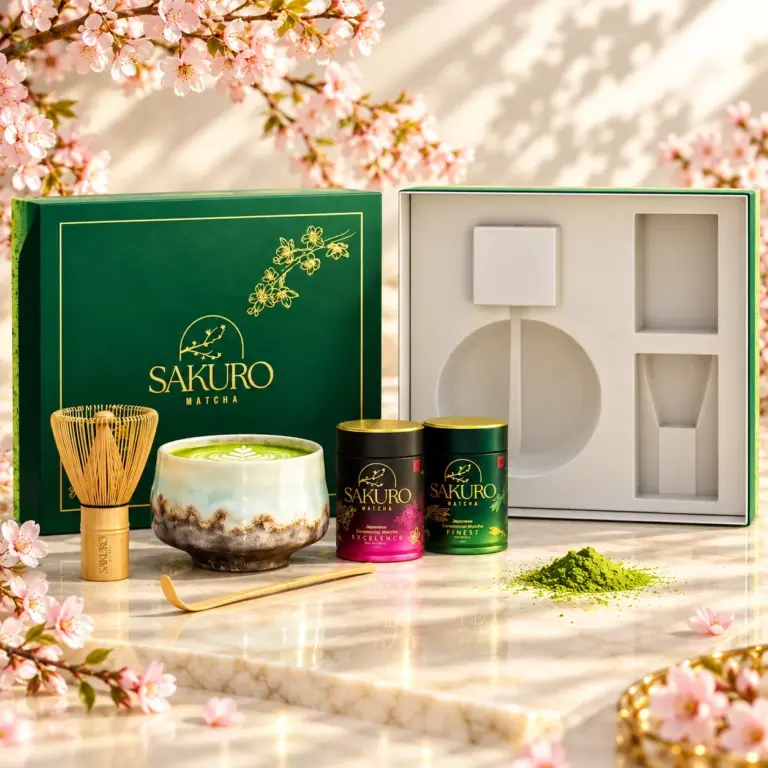
| Testing matcha on the menu for a month | Finest 40 g plus Excellence 40 g, 46.90 € | Both grades side by side, about 40 drinks, enough to pick one before you commit |
| One drink on the menu, steady trade | Three tins of Finest 40 g, 46.90 € | About 0.78 € per 2 g serving, the cheapest retail format, and three sealed tins rotate properly |
| Busy bar, several matcha drinks | Set of four Finest 40 g tins, 80.90 € | 160 g in sealed tins, so the working tin is always small and fresh |
| Over roughly 40 drinks a week | 1 kg bags, wholesale | About 0.22 € per serving, one lot for months, far less packaging |
| Replacing worn tools | Chasen 14.90 €, chashaku 5.90 € | A tired whisk is a silent recipe change; keep a spare behind the bar |
For wholesale, talk to Ewelina: [email protected] or +48 515 025 329. Orders go out in kilograms (1 kg bags) and ship from Poland inside the EU, with 5 % off from 3 kg and 10 % off from 5 kg. She sends the binding offer, including a sample before you switch your whole menu.
What one serving actually costs
Prices below are our shop prices on the day of writing, converted per 2 g serving. Wholesale figures come from the Sakuro trade list, 480 PLN/kg net for Finest and 690 PLN/kg net for Excellence, converted at the National Bank of Poland rate of 4.4556 PLN to the euro (table 227/A/NBP/2026). Treat the euro figures as an indication; Ewelina sends the binding offer.
| Format | Price | Per 2 g serving |
|---|---|---|
| Finest, 40 g tin | 23.90 € | about 1.20 € |
| Excellence, 40 g tin | 26.90 € | about 1.35 € |
| Three Finest tins, 120 g | 46.90 € | about 0.78 € |
| Four Finest tins, 160 g | 80.90 € | about 1.01 € |
| Finest, 1 kg wholesale | about 108 € per kg | about 0.22 € |
| Finest, 5 kg wholesale | about 97 € per kg | about 0.19 € |
At 0.22 € a serving, a bar that lets the scoop drift to 2.6 g is giving away about 0.07 € per drink. At 300 matcha drinks a month that is around 21 €, which is not the painful part. The painful part is that those drinks taste different, and the guest who liked the strong one is disappointed by the weak one.
Next step: write your card with numbers tonight, weigh the first dose tomorrow morning, and keep the reference bowl. If the powder itself is the weak link, start with the Finest and Excellence pair and taste both against your current supplier at the same 2.0 g.
Related reading: matcha wholesale for cafés and restaurants, the real cost per cup of a matcha latte and why matcha turns bitter and clumpy.
Frequently asked questions
Should every barista weigh the matcha, or is a trained scoop enough?
Weigh it. Even a trained hand moves between 1.6 g and 2.6 g on a heaped bamboo scoop, and the difference lands directly in the glass. A 0.1 g scale costs less than a week of wasted powder.
Is an electric frother more repeatable than a bamboo whisk?
Across a team, usually yes, because it removes the barista’s wrist from the recipe. The texture is different: a frother gives larger bubbles and a thinner foam, a chasen gives microfoam and more control. Pick one, build the menu on it, and keep a spare of whichever you chose.
Can we whisk a litre of matcha base for the morning rush?
Yes, with limits. Storage trials on green tea beverages found total polyphenols falling by about 8 to 23 % over an extended period at 4 °C, with caffeine and free amino acids essentially unchanged, and browning getting much faster above room temperature. Keep the base cold, keep it dark, date it, and follow your own food safety rules for anything containing milk.
Why does the same drink taste stronger in winter than in summer?
Mostly ice and base temperature. A base that sits at 20 °C in July melts more than twice as much ice as the same base at 8 °C, which thins the drink by roughly a tenth before the guest touches it. Cold also mutes taste, so an iced drink needs a higher dose to read the same.
How long is an opened kilogram bag good for on the bar?
Once opened, the protective atmosphere is gone and the clock runs faster, especially warm. Decant two or three days of trade into a small tin, keep the rest sealed, cool and dark, and plan the bag around weeks rather than months. Cold storage at around 4 °C is the single most effective thing you can do.
Our new supplier’s matcha looks the same but tastes sharper. Why?
Harvest and shading, most often. Leaf from the first flush carries far more theanine than later pickings, and the catechin-to-theanine ratio climbs steeply through the year, which is exactly the direction that reads as sharp and drying. Colour alone will not tell you; taste two bowls side by side at the same dose.
How much caffeine is in a double-dose matcha drink?
Published figures for matcha run roughly 19 to 44 mg of caffeine per gram, so 2 g gives about 38 to 89 mg and a 4 g drink roughly twice that. EFSA considers single doses up to 200 mg and daily intakes up to 400 mg unproblematic for healthy adults, with a lower figure in pregnancy, so a strong matcha fits comfortably as long as the day’s total is reasonable.
Discover our TOP products!




Your dream figure


Discover new flavors


Yerba mate with tea




Accessories


Superfoods











Certified raw honeys from Poland

Check the current price
free shipping
Up to 90 days
free returns
24 H
shipping