
Why is my matcha bitter and clumpy? 6 mistakes to fix
2026-11-23
Bitter, lumpy matcha is almost always a preparation problem, not a bad tin of tea. Water hotter than 80 °C, too much powder for too little water, and a skipped sieve cause the great majority of it, and each of those takes under a minute to put right.
I have watched this go wrong in cafés and in my own kitchen often enough to know the pattern. Someone buys a good ceremonial powder, uses the kettle straight off the boil, tips in a heaped teaspoon, beats it for a minute with a cheap whisk and ends up with a green drink that tastes like over-brewed tea with sand in it. The powder gets the blame. It rarely deserves it.
- Water at 80 °C, never boiling. Ippodo Tea, the Kyoto tea house trading since 1717, tells you to pour boiling water into a cup first so it drops to 80 °C, then pour it into the bowl.
- 2 g of matcha to 60 ml of water for a classic bowl (usucha). Koicha is 4 g to 30 ml and is supposed to be intense.
- Sift every time. Matcha clumps on its own: the particles are tiny, the powder is light, and stone-milled matcha carries a static charge.
- Whisk about 15 seconds. Ippodo is explicit that whisking longer brings out more bitterness.
- The bitter molecules are the gallated catechins, ECg and EGCg. In a cell assay with the human bitter receptor hTAS2R39, those two gave a clear response and EC and EGC a much weaker one (Narukawa et al., 2011).
- Caffeine: 2 g of matcha works out at roughly 38–89 mg. EFSA puts the safe daily intake for healthy adults at 400 mg, and 200 mg in pregnancy.
Mistake 1: water straight off the boil
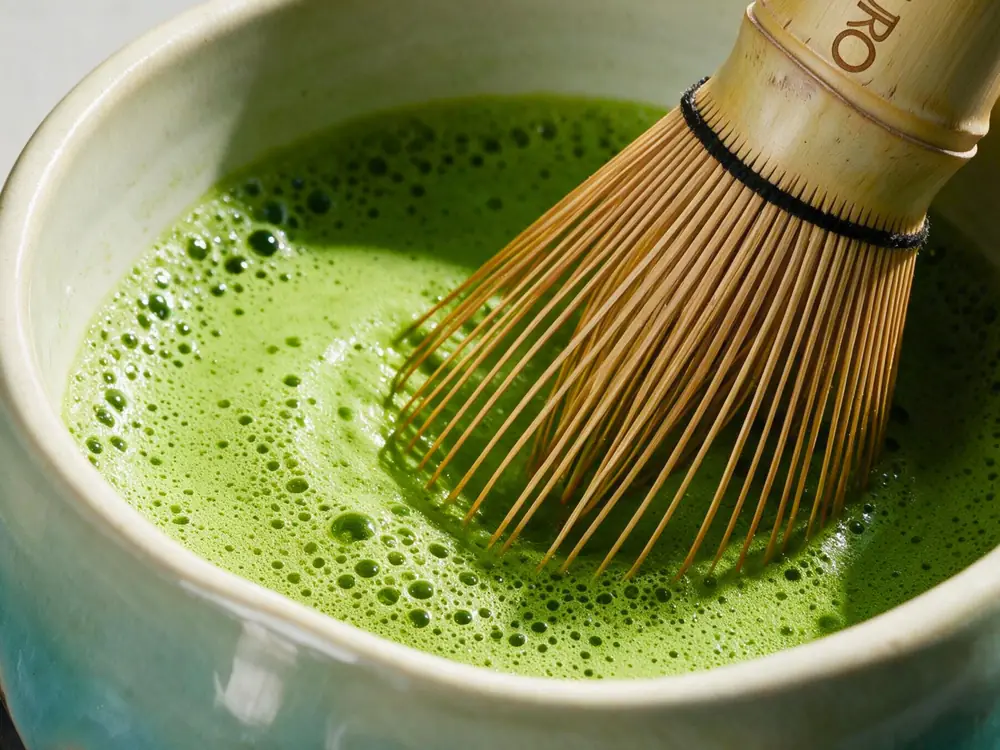
Boiling water is the single most common cause of bitter matcha. Matcha is not steeped, it is suspended, so every bitter compound in the powder goes into the cup; hotter water simply pulls them out faster and in a worse ratio. In a 2026 study in Food Chemistry, brewing green tea with boiling water increased catechin extraction with a preferential increase in the gallated catechins (Mika and Wikiera, 2026) — and the gallated ones are exactly the bitter ones.
The target is 80 °C. If you have a kettle with temperature control, that is the end of the problem. If you do not, use Ippodo’s own trick from its usucha recipe: boil the kettle, pour the 60 ml into a cold teacup, wait while you sift the powder, then pour that water into the bowl. The transfer plus the cold ceramic drops it roughly to where you want it. Two transfers if the room is warm.
How much difference does it make? Enough that most people taste it on the first try. The same powder that tasted like burnt spinach at 100 °C tastes sweet and marine at 80 °C. Nothing else changed.
What about cold water?
Cold matcha is not bitter, it is flat and hard to mix. Below about 15 °C your tongue registers sweetness, umami and bitterness less strongly — those three taste pathways all run through a temperature-sensitive channel, TRPM5, whose currents rise steeply between 15 and 35 °C (Talavera et al., Nature, 2005). That is why iced matcha needs more powder, not less, and why cold powder refuses to wet properly. Make a paste with a splash of warm water first, then add the ice.
Mistake 2: the ratio is wrong, and a teaspoon is lying to you
A classic bowl of matcha is 2 g of powder to 60 ml of water. That is the ratio in Ippodo’s usucha recipe, and it is the one to measure yourself against before you decide your matcha is bad. The trouble is that a “heaped teaspoon” of a light, electrostatic powder can be anything from 1.5 g to 4 g depending on how compacted the tin is, so people routinely drink something close to koicha and wonder why it bites.
Koicha — thick matcha — is 4 g to 30 ml, stirred slowly for fifteen seconds without foam, and it is genuinely intense. Ippodo recommends a sweeter, less sharp grade for it and suggests eating something beforehand. If you have accidentally been making koicha-strength bowls with a culinary-grade powder, bitterness is the expected outcome, not a fault.
| Preparation | Matcha | Water | Temperature | Whisking |
|---|---|---|---|---|
| Usucha (classic bowl) | 2 g | 60 ml | 80 °C | 15 s, fast, M shape |
| Koicha (thick) | 4 g | 30 ml | 80 °C | 15 s, slow, no foam |
| Larger mug | 2 g | 60 ml, then top up to 150–200 ml | 80 °C | Whisk the concentrate first |
| Hot matcha latte | 2–3 g | 50 ml + 150 ml milk | 80 °C water, milk 60–65 °C | 15 s for the paste |
| Iced matcha | 3 g | 60 ml + ice to 300 ml | 80 °C for the paste | 15 s, then pour over ice |
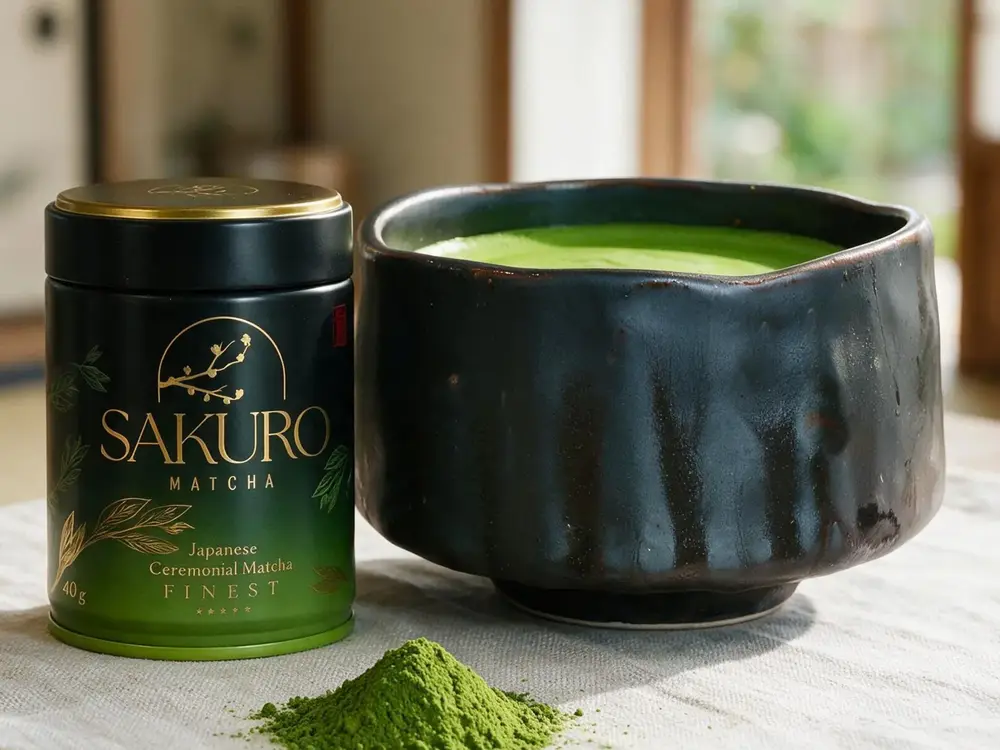
Note the third row. If you like a big mug, do not simply add more water to the bowl — Ippodo warns that too much water in the bowl makes a thick foam hard to develop. Whisk the espresso-strength concentrate properly, then lengthen it. Buying a Sakuro Matcha Finest 40 g tin (about 23,90 € on yerbador.com, roughly 20 bowls at 2 g) and then guessing the dose with a spoon is a waste of good tea; a Chashaku bamboo scoop (about 5,90 €) or a 0,1 g kitchen scale solves it permanently.
Mistake 3: you did not sift, so you are drinking lumps
Matcha clumps for physical reasons that have nothing to do with quality. The particles are tiny and the bulk density is low, which makes the powder awkward to handle in the first place, and stone-milled matcha is electrostatically charged, so it flows badly and sticks to itself; discharging the static improves flow, and how much depends on the humidity (Sawamura et al., 2009). Add the compaction that happens inside a tin during shipping and you get clumps in a brand new, perfectly fresh powder.
A tea strainer’s mesh is roughly 0,15–0,25 mm wide, around ten times a matcha particle. It does not grind anything and it does not remove the coarse fraction. All it does is break up agglomerates, which is exactly the job. Ippodo sifts straight into the bowl it whisks in, every single time, because “matcha powder will naturally clump up”.
Unsifted lumps do two things. The dry core of a lump never wets, so it survives the whisking and arrives on your tongue as a concentrated pellet of powder — that is the gritty, sharply bitter mouthful people describe. And the lump takes powder out of circulation, so the drink is weaker than you intended while tasting harsher. Both problems, one sieve.
No sieve in the house?
Press the powder through a small kitchen sieve with the back of a spoon, or put 2 g in a jar with 60 ml of water, screw the lid on and shake hard for ten seconds — the shaking breaks the clumps mechanically. It is not as good as whisking, but it beats drinking lumps. There are more workarounds in our guide to making matcha without a whisk.
Mistake 4: whisking too slowly, too gently, and far too long
Whisk fast for about fifteen seconds and then stop. This is the instruction most people get backwards: they whisk gently for a minute, hoping for foam, and make the drink bitter in the process. Ippodo puts it plainly — matcha is fine tea leaves in hot water, so the longer you whisk, the more bitterness emerges, and they cap it at around fifteen seconds no matter how much foam has appeared.
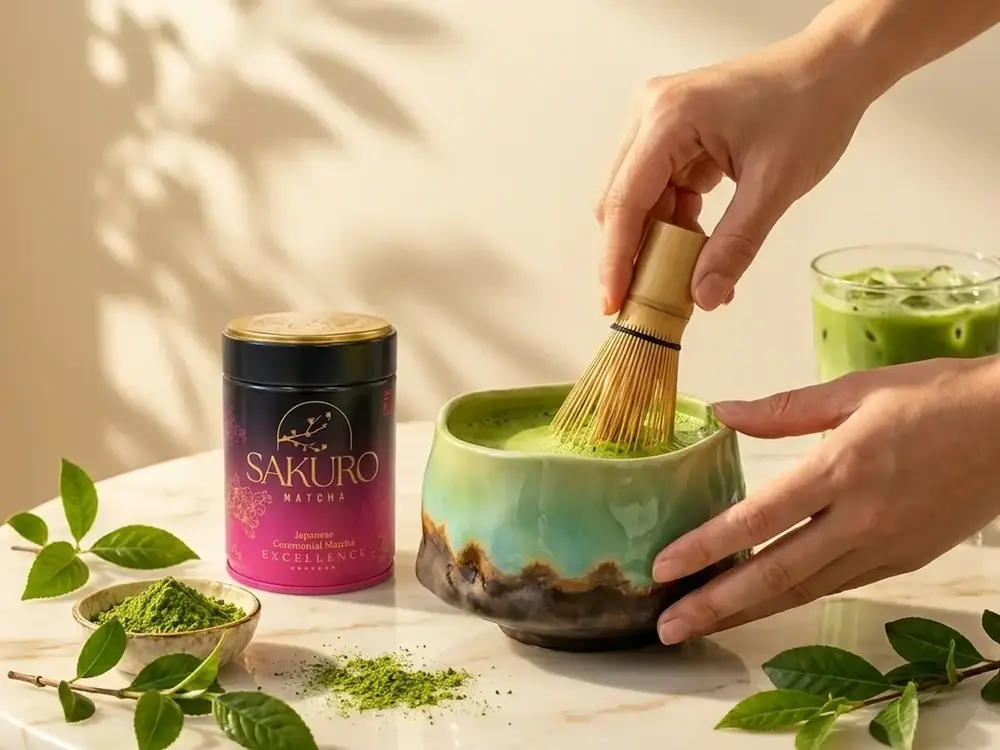
The motion matters as much as the duration. Stirring in circles pushes the powder to the edge and makes almost no foam. A fast forwards-and-backwards snap in an M or W shape, driven from the wrist with the tips just off the bottom of the bowl, aerates the liquid properly. Finish by lifting the whisk and drawing it slowly across the surface for two seconds: that breaks the big bubbles into microfoam and changes the texture completely.
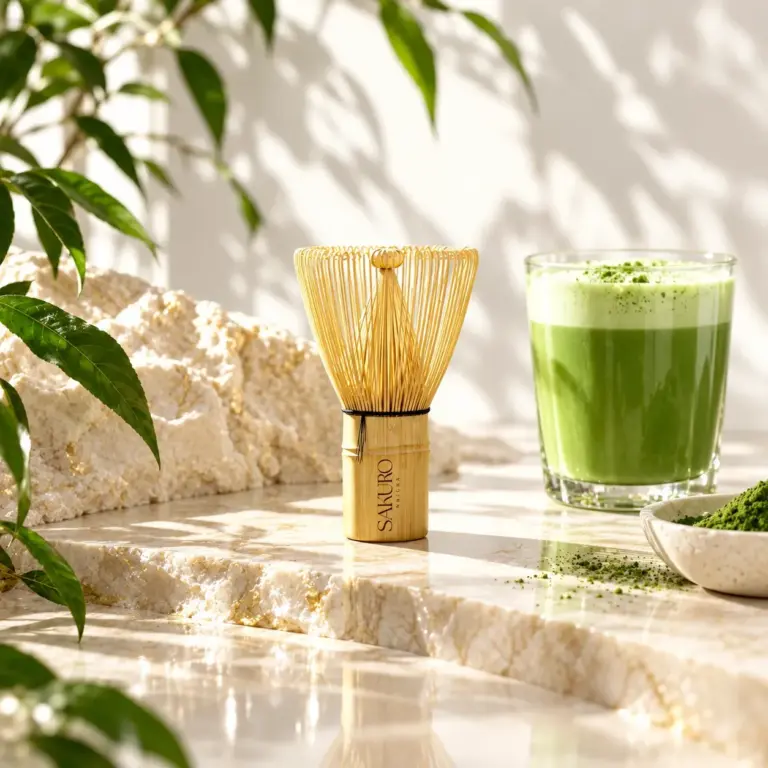
Three practical points. First, make a paste before you add the rest of the water — 2 g of powder with a tablespoon of water, worked smooth, then the remaining water. Second, a bowl with a wide flat base gives the whisk room; a narrow mug does not. Third, a Chasen bamboo whisk (about 14,90 €) that has lost prongs or dried out hard will not aerate anything. If yours is stiff and splayed, read our piece on cleaning and caring for a chasen, and if you want the full sequence from scoop to bowl, we set it out in how to make matcha the traditional way.
Mistake 5: the powder really is the problem
Sometimes the preparation is fine and the tin is the culprit. Three things to check: the grade, the grind and the age.
Grade. Culinary matcha is made from later harvests and is meant to survive sugar, butter and heat. Drink it straight and it tastes astringent and flat because that is what it is for. Ceremonial grade from a first harvest has more theanine and less of the harsh edge. We compare them properly in ceremonial versus culinary matcha.
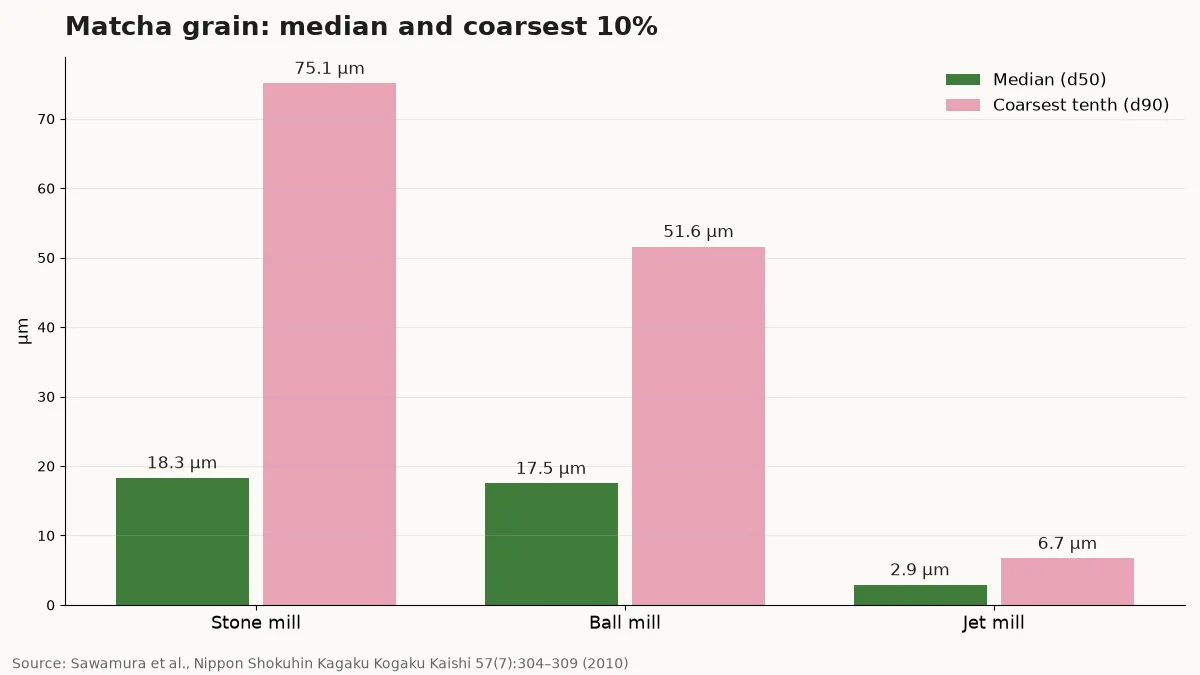
Grind. Here is the number most people have never seen. Stone-milled matcha has a median particle of 18,3 µm — but a tenth of the powder is coarser than 75,1 µm, four times the median (Sawamura et al., 2010). Ball-milled powder has almost the same median, 17,5 µm, and a much shorter tail at 51,6 µm. That coarse tenth is what settles fastest at the bottom of the bowl and what you feel as grit. Normal matcha spans 1 to 100 µm (Haraguchi et al., 2003); the range matters more than the average.
Age and storage. Matcha does not spoil in a dangerous way, but it fades, and heat does it fastest. Stored at 5 °C the foaming ability of matcha barely changed over the test period; at 30 °C it dropped after six months, and at 45 °C after only two — and higher-grade matcha was less sensitive to temperature than mid-grade (Ikeda et al., 2012). A tin that has sat on a sunny shelf since spring will be duller, browner and more bitter than the same tin kept closed in the fridge.
Mistake 6: your water is working against you
Hard water does not make matcha bitter — it makes it flat, and then it destroys it if you keep it hot. Increasing water mineralisation reduced catechin extraction and lowered the relative share of EGCG in the same 2026 Food Chemistry work. The striking figure is what happens afterwards: EGCG retention after an hour at 80 °C fell from 38,4 % in distilled water to 1,4 % in mineral water. Acidifying with lemon juice held retention at roughly 95 % regardless of the water.
Two practical conclusions. If your tap water is very hard and your matcha tastes dull and slightly chalky, a simple filter jug is the cheapest upgrade available. And if you are holding whisked matcha hot — in a café, in a thermos — you are losing far more than flavour. Make it to order, or make it cold.
| Symptom | Most likely cause | Fix |
|---|---|---|
| Sharp, burnt bitterness | Water at or near boiling | Drop to 80 °C; pour through a cold cup first |
| Gritty, sandy mouthfeel | Lumps, or a coarse grind | Sift into the bowl; switch to a finer ceremonial powder |
| Thin, bitter and weak at once | Lumps holding back the powder | Sift, then make a paste before the rest of the water |
| Astringent, dries the mouth | Culinary grade, or a late harvest | Use ceremonial grade for drinking, culinary for baking |
| Flat, chalky, no aroma | Hard water, or old powder | Filtered water; buy smaller tins and refrigerate them |
| No foam, big bubbles | Too much water, slow whisking, tired chasen | 2 g to 60 ml, fast wrist, finish slowly on the surface |
It is already bitter: what actually rescues the cup
Milk is the most effective rescue, and not for the reason most people assume. β-casein, the main protein in cow’s milk, binds EGCG and cut activation of the human bitter receptor hTAS2R39 by about 93 % in a cell assay; sodium caseinate was nearly as effective, while β-lactoglobulin did very little (Bohin et al., 2013). A bitter bowl turned into a latte is genuinely less bitter, not just diluted.
- Lengthen it. 60 ml of extra hot water drops the concentration by half without re-whisking.
- Add milk, oat drink or a splash of cream. Dairy works best on bitterness; oat drink works mostly by sweetness and body.
- A few drops of honey or maple. Sweetness suppresses perceived bitterness directly.
- Serve it cold. Cold suppresses bitter perception, which is why mediocre matcha survives as an iced latte and fails in a bowl.
- Do not add lemon to a hot bowl. It protects the catechins and shifts the colour towards yellow-green. Fine in an iced drink, wrong in usucha.
What people actually worry about
“Is bitter matcha off, or unsafe?” No. Bitterness is a flavour signal, not a safety signal. A best-before date on a tin of matcha is about quality — colour, aroma, foam — not about whether it will make you ill. A tin that is six months past its date and has been kept cool and sealed is dull, not dangerous.
“Did I buy a fake?” Unlikely, but you may have bought the wrong thing. Brown-green colour, a dusty rather than sweet smell, no stated origin and a price far below everything else are the warning signs. Real Japanese ceremonial matcha costs what it costs because tencha is shaded, hand-sorted and milled slowly.
“Does bitterness mean too much caffeine?” No, though both are bitter. Matcha runs about 18,9–44,4 mg of caffeine per gram, so a 2 g bowl is roughly 38–89 mg — a cup of filter coffee is around 90 mg. EFSA puts the safe daily intake at 400 mg for healthy adults and 200 mg during pregnancy. If you are pregnant, count your bowls alongside your coffee.
“Should I just add sugar and stop worrying?” If you enjoy it, yes. But fix the temperature and the sieve first — most people who sweeten their matcha were compensating for 100 °C water, and they stop once it tastes right at 80 °C.
Which matcha to choose for the problem you have
| Your situation | What to buy | Price on yerbador.com |
|---|---|---|
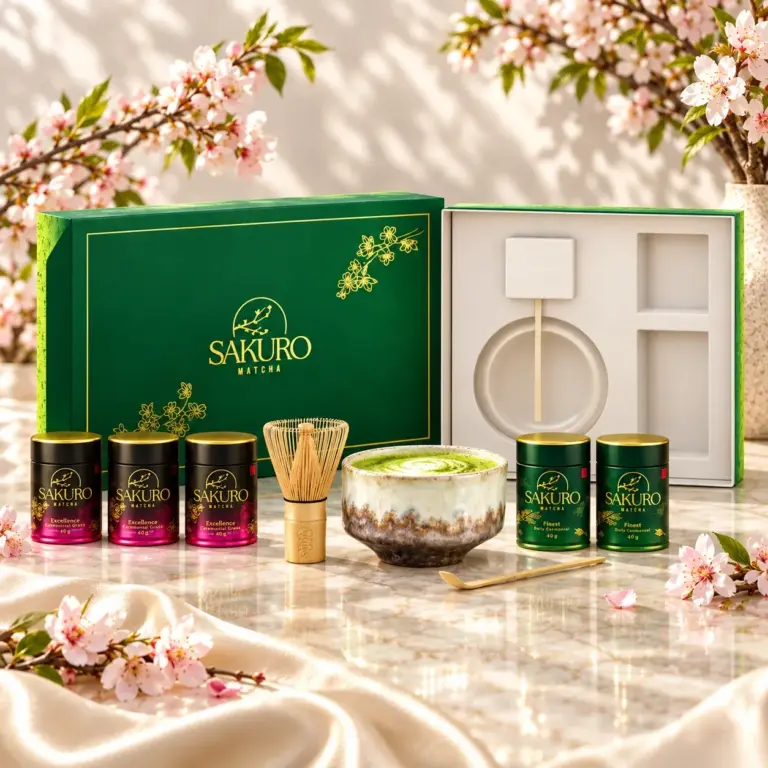
| You drink it straight and it is harsh | Sakuro Matcha Finest 40 g + Excellence 40 g — taste the two side by side | 46,90 € |
| You drink a bowl every morning | Matcha set, 4 × Finest 40 g — about 80 bowls at 2 g | 80,90 € |
| You whisk in a mug and get no foam | Matcha bowl HISUI – JADE, wide and flat-bottomed | 26,90 € |
| You want a first bowl and whisk | Matcha bowl NIWA – GARDEN with a Chasen (about 14,90 €) | 23,90 € |
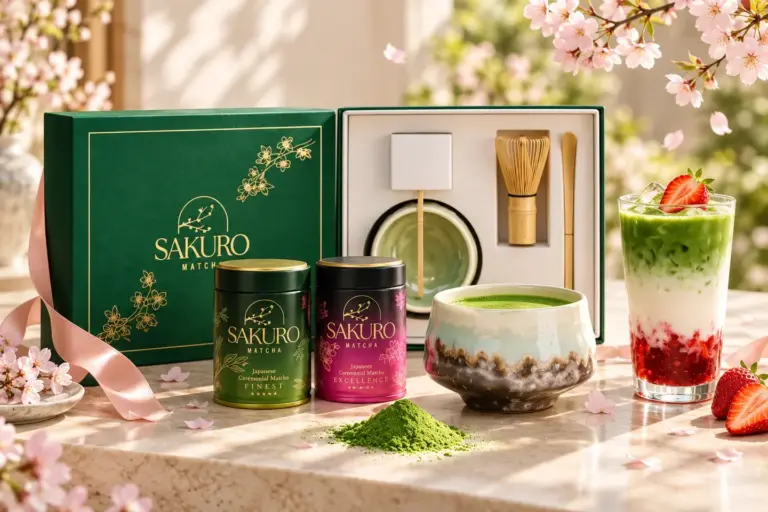
Sakuro Matcha Finest (40 g tin, about 23,90 €) is Japanese ceremonial-grade matcha from Shizuoka and the one to start with for drinking straight; Sakuro Matcha Excellence (40 g, about 26,90 €) is the sweeter, rounder one and the one we reach for when someone says their matcha is too sharp. Both are sold in euro and shipped from the EU.
For cafés: bitterness is a consistency problem
In a café the complaint is rarely “this is bitter” and usually “this tasted different yesterday”. The fixes are the same ones, written down: one dose by weight rather than by scoop, one water temperature set on the boiler, sieved powder prepared in batches at the start of a shift, and a whisk time someone actually counts. Two baristas free-pouring a heaped spoon will produce two different drinks from the same tin.
For wholesale, matcha is sold in 1 kg bags. Based on the Sakuro 2026 trade list, Finest is 480 PLN per kilo net and Excellence 690 PLN net; at the National Bank of Poland rate of 20 November 2026 (1 EUR = 4,4559 PLN) that is roughly 108 € per kilo, about 0,22 € per 2 g serving, and roughly 155 € per kilo, about 0,31 € per serving. Treat those as indicative conversions. Volume discounts are 5 % from 3 kg and 10 % from 5 kg, shipping is from Poland within the EU, and the binding offer comes from Ewelina — [email protected], +48 515 025 329.
Frequently asked questions
Can I use boiling water if I let the bowl stand for a minute?
Not reliably. The damage happens in the first seconds of contact, when the powder meets water at 100 °C. Pouring through a cold cup first lowers the temperature before it touches the matcha, which is the point of the method.
Does sifting change the taste, or only the texture?
Both. Lumps keep powder dry and out of suspension, so the drink is weaker overall while the surviving lumps deliver concentrated, bitter mouthfuls. Sifting evens out the extraction, which is why it reads as a flavour improvement.
Why does my matcha latte taste bitter when the plain bowl does not?
Usually dose. People scale the milk up to 250 ml but keep the powder at 2 g, then compensate by whisking longer or using hotter water. Keep the concentrate identical — 2–3 g at 80 °C, fifteen seconds — and add milk at 60–65 °C.
Is an electric milk frother as good as a bamboo whisk?
For a latte, close enough. For a bowl of usucha, no: a frother whips air into a few large bubbles and does not break clumps against the bottom of a bowl the way a hundred bamboo tines do. Sift first and the gap narrows considerably.
Can I save a bitter bowl by topping it up with water?
Yes, and it is the fastest fix. Add 60 ml of hot water, stir once with the whisk and taste. You lose the foam; you keep the tea.
How long does an opened tin stay good?
Treat an opened 40 g tin as something to finish within four to six weeks, kept closed, cool and away from light. Storage temperature matters more than time: foaming held up at 5 °C but dropped after six months at 30 °C and after two months at 45 °C.
Does cold-brewed matcha avoid the bitterness?
Partly, but not for the reason people expect. Cold water extracts more slowly, yet long cold steeping of tea still pulls out gallated catechins, and the reason cold matcha tastes mild is largely that cold dulls bitter perception. Shake it cold, drink it cold, and use 3 g rather than 2 g so it does not taste thin.
Start with the two changes that cost nothing: a thermometer or the cold-cup trick, and a sieve. If the bowl is still harsh after that, it is the powder, and the honest next step is a side-by-side tasting of a Finest and Excellence pair against whatever you are drinking now.
Discover our TOP products!





Your dream figure




Discover new flavors



Yerba mate with tea




Accessories



Superfoods










Certified raw honeys from Poland

Check the current price
free shipping
Up to 90 days
free returns
24 H
shipping