
Ceremonial vs culinary matcha: which grade for lattes, baking and cafés
2026-11-13
A café owner in Rotterdam asked me last spring whether she was being taken for a ride. Two bags sat on her back bar: one labelled ceremonial, one culinary, both Japanese, and the price per kilo differed by a factor of three. In a latte, she said, she could not tell them apart.
She was half right. The words on the bag are not a grading system. What sits behind them — the harvest, the shading, the mill — is real, and it does show up in the cup, though not in every cup. Below: what actually separates the two, which one belongs in which drink, and what each costs per serving once you buy kilograms instead of tins.
Ceremonial and culinary are sales words, not Japanese grades
There is no Japanese authority that certifies a matcha as ceremonial. The phrase was coined for Western buyers who wanted a quick way to tell drinking powder from cooking powder, and as VinePair notes, no organisation regulates its use. In Japan the leaf is sorted by things you can check: the region it grew in, which harvest it came from, how long it was shaded, the cultivar.
That matters commercially. Two tins can both say ceremonial at wildly different prices and neither label is lying, because neither means anything fixed. Ignore the adjective and ask the supplier four questions: which prefecture, which harvest, how long under shade, stone-milled or not. A supplier who cannot answer is reselling something they have never traced.
The harvest question carries most of the weight. First-flush leaf — ichibancha, picked in spring — is the sweetest and most aromatic. Nibancha comes roughly forty days later and runs more bitter; the third flush, more astringent again. Most of what the market sells as culinary comes from those later pickings, often with stem and vein left in — which is why it tastes rough on its own, and why it survives sugar and heat.
What actually changes in the bowl
Shading is the step that makes matcha taste like matcha. Covering the bushes for the final weeks before picking starves the leaf of light, which keeps amino acids in the leaf instead of converting them, and holds the colour at a deep, almost fluorescent green. Shade longer and you get more umami and less edge. Shade briefly or not at all and you get a yellow-khaki powder that tastes like strong green tea.
After picking, tencha is steamed and dried without rolling — unlike sencha — then stems and veins are blown out before milling. Leaving them in is cheaper and gives a duller, hay-like powder. Stone mills turn slowly and grind cool, which protects aroma; industrial mills are faster, and the heat flattens the top notes.
| What to check | Sold as “ceremonial” | Sold as “culinary” | Sakuro Finest / Excellence |
|---|---|---|---|
| Harvest | Usually first flush | Usually second or third flush | Excellence: first harvest. Finest: bold, deep-umami leaf |
| Colour, dry | Vivid jade | Olive to khaki | Vivid jade, both tins |
| Taste, in water | Sweet, umami, long finish | Grassy, bitter, short | Excellence: floral, velvety. Finest: deep umami with a light tannic edge |
| Taste, in milk | Can disappear behind the milk | Comes through, often harshly | Finest cuts through milk; Excellence stays delicate |
| Price per 2 g, wholesale | High | Low | Approx. 0,22 € (Finest) / 0,31 € (Excellence) |
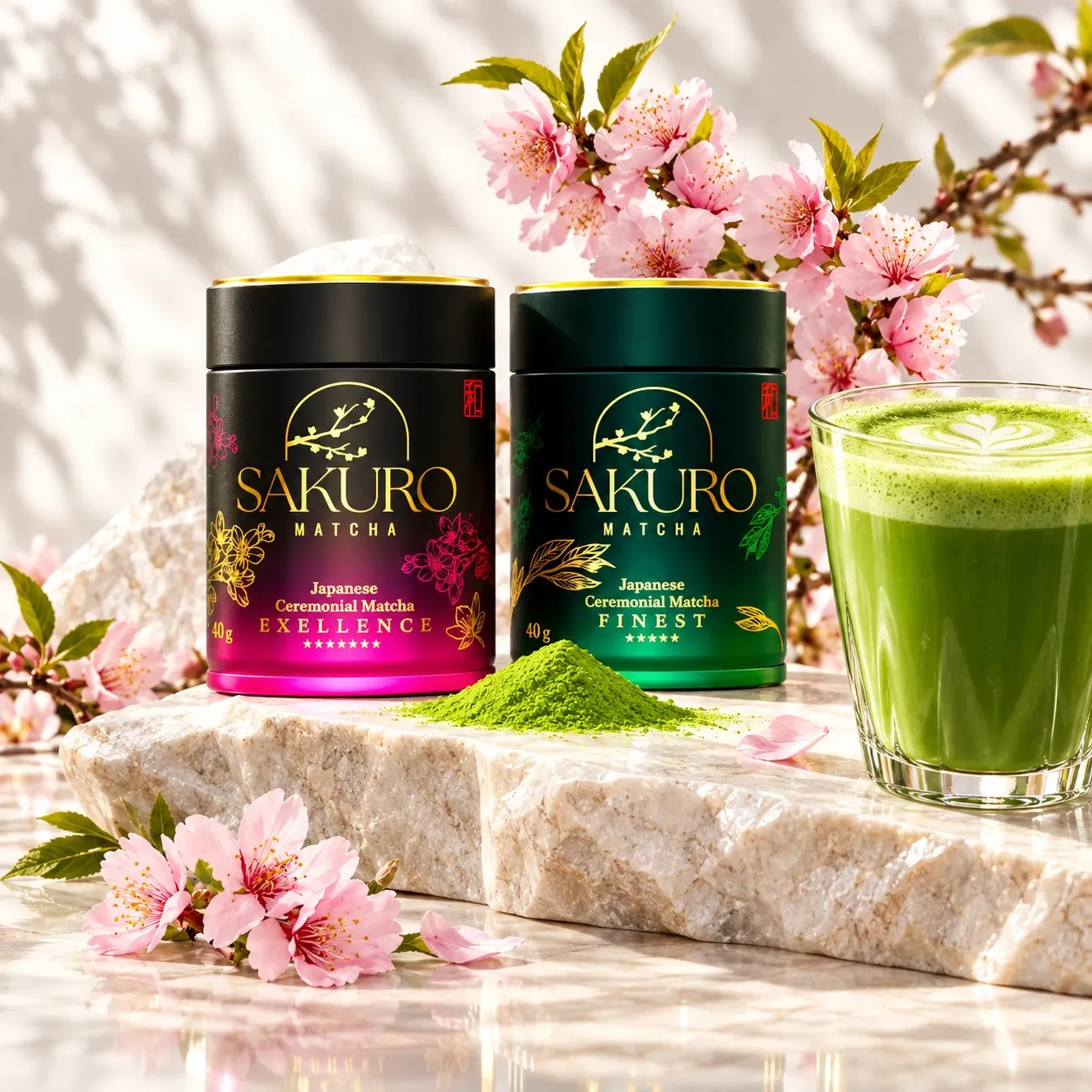
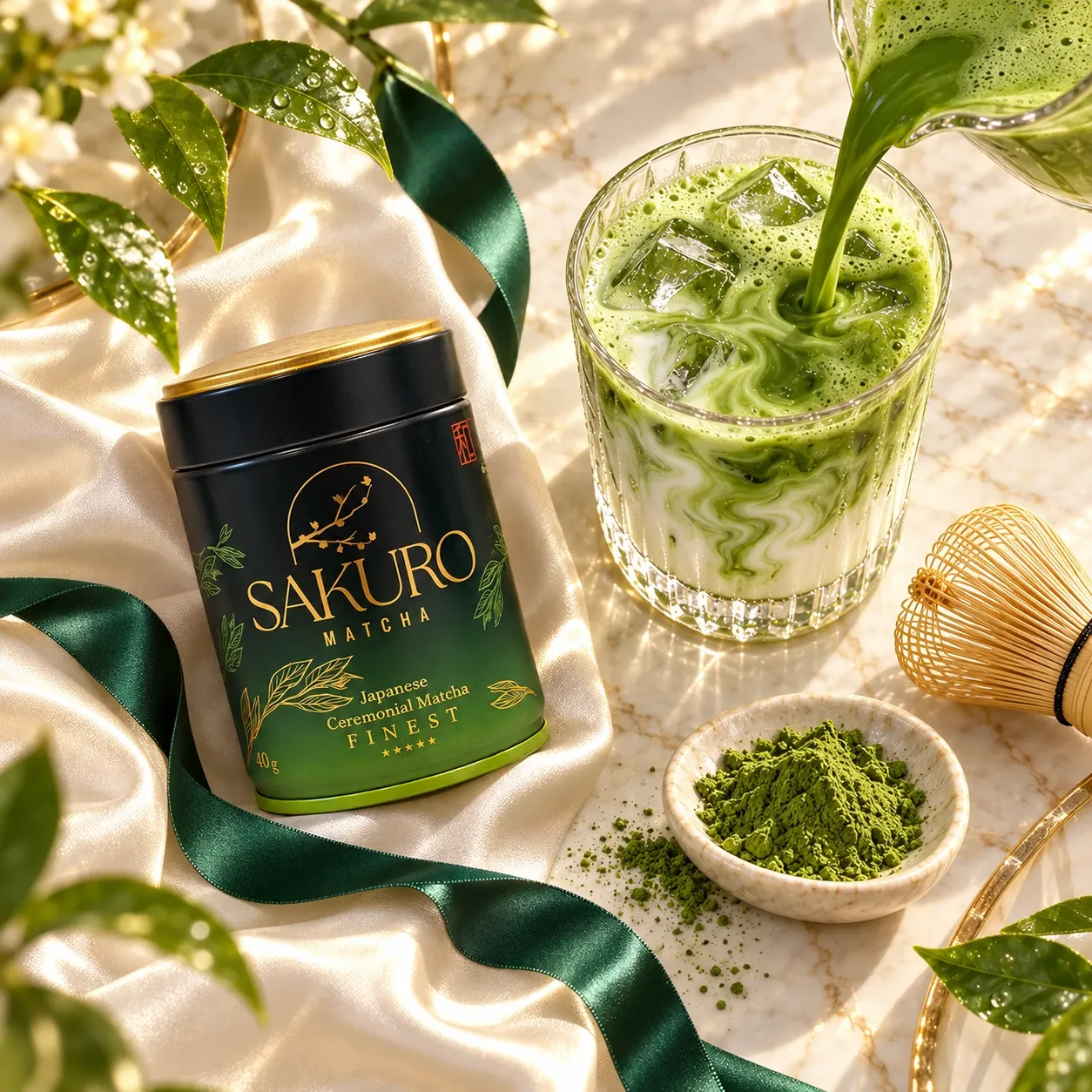
One honest caveat about our own range: both Sakuro tins are ceremonial Japanese matcha from Shizuoka, and we do not sell a culinary line. In a busy café the same bag has to make a straight bowl at 9 a.m. and twenty iced lattes at 2 p.m., and a second, cheaper bag in the cupboard is one more thing to mix up on a Saturday.
Which grade for which drink
The rule is simple: the more you add to the matcha, the less the top of the quality curve buys you. Water hides nothing, milk hides a little, and sugar, vanilla syrup, strawberry purée and 180 °C in an oven hide a lot. So spend the money where it is tasted. A bowl of usucha and a 500 ml iced matcha with oat milk are not the same product, and treating them as one is how cafés either overpay or serve something bitter.
| Drink or dish | Matcha | Liquid | Grade we would use |
|---|---|---|---|
| Usucha (thin, in a bowl) | 2 g | 70 ml water, 75–80 °C | Excellence |
| Koicha (thick) | 4 g | 30 ml water, 75 °C | Excellence |
| Hot latte, 250 ml | 2 g | 50 ml water + 180 ml milk | Finest |
| Iced latte, 350 ml | 2.5 g | 50 ml water + 150 ml milk + ice | Finest |
| Matcha lemonade, 400 ml | 2 g | 60 ml water + tonic or lemonade | Finest |
| Sponge, cookies (per 500 g batter) | 8–12 g | — | Finest |
| Ice cream, ganache (per 1 kg base) | 12–18 g | — | Finest |
Two notes on baking. Dose high: in a cake the powder competes with butter, sugar and flour, and 5 g in a loaf tin gives a vaguely green cake that tastes of nothing. And expect the colour to move — chlorophyll is unstable in heat and in acidic batters, so a bright powder bakes towards olive and an olive one bakes towards brown. That is the one place where a better grade pays off visually, even though the flavour is half buried.
The number that settles the argument: cost per serving
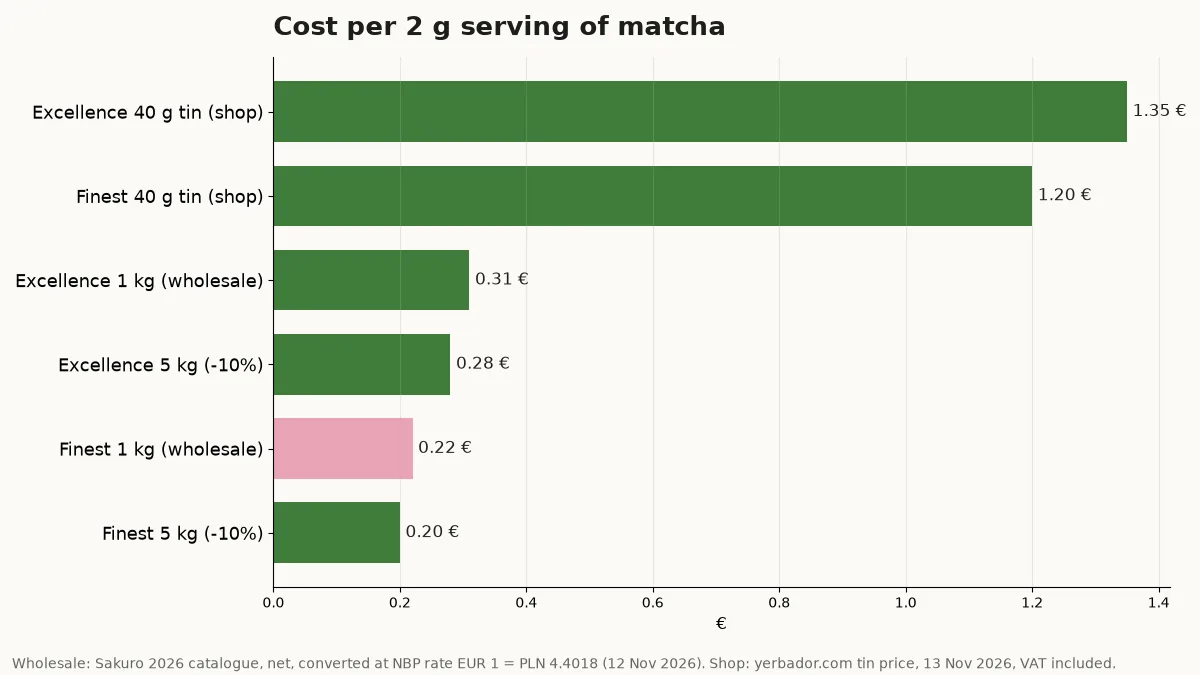
Grade debates end quickly once you divide by 500, because a 1 kg bag is 500 servings of 2 g. The figures below come from the Sakuro 2026 wholesale catalogue, net, converted at the National Bank of Poland rate of 1 EUR = 4,4018 PLN on 12 November 2026 — an indicative conversion; the binding offer comes from Ewelina.
| Format | Finest | Excellence | Per 2 g serving |
|---|---|---|---|
| 1 kg bag | approx. 109 €/kg | approx. 157 €/kg | 0,22 € / 0,31 € |
| 3 kg (−5 %) | approx. 103,60 €/kg | approx. 148,90 €/kg | 0,21 € / 0,30 € |
| 5 kg (−10 %) | approx. 98,10 €/kg | approx. 141,10 €/kg | 0,20 € / 0,28 € |
| 40 g tin, shop price | 23,90 € | 26,90 € | 1,20 € / 1,35 € |
Put that against a menu price. A latte at 4,50 € carries about 0,22 € of Finest — roughly 5 % of the ticket, before milk and cup. Moving up to Excellence adds nine cents. Nine cents is not what decides whether a café makes money on matcha; the milk, the cup and the minute of labour are far bigger lines. Which is why “we use the cheap one for lattes” saves less than most owners think.
The tin row is the one worth staring at. Running a service bar off 40 g tins is a habit, not a decision — at twenty drinks a day you open a new tin every other day and pay 1,20 € a serving for the privilege.
How to test a matcha before you commit to a kilo
Ask any supplier for a sample and run the same three cups. It takes ten minutes and it is the only review that counts, because it happens with your water, your milk and your palate.
Cup one, straight. Sift 2 g, add 70 ml of water at 75–80 °C, whisk thirty seconds. Look first: a good powder throws a fine, stable foam and stays bright green for a minute. Then taste. Bitterness that lands immediately and stays is a later-harvest leaf; bitterness that turns sweet is normal.
Cup two, in milk. Same 2 g, 50 ml of water, then 180 ml of whatever milk you actually serve — in Germany and the Netherlands that will often be oat. If the matcha vanishes, it is too delicate for your menu. If it tastes of wet hay, it is too coarse.
Cup three, cold. Shake 2 g with 150 ml of cold water. Cold water will not rescue a badly milled powder, so grit at the bottom of the glass tells you about the mill, not the leaf. Weigh every dose on a scale — scooping by eye introduces a bigger difference than the grades you are comparing.
What we sell, and how to order it
Everything here refers to Japanese ceremonial matcha from Shizuoka, in two expressions. Sakuro Matcha Excellence (26,90 € / 40 g) is first-harvest leaf — floral, velvety, long finish; the one for bowls and for a tasting flight on the counter. Sakuro Matcha Finest (23,90 € / 40 g) is bolder, with a light tannic edge that survives milk and ice, and it is our default for a service bar. To judge them side by side, the Finest 40 g + Excellence 40 g pair is 46,90 €; a bamboo chasen is 14,90 €.
Wholesale. Cafés, restaurants, bakeries and offices order in kilograms: 1 kg bags, 3 kg −5 %, 5 kg −10 %, shipped from Poland within the EU. One kilo is 500 servings, so a bar doing twenty matcha drinks a day opens a new bag about every five weeks.
For a quote, samples or a mixed pallet of Finest and Excellence, write to Ewelina: [email protected] or call +48 515 025 329. She sends the binding offer with current prices and shipping; the figures above are an indicative conversion from our catalogue.
FAQ
Can I use ceremonial matcha for baking?
Yes, and it bakes a better colour than cheaper powder. You just will not taste most of what you paid for, because sugar, fat and oven heat flatten the delicate end of the flavour. If you bake daily, use the same bag you pour and dose it properly — 8–12 g per 500 g of batter.
Does culinary matcha contain less caffeine?
Not reliably. Caffeine in matcha depends on cultivar, shading and harvest rather than on the word printed on the bag, and the differences between two powders can run in either direction. For planning a menu, the figure that matters is the EFSA guidance for adults: up to 400 mg of caffeine a day is not a safety concern for healthy adults, and 200 mg a day during pregnancy. Treat matcha like espresso when you count.
How much matcha does a café actually get through?
Count drinks, not weeks. Twenty drinks a day at 2 g is 40 g a day, so roughly 1 kg every five trading weeks. Forty drinks a day doubles that to a bag every two to three weeks, which is the point where 3 kg or 5 kg ordering starts to make sense.
How should an open kilo bag be stored?
Cool, dark, closed and away from the coffee grinder — matcha picks up aromas. Decant the week’s working stock into a small tin at the bar and keep the rest sealed in the fridge, letting it come back to room temperature before opening so condensation stays out. Colour fading from jade towards olive means it has been open too long.
Is Sakuro matcha actually Japanese?
Yes — Japanese ceremonial matcha from Shizuoka, shipped to the EU from our warehouse in Poland. Japanese tencha, the leaf that becomes matcha, has been in short supply: the Global Japanese Tea Association reported that the first Kyoto tencha auction in May 2025 averaged 8,235 yen per kilogram, about 1.7 times the previous year’s average and well past the 2016 record of 4,862 yen. That is the background to every matcha price list you have read this year, ours included.
Discover our TOP products!
Your dream figure
Discover new flavors
Yerba mate with tea

Accessories
Superfoods



Certified raw honeys from Poland

Check the current price
free shipping
Up to 90 days
free returns
24 H
shipping