
Matcha trends: the viral drinks cafés add to the menu
2026-11-22
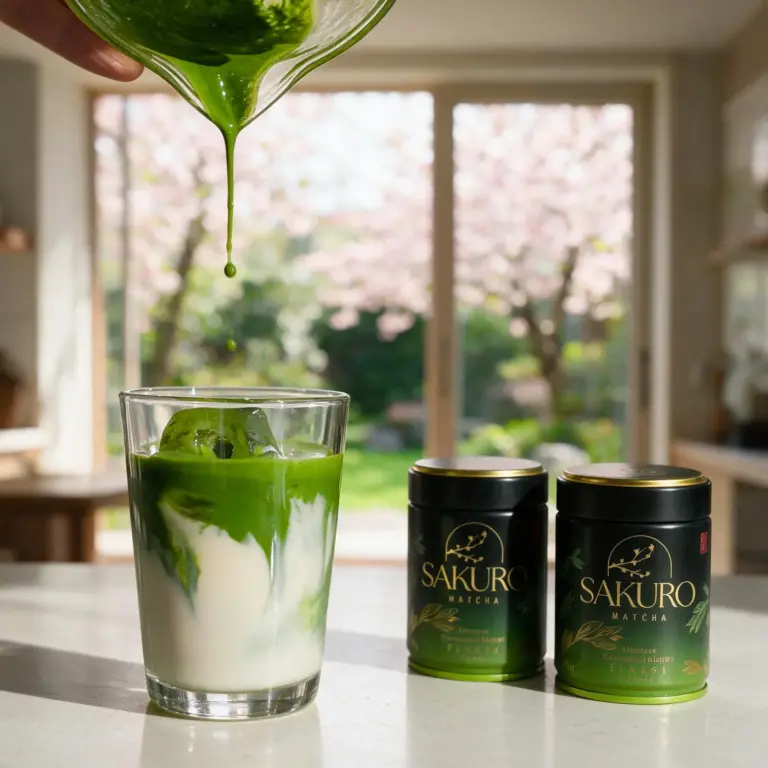
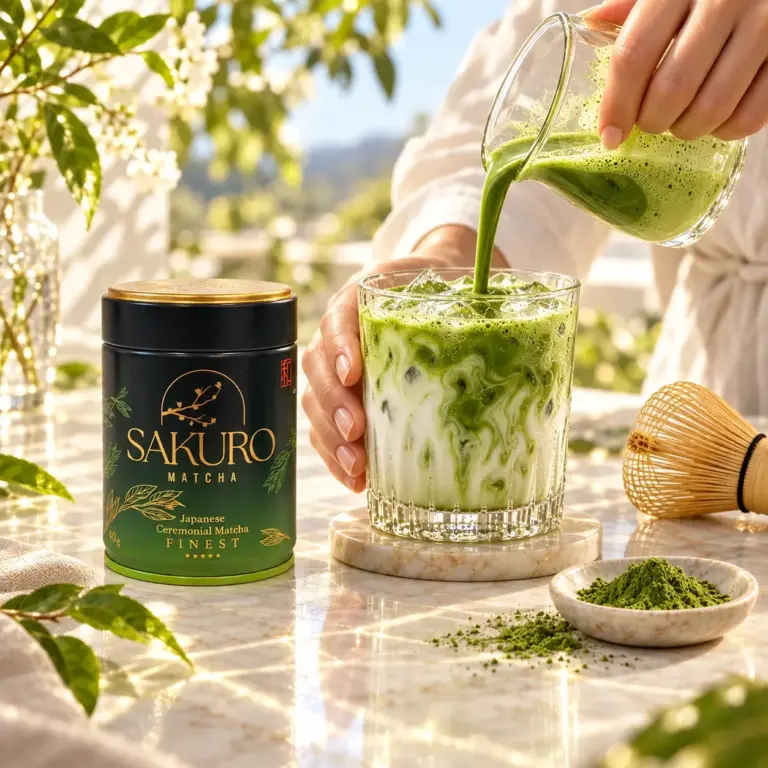
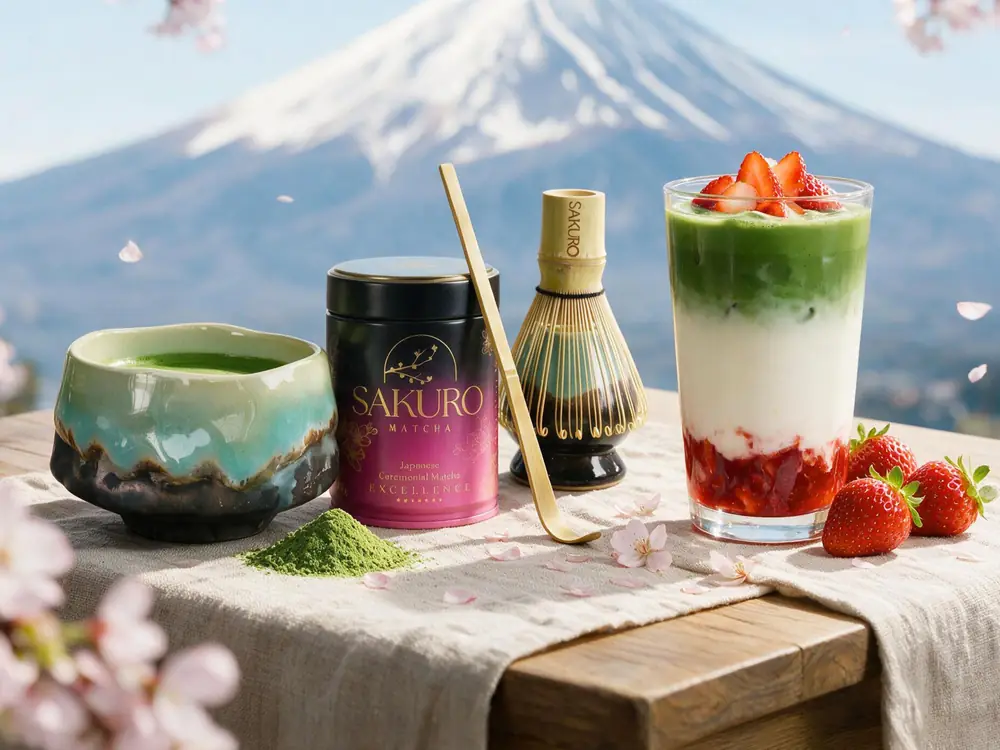
The matcha drinks that travel furthest on social media right now are layered: a strawberry or berry base, a white milk band, and a thick green cap poured last. Next to them sit dirty matcha (espresso over an iced matcha latte) and sparkling matcha tonic — three builds that photograph well, take under two minutes behind the bar and use between 2 and 3 g of powder.
That is the short answer. The longer one is more interesting, because the trend is no longer only a social-media story. It now shows up in Japan’s export statistics, in the price a café pays per kilogram, and in what a drinks list looks like in Berlin, Amsterdam or Milan. Below: what the numbers actually say, which drinks are worth adding, how much caffeine each one carries, and what it costs per cup.
- Powdered green tea, matcha included, is now about 70% of Japan’s green tea export volume — Finance Ministry customs data for fiscal 2025, reported by Jiji Press.
- Japan exported 13,125 tonnes of green tea in fiscal 2025, up 42%; by value the figure rose 2.2-fold to ¥84.7 billion.
- A May 2025 tencha auction in Kyoto fetched ¥8,235 per kg, up 170% year on year (Global Japanese Tea Association, via Reuters).
- Standard dose for a viral drink: 2 g of matcha for a latte, 3 g for a tonic, 4 g for a thick shot.
- Caffeine per cup: roughly 60 mg in a 2 g iced latte, about 140 mg in a dirty matcha — against a 400 mg daily reference for adults from EFSA.
- Matcha cost per 2 g serving: about €1.20 from a 40 g Sakuro Finest tin, about €0.22 at wholesale.
What the export figures say about the matcha boom
Japan’s green tea exports reached 13,125 tonnes in fiscal 2025, which ended in March 2026 — a 42% jump on the previous year — and the value rose 2.2-fold to ¥84.7 billion. Powdered green tea, matcha included, accounted for about 70% of that volume, while shipments of leaf teas such as sencha fell. Those are customs-cleared figures from Japan’s Finance Ministry, reported by Jiji Press on 1 May 2026.
Read that sentence again, because it is the whole story in one line. Japanese green tea used to mean sencha in a teapot. Today, seven kilos out of every ten that leave the country are powder — the format you can only use if you whisk it, blend it or bake with it. The export boom is a matcha boom.
The supply side is tighter than the demand side. Tencha, the shaded leaf that gets stone-ground into matcha, came in at 5,336 tonnes in 2024 according to the Japanese Tea Production Association — nearly 2.7 times more than ten years earlier, as farmers switched over from sencha. Even so, a May 2025 auction in Kyoto cleared tencha at ¥8,235 per kg, a 170% rise year on year and well above the previous record of ¥4,862 set in 2016, figures the Global Japanese Tea Association gave Reuters in July 2025. New shaded fields need about five years before the first harvest, so the gap does not close quickly.
Two more numbers from the Jiji report are worth keeping in your head if you run a café. Japan itself imported 5,801 tonnes of green tea in fiscal 2025, 82% more than a year earlier — cheap foreign leaf filling the space domestic growers left. And 13 Japanese tea producers shut down temporarily or permanently in 2025, a record, up from eight the year before, according to the research firm Teikoku Databank. Prices are high and the number of people able to supply you is not growing.
Which matcha drinks actually go viral
A matcha drink spreads when it is visually unambiguous in a two-second clip: strong colour contrast, clean horizontal bands, something poured on camera. Taste decides whether people come back; the build decides whether they film it at all. Seven drinks currently do both.
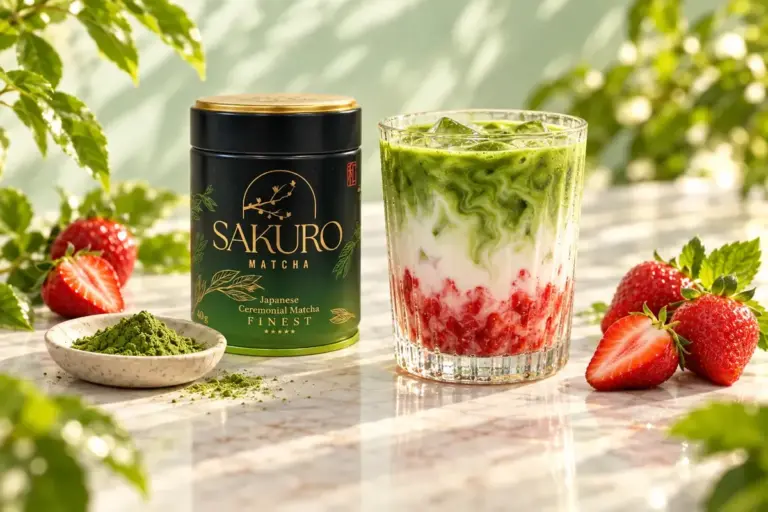
Layered strawberry matcha. Crushed strawberries at the bottom, cold milk, then matcha poured over the back of a spoon so it floats as a green cap. It is the most-ordered of the group in our experience, and the easiest to get wrong — the matcha has to be cold and properly dissolved or it sinks in streaks.
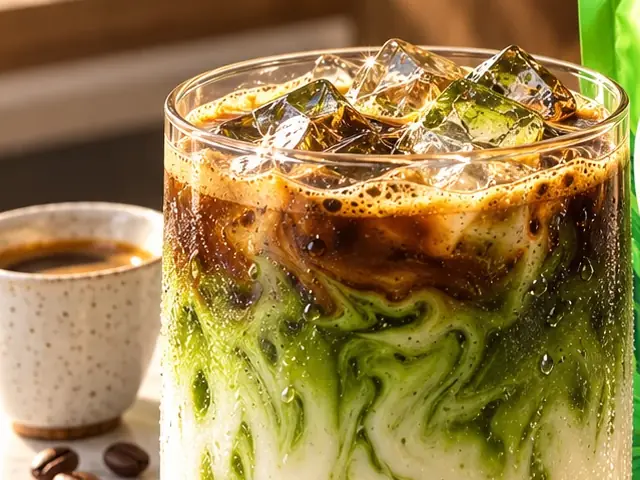
Dirty matcha. An iced matcha latte with a shot of espresso poured over the top. The two layers hold for maybe thirty seconds before they marble, which is exactly the window people film. It is also the strongest drink on the list, and we come back to that in the caffeine section.
Matcha tonic. Matcha, ice, tonic water, a slice of citrus. Bitter-bright rather than creamy, no milk to split, and it stays green. Summer menus in Spain and Italy have taken to it faster than anywhere else.
Blueberry or blackberry matcha. Same architecture as the strawberry version, with a purple base that reads almost black against the green. Works with frozen fruit all year, which matters in February.
Matcha with cold foam. A salted or vanilla cream cap on an iced matcha. The foam has to be thick enough to sit, which means whipping cold milk with a touch of cream or a foaming syrup, not just frothing it.
Pistachio matcha. Pistachio paste or syrup under the milk, matcha on top. The flavour pairing rides on the wider pistachio wave that has been running through pastry for a couple of years.
Thick matcha shot. Four grams in 30–40 ml, served in a small glass, sometimes with a chaser of cold water. Closer to koicha than to a latte, and currently the drink serious matcha bars use to show off what they stock.
| Drink | Matcha | Liquid | Served | Visual hook | Prep time |
|---|---|---|---|---|---|
| Layered strawberry matcha | 2 g | 60 ml strawberry purée + 180 ml milk | Iced, 350 ml glass | Three bands: red, white, green | 2 min |
| Dirty matcha | 2 g | 180 ml milk + 1 espresso (30 ml) | Iced, 300 ml glass | Brown poured over green | 90 s |
| Matcha tonic | 3 g | 200 ml tonic water + lime | Iced, 300 ml glass | Bubbles rising through green | 90 s |
| Blueberry matcha | 2 g | 60 ml berry purée + 180 ml milk | Iced, 350 ml glass | Near-black base under green | 2 min |
| Matcha with cold foam | 2 g | 150 ml milk + 60 ml cold foam | Iced, 300 ml glass | White cap that holds | 2 min |
| Pistachio matcha | 2 g | 20 ml pistachio paste + 180 ml milk | Iced or hot, 300 ml | Green on green, two shades | 2 min |
| Thick matcha shot | 4 g | 35 ml water at 80 °C | Small glass, 60–80 ml | Glossy, almost paint-like | 60 s |
Note what is missing from that list: hot matcha lattes. They still sell, especially from November onwards, but they do not travel. If you are picking one drink to photograph for your own menu card, pick a cold layered one.
How much caffeine is in each of these drinks?
A 2 g iced matcha latte carries roughly 60 mg of caffeine, a 3 g matcha tonic about 90 mg, and a dirty matcha with one espresso around 140 mg. For comparison, a 200 ml filter coffee is listed at 90 mg and a 60 ml espresso at 80 mg in the caffeine FAQ published by Germany’s Federal Institute for Risk Assessment (BfR), which marks those values as modified from EFSA data.
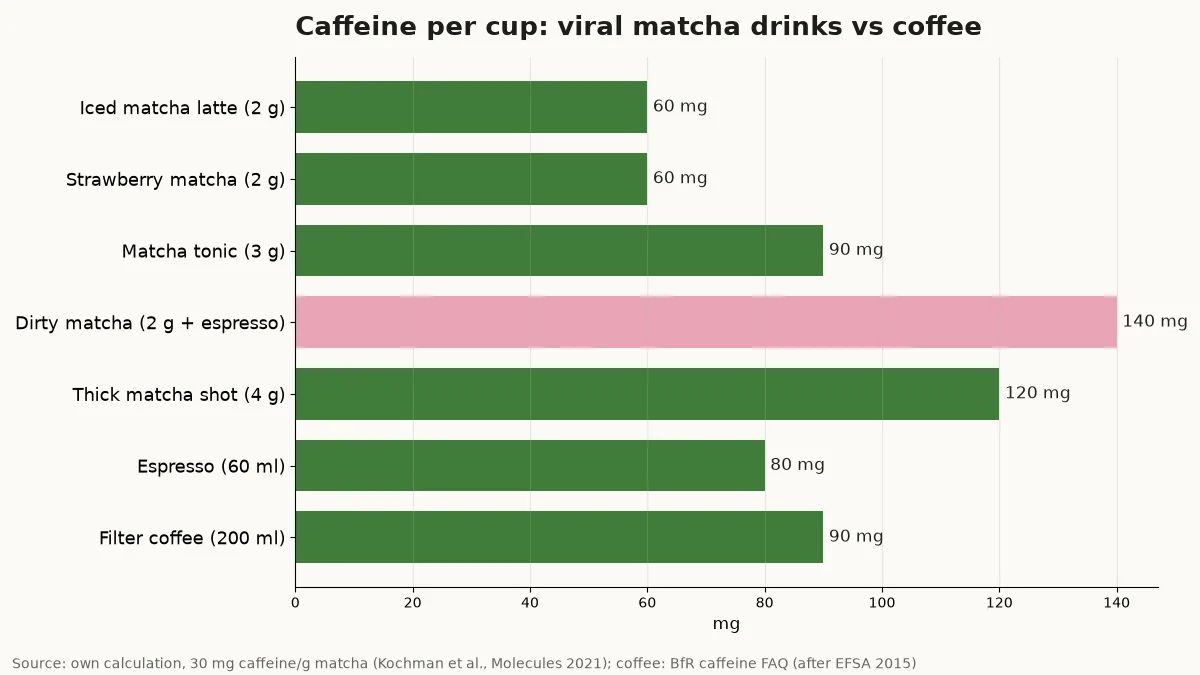
Where does 30 mg per gram come from? The review by Kochman and colleagues in Molecules 2021;26(1):85 puts matcha at 18.9–44.4 mg of caffeine per gram, against 11.3–24.67 mg/g for ordinary green tea and 10.0–12.0 mg/g for coffee beans. We use the midpoint, 30 mg/g, for the chart. Your tin will sit somewhere in that range depending on cultivar, harvest and how early the leaf was picked, so treat every number here as an estimate rather than a lab result.
EFSA puts the daily reference at 400 mg for healthy adults and 200 mg for a single dose, with 200 mg per day during pregnancy and breastfeeding. EFSA also notes that a single 100 mg dose close to bedtime can affect sleep duration and structure in some adults. Practical reading: two matcha lattes in a day are unremarkable; two dirty matchas after 6 pm are a different proposition.
Two recipes worth stealing
These are the two we would put on a menu first. Both are written for a 350 ml glass and both assume the matcha has been sifted — a tea strainer over the jug is enough.
Layered strawberry matcha (2 g, 4 minutes)
- 80 g strawberries (fresh or frozen), 10 g sugar or 10 ml syrup
- 180 ml cold milk — oat milk with a barista formulation holds the layer best
- 2 g matcha + 50 ml water at 80 °C
- Ice, about 120 g
- Crush the strawberries with the sugar and leave them five minutes. Do not blend to a smooth purée; small pieces look better through glass.
- Whisk the matcha with 50 ml of 80 °C water for about 15 seconds, until the surface carries a fine, even foam. Then add 30 ml of cold water and set it aside.
- Spoon the strawberries into the glass, fill with ice, pour the milk down the side.
- Pour the matcha slowly over the back of a spoon. It should sit on the milk as a distinct green band.
The two things that go wrong: matcha that is still warm (it sinks straight through) and milk without enough protein or fat (the band blurs within seconds). If your matcha latte is separating in the glass more generally, our guide on making matcha latte hot and iced with oat milk covers the milk side in detail.
Dirty matcha (2 g + one espresso, 2 minutes)
- 2 g matcha + 50 ml water at 80 °C
- 180 ml cold milk
- 1 espresso, 30 ml, brewed fresh and not sweetened
- Ice, about 100 g
- Whisk the matcha, then chill it with 30 ml cold water.
- Ice in the glass, milk, then matcha. Stir once so matcha and milk are one layer, not two.
- Pull the espresso and pour it over the top, slowly, against a spoon. Serve immediately with a straw and let the customer mix it.
Use a lighter roast if you can. A dark, bitter espresso flattens the matcha completely, and then you are selling an expensive coffee with a green tint. For the full version, see our iced strawberry matcha latte recipe.
What a café should add to the menu — and what to skip
Start with three matcha items, not seven. One iced latte, one fruit-layered drink, one non-dairy option such as the tonic. That covers the people who want the classic, the people who came for the photograph and the people who do not drink milk, and it means your staff build three drinks often enough to build them well.
Batch the matcha base rather than whisking to order. Two litres of matcha concentrate — 40 g of powder to 1 litre of water at 80 °C, doubled — holds in a chilled bottle for a service and cuts the build to under a minute. Shake before every pour; it settles. The one drink that should always be made fresh is the thick shot, because the whole point of it is the foam.
What to skip: anything that needs a fourth layer, anything with more than two syrups, and seasonal flavour pairings you cannot restock. The failure mode we see most often is a café that puts six matcha drinks on a board in April, sells two of them, and still has four open tins going dull in July. On quantity planning, our piece on matcha latte cost per cup and café pricing walks through the arithmetic.
| Order size | Sakuro Finest, net per kg | Cost of 2 g | Cost of 3 g | Servings of 2 g per kg |
|---|---|---|---|---|
| 1 kg | approx. €107.70 | approx. €0.22 | approx. €0.32 | 500 |
| 3 kg (−5%) | approx. €102.30 | approx. €0.20 | approx. €0.31 | 500 |
| 5 kg (−10%) | approx. €96.95 | approx. €0.19 | approx. €0.29 | 500 |
| 1 kg Excellence | approx. €154.85 | approx. €0.31 | approx. €0.46 | 500 |
| 3 kg Excellence (−5%) | approx. €147.10 | approx. €0.29 | approx. €0.44 | 500 |
| 5 kg Excellence (−10%) | approx. €139.35 | approx. €0.28 | approx. €0.42 | 500 |
Those euro figures are an indicative conversion of our 2026 wholesale catalogue in Polish złoty (Finest 480 PLN/kg net, Excellence 690 PLN/kg net) at the National Bank of Poland reference rate of 22 November 2026, table 226/A/NBP/2026: 1 EUR = 4.4559 PLN. The binding quote comes from Ewelina, not from this table. Milk, cup, lid and syrup are on top — add your own supplier prices to get a real cost per drink.
Which grade for which drink
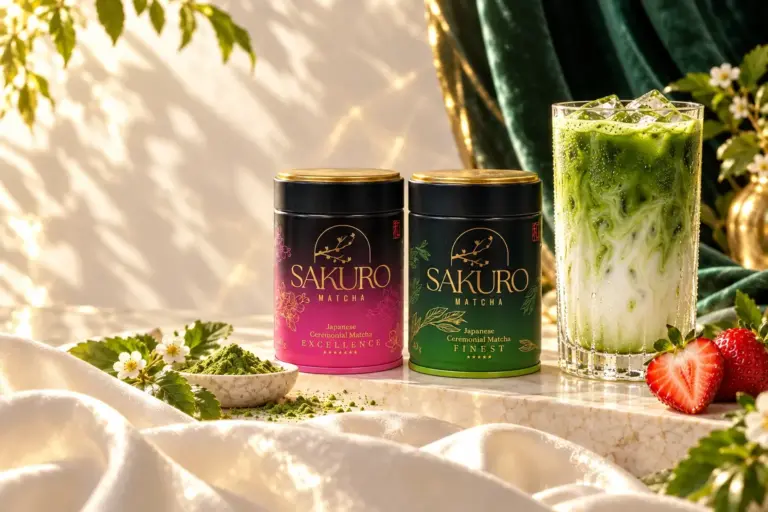
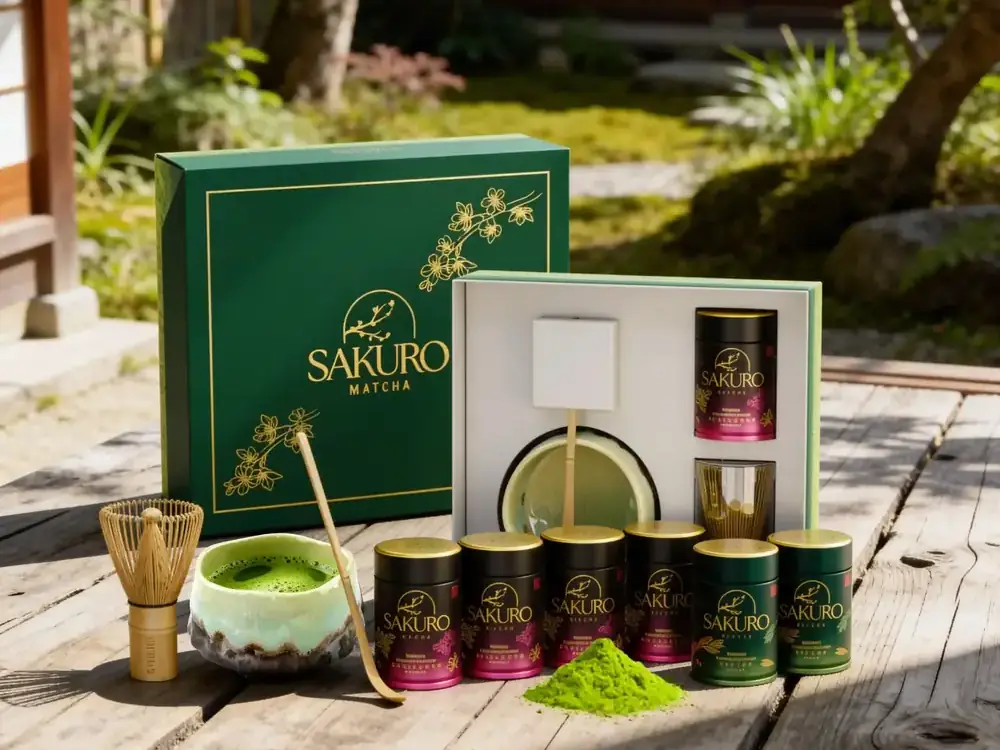
Sakuro Matcha Finest (yerbador.com) is a Japanese ceremonial-grade matcha from Shizuoka in a 40 g tin, €23.90 — twenty servings of 2 g, so about €1.20 of matcha per drink at retail. It is the one we reach for in milk drinks: the flavour is clean and it stands up to oat milk and fruit without turning grassy.
Sakuro Matcha Excellence, also 40 g, €26.90, is a step up in sweetness and in colour. In a thick shot or a plain usucha it is obviously the better tea. In a strawberry latte under 60 ml of fruit purée, honestly, most people will not tell the difference — which is why most cafés we talk to run Finest on the bar and keep Excellence for the ceremonial-style serves.
| Grade | Character | Best for | Dose | Tin (40 g) | Per 2 g serving |
|---|---|---|---|---|---|
| Sakuro Matcha Finest | Clean, lightly sweet, strong colour | Iced lattes, layered fruit drinks, tonic | 2–3 g | €23.90 | approx. €1.20 |
| Sakuro Matcha Excellence | Sweeter, rounder, more umami | Thick shots, usucha, tasting flights | 2–4 g | €26.90 | approx. €1.35 |
| Finest + Excellence pair | Both tins, side by side | Deciding which one your bar runs | — | 2 × 40 g | €46.90 |
| Set of 4 × Finest 40 g | 160 g, about 80 servings | A month of home drinking, or a trial run on the bar | — | 4 × 40 g | €80.90 |
Prices are from yerbador.com on the day of publication; the product page always shows the current one. If you want the grade question answered properly, we ranked them in matcha grades ranked by colour, taste and price.
Four mistakes that kill a trend drink
Not sifting. Matcha clumps in the tin. A clump that survives into the glass turns into a bitter lump at the bottom, and in a layered drink you can see it. Ten seconds with a tea strainer solves it.
Water that is too hot. Boiling water scalds the powder and pushes the catechins forward, which reads as harsh astringency. Around 80 °C is the working temperature; off the boil for two minutes gets you close enough without a thermometer.
Letting the colour go. Matcha fades from bright green to olive with heat, light and oxygen. An open tin left on a sunny shelf through a quiet week will visibly dull, and the drink photographs grey. Keep tins closed, cool and out of the light, and open one at a time.
Over-sweetening. The fruit purée already carries sugar, the syrup carries more, and at some point the matcha is just colouring. If your customers keep saying the drink does not taste of anything, cut the syrup before you increase the dose.
Where to buy matcha for these drinks
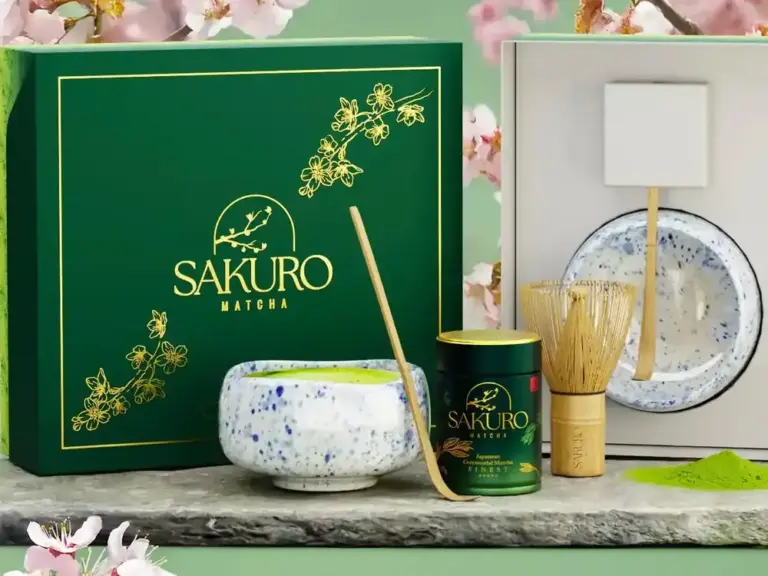
For home: Sakuro Matcha Finest 40 g at €23.90 is the sensible starting tin — twenty 2 g servings, enough to work through the whole list above twice. If you want to compare grades before committing, the Finest + Excellence pair is €46.90, and the four-tin Finest set is €80.90.
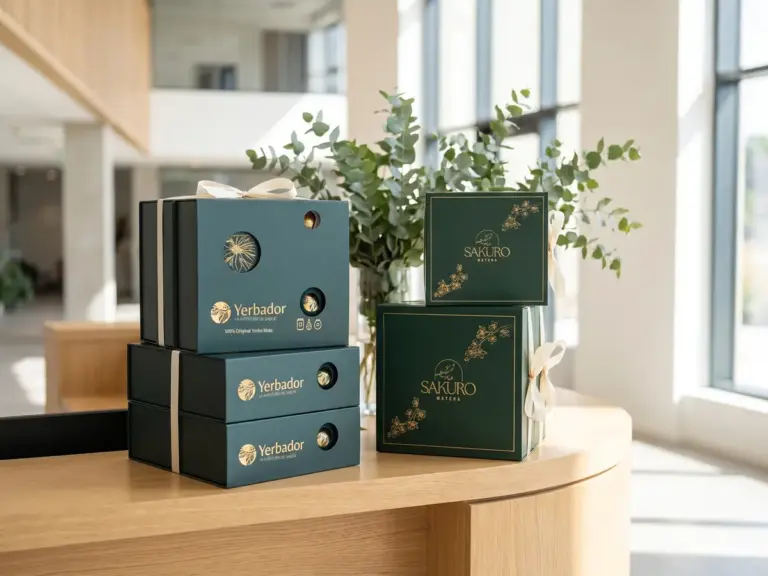
For cafés, restaurants, bakeries and offices: we sell by the kilogram, shipped from Poland within the EU, with 1 kg bags and volume discounts of 5% at 3 kg and 10% at 5 kg. Wholesale goes through one person — Ewelina, [email protected], +48 515 025 329. Write with your monthly volume and which drinks you plan to run; she will send a binding quote and a sample. Background reading before you do: matcha wholesale for cafés and restaurants, and, on why your supplier keeps raising prices, the matcha shortage and what it means for prices.
FAQ
Which matcha drink is the most popular in cafés right now?
The iced matcha latte remains the volume seller, but the layered strawberry matcha is the one that drives new customers through the door. In practice most bars run both: the plain iced latte for regulars, the layered version as the drink people photograph and ask for by name.
Why has matcha become so expensive?
Demand grew faster than shaded tea fields can be planted. Japan’s green tea exports rose 42% by volume in fiscal 2025 and 2.2-fold by value, with powdered tea making up around 70% of the volume, while a Kyoto tencha auction in May 2025 cleared at ¥8,235 per kg — 170% up year on year. New shaded fields need roughly five years before a first harvest, so the shortage is not a one-season event.
How much matcha goes into one viral drink?
Two grams for a standard iced or layered latte, three grams for a tonic or a stronger 400 ml serve, four grams for a thick shot. A 40 g tin therefore gives twenty 2 g drinks, and one kilogram gives 500.
Can I make these drinks without a bamboo whisk?
Yes. A small electric milk frother or a lidded jar both dissolve 2 g of matcha well enough for a milk drink, as long as you sift first. A bamboo chasen gives a finer, more stable foam, which matters for a thick shot and barely matters under 180 ml of milk and fruit.
Is matcha stronger than coffee?
Per gram, yes: 18.9–44.4 mg of caffeine per gram of matcha against 10.0–12.0 mg/g for coffee beans (Kochman et al., Molecules 2021). Per cup, usually not, because a latte uses 2 g of matcha and an espresso uses 7–9 g of coffee. A dirty matcha combines both and lands near 140 mg.
Which grade do I need for an iced latte with milk?
Ceremonial grade, but not the most expensive one. Sakuro Matcha Finest at €23.90 per 40 g tin is the right level for milk drinks; Excellence is worth the extra €3 when the matcha is served on its own and nothing is hiding behind it.
How much matcha does a small café need per month?
Thirty matcha drinks a day at 2 g each is 1.8 kg a month. That puts you straight into the 3 kg discount tier if you order every six weeks. Send your real daily count to Ewelina and she will size the first order rather than guessing at it.
Discover our TOP products!
Your dream figure
Discover new flavors
Yerba mate with tea
Accessories
Superfoods



Certified raw honeys from Poland

Check the current price
free shipping
Up to 90 days
free returns
24 H
shipping