
Choosing a matcha supplier: the checklist before your first kilo
2026-11-22
Six things decide whether your first kilo of matcha was a good buy: where the tea grew, which harvest it came from, how finely it was ground, how it behaves in milk, what one serving actually costs, and whether the same powder will still be on the shelf in March. Everything else on a matcha supplier‘s website is decoration.
Below is the order we would work in if we were buying for a café or a shop: sample first, label second, taste third, arithmetic fourth, supply last. It takes about a week and it saves you from 500 servings of something your customers push back across the counter.
A kilo is 500 drinks. Buy 40 grams first.
At 2 g per serving, one kilogram is five hundred cups. That number is worth saying out loud, because it changes how a bad decision feels. A disappointing 40 g tin costs you a morning. A disappointing kilo sits in the back of the fridge for a year while you quietly buy matcha somewhere else.
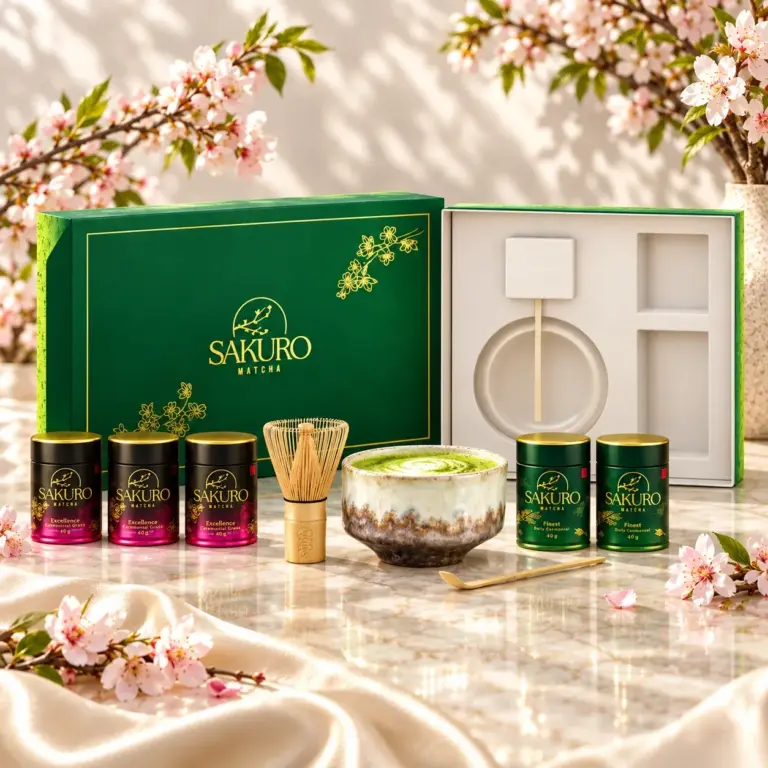
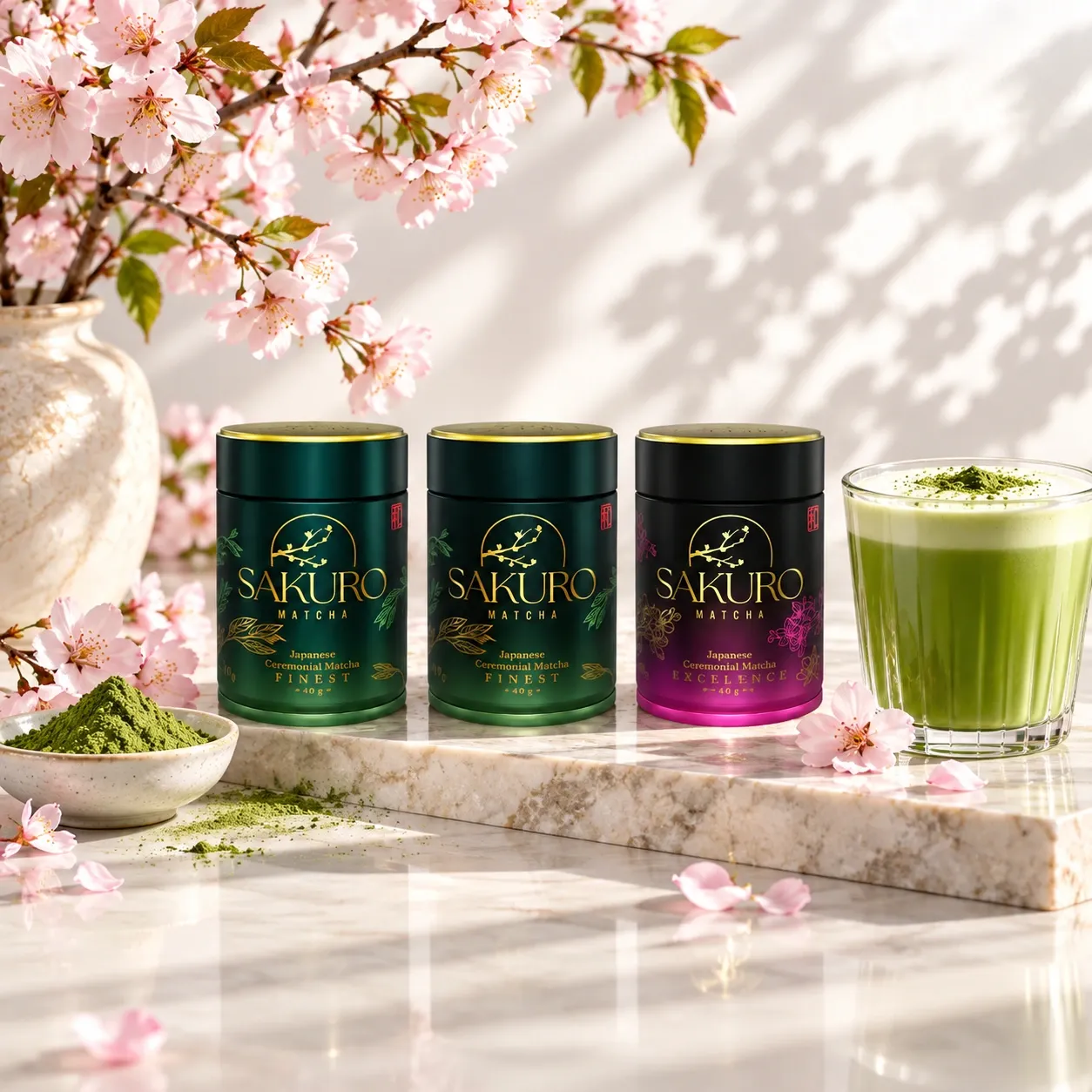
So the first order to any new supplier is small and deliberate. Buy one retail tin of each grade they sell, at their normal shop price, with no conversation about volumes yet. From us that means Sakuro Matcha Finest 40 g at 23,90 € and Sakuro Matcha Excellence 40 g at 26,90 €, or the Finest + Excellence pair at 46,90 € if you want both in one parcel.
Forty grams is twenty servings. That is enough for a real test, not a polite one: four bowls of plain usucha, six hot lattes, four iced, two small bakes, and four spare for the shifts that go wrong. Make them on your water, with your milk, in your cups, by the people who will actually be making them at 9:40 on a Saturday. Matcha that only works when the owner makes it slowly is not a product you can put on a menu.
A supplier who will not sell you 40 g, or who answers a sample request with a pallet price list, has told you something useful about how the relationship will go.
Read the label before you read the price
Almost everything that matters is declared, or conspicuously not declared, on the packaging and the product page.
Country and region
Matcha should say Japan and, ideally, a prefecture. Sakuro is grown and milled in Shizuoka, Japan’s largest tea region. Green powder sold simply as “matcha” with no origin at all is usually not Japanese, and sometimes not matcha in the strict sense — it may be ground sencha or ground green tea leaf, which is a different product at a different price. There is nothing wrong with a supplier selling that, as long as they say so.
Harvest
The first harvest of the year, picked from late April, gives the sweetest and most umami-heavy leaf. Later harvests are coarser, more astringent and much cheaper. A supplier who cannot tell you which harvest a batch came from either does not know or would rather you did not.
Grade and intended use
Ceremonial and culinary are commercial labels, not legal ones, which is why a 9 €/kg powder can be sold as “ceremonial” with no consequence. What you want is a straight answer about use: in a bowl, in milk, or in a cake. We go through the differences in detail in our guide to ceremonial and culinary grades.
Grind
Stone-milled matcha feels like dry silk between your fingers and leaves a film on the skin, not grains. Rub a pinch on the back of your hand. If you can feel individual particles, you will taste them as grit at the bottom of an iced drink, and no amount of whisking will fix it.
Packaging
Light, air and warmth are what turn green powder khaki. For retail that means an opaque tin; for wholesale, a sealed 1 kg bag you can close properly after opening. Loose powder repacked into a zip bag by the supplier is a sign that someone upstream is dividing a sack of unknown age.
Dates
A best-before date is a minimum. A packing or milling date is better, because it tells you how much of the shelf life has already been spent in someone else’s warehouse.
The checklist: twelve questions, and what the answers mean
Send these in one e-mail. The speed and specificity of the reply tells you as much as the content.
| What you ask | A good answer | A red flag |
|---|---|---|
| Which country and region is it from? | Japan, named prefecture | “Asia”, “the Far East”, or no answer |
| Which harvest? | First harvest, with the year | “We don’t get that information” |
| Ceremonial or culinary, and for what? | A clear use: bowl, milk, baking | Everything is “ceremonial”, at every price |
| Can I buy 40 g to test? | Yes, retail tin or sample | Minimum order 5 kg, no samples |
| What does 1 kg cost, net? | A number, plus volume discounts | “Prices on request” and a phone call |
| What is that per 2 g serving? | They work it out with you | They have never done the sum |
| How is wholesale packed? | Sealed 1 kg bag | Repacked loose powder, no seal |
| Is there stock in the EU? | Yes, ships from an EU warehouse | Everything shipped from Japan per order |
| What is the lead time? | A number of working days | “Soon”, “depends” |
| Will the next kilo taste the same? | Same grade, same garden, same spec | “We buy wherever it’s cheapest” |
| Can I have the product specification and label data? | Sent without drama | “You don’t need that” |
| Who is my contact? | A named person, e-mail and phone | A web form nobody answers |
Two of these carry more weight than the rest. “Can I buy 40 g” tells you whether the supplier is confident in the product. “Is there stock in the EU” tells you whether your menu survives a bad month in Japan.
The bar test: twenty minutes, three people, no labels
Cover the tins with tape and number them. Tasting blind takes ten extra seconds and removes the price bias that otherwise decides everything.
Round one, plain. Sift 2 g, add 70 ml of water at 80 °C, whisk for about 20 seconds in a brisk W motion until the foam is fine and even. Look at the colour first: vivid jade is what you want, olive or yellowish means an older or later-harvest leaf. Then smell it. Then drink it warm, not hot. You are looking for sweetness and a savoury, broth-like depth that lasts a few seconds after you swallow. Sharp bitterness that arrives immediately and leaves nothing behind is a no.
Round two, in milk. Same 2 g, 40 ml of water to make a paste, then 150 ml of oat milk. This round eliminates more candidates than the first. Some matcha vanishes behind oat milk entirely and you end up serving warm sweetened milk at 4,80 €. Others turn grey. Keep the ones that stay green and still taste of tea.
Round three, iced. 2 g, 50 ml of cold water, shake hard with ice. Leave it on the counter for ten minutes, then look at the bottom of the glass. A fine stone-milled powder leaves a faint haze. A coarse one leaves sludge, and your customer will find it with a straw.
Score each sample from 1 to 5 on colour, aroma, bitterness, foam and how it holds up in milk, and have at least two other people on the team do the same. Write the numbers down. In a month, when someone asks why you chose this supplier, the sheet is your answer.
One pattern worth knowing before you taste: the matcha that wins in a bowl is not automatically the one that wins in a cup. Excellence is first-harvest leaf, floral and velvety with a long finish, and it is the one to serve plain or in a short, lightly sweetened latte. Finest has more body and a light tannic edge, which is exactly what you need to push through 180 ml of oat milk and a shot of syrup. Most bars end up buying both, and using them for different lines on the menu.
What a serving actually costs
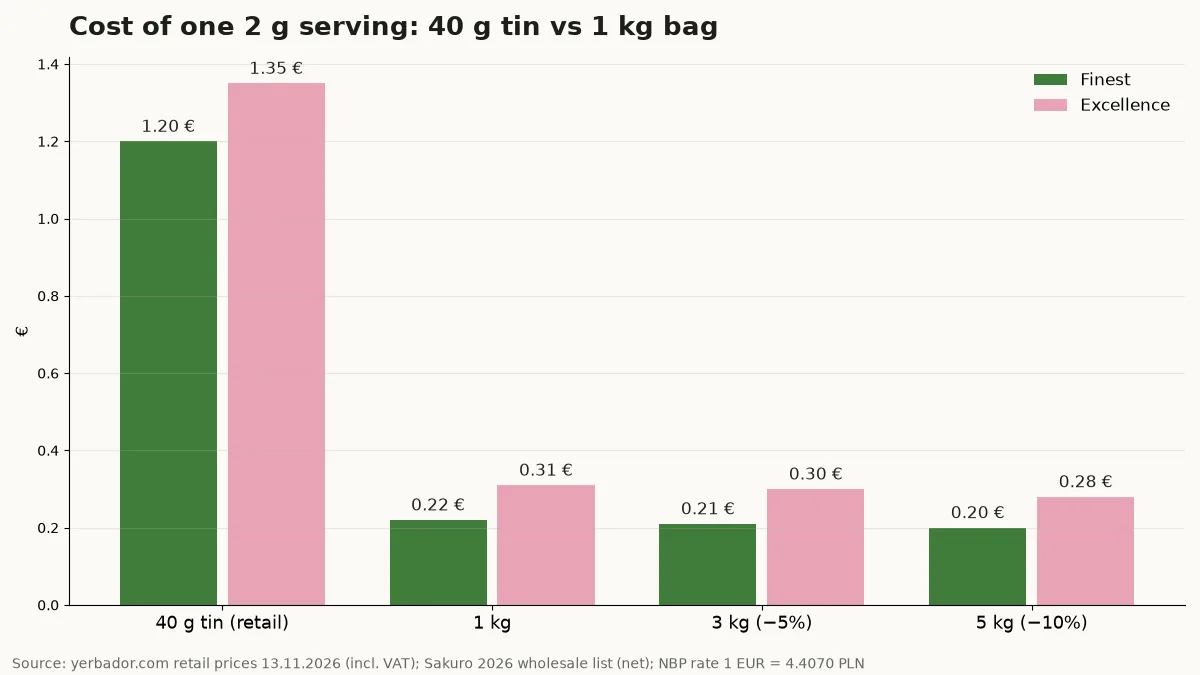
Price per kilogram is the number suppliers quote. Price per serving is the number that reaches your margin. Divide the kilo price by 500 and you have the cost of one 2 g drink.
| Format | Finest | Excellence | Per 2 g serving |
|---|---|---|---|
| 40 g tin, retail (incl. VAT) | 23,90 € | 26,90 € | 1,20 € / 1,35 € |
| 1 kg bag, wholesale (net) | approx. 108,92 € | approx. 156,57 € | 0,22 € / 0,31 € |
| 3 kg, −5 % (net) | approx. 103,47 € per kg | approx. 148,74 € per kg | 0,21 € / 0,30 € |
| 5 kg, −10 % (net) | approx. 98,03 € per kg | approx. 140,91 € per kg | 0,20 € / 0,28 € |
Wholesale figures come from the Sakuro 2026 catalogue — 480 PLN per kg net for Finest, 690 PLN per kg net for Excellence — converted at the National Bank of Poland rate for 13 November 2026, 1 EUR = 4,4070 PLN. Treat them as an indication for your own spreadsheet; the binding offer comes from Ewelina, with the rate of the day you order.
Now the part people skip. A cheaper powder is only cheaper if you use the same amount of it. If a 60 €/kg matcha needs 3 g to taste of anything in a latte, it costs 0,18 € per drink against 0,22 € for 2 g of a 109 €/kg matcha that tastes better and looks greener. The saving is four cents and the drink is worse. Always run the comparison on grams per drink, not on the invoice total.
The same logic decides the retail-versus-wholesale question. Thirty drinks a day on 40 g tins costs about 36 € a day in raw material. The same thirty drinks on a 1 kg bag cost about 6,60 €. If you are selling more than a handful of matcha drinks a week, the kilo pays for itself in days, which is why the question is not whether to buy wholesale but how to be sure of what you are buying. Our cost-per-cup breakdown has the full calculation with milk, cup and labour.
Will they still have it in March?
Matcha has one main harvest a year, and the price of the leaf behind it is set in a few weeks each spring. At the opening tencha auction of the 2026 season in Kyoto on 13 May, the average came in at about 14,127 yen per kilogram — roughly 1.7 times the previous year’s average, and the highest opening figure in a decade, according to Kyoto Shimbun. We wrote about what that means for buyers in our piece on matcha supply and prices.
For a café, the practical consequence is simple: availability is worth more than a two percent discount. Before you build a drink around a particular matcha, ask three questions. How much of this grade is physically in an EU warehouse right now? What is the lead time on a repeat order? And what do you send me if this batch runs out — nothing, or the next grade up at the same price?
Shipping from inside the EU matters more than it sounds. Our bags leave from Poland, which for most of the continent means a courier parcel rather than an import, no customs file to open, and a lead time measured in days. A supplier who ships each order from Japan can be perfectly honest and still leave you with an empty jar for three weeks in February.
Keep two to three weeks of cover in the building once you know your usage. Not more: matcha is not a commodity you want to warehouse.
How much to order the first time
Count the drinks, not the kilos. Multiply your realistic daily matcha drinks by 2 g, then by thirty days.
| Matcha drinks a day | Per day | Per 30 days | Sensible first order |
|---|---|---|---|
| 10 | 20 g | 0,6 kg | 1 kg |
| 20 | 40 g | 1,2 kg | 1 kg, reorder in three weeks |
| 30 | 60 g | 1,8 kg | 3 kg at −5 %, split Finest and Excellence |
| 50 | 100 g | 3,0 kg | 3 kg monthly, or 5 kg at −10 % every seven weeks |
| 80 | 160 g | 4,8 kg | 5 kg at −10 % |
The rule of thumb we give new wholesale customers: one month of consumption plus twenty percent, and no more on the first order. Buying 5 kg to save ten percent makes no sense if it takes you six months to drink it — by then the colour has faded and you have paid a discount in quality. The discount is there for volume you genuinely turn over, not for optimism.
If you sell retail as well, remember that tins and bags behave differently. A 40 g tin on the shelf next to the till is a product with a margin of its own; a kilo bag is raw material. Many shops order both from the start.
What to do when the bag arrives
Do not work out of the kilo bag. Decant 200–300 g into a small airtight container for the bar, write the date on it, and keep the rest sealed, cool and dark — away from the grinder, away from cinnamon and vanilla syrups, never above the dishwasher. Matcha picks up smells like a sponge.
First in, first out, with the date visible. Our working rule is to finish an opened container within six to eight weeks, and the colour will tell you before the calendar does: when the bright jade starts turning dull and the aroma flattens, that powder belongs in a bake, not in a bowl.
Sift before service, in batches, into the bar container. Thirty seconds with a small sieve prevents the lumps that otherwise cost you ten seconds per drink and leave specks floating on top of a latte.
And weigh, do not scoop. A bamboo chashaku holds anywhere between 0,8 and 1,2 g depending on who is holding it, which is a swing of plus or minus twenty percent on both taste and cost. A 0,1 g scale is the cheapest consistency fix in the building.
Samples and the first kilo from us
For the test week, order from the shop like any customer: Finest 40 g at 23,90 €, Excellence 40 g at 26,90 €, the Finest + Excellence pair at 46,90 €, and a bamboo chasen at 14,90 € if your bar does not have one yet.
For kilos, talk to a person. Wholesale goes through Ewelina, who handles every B2B order for matcha: [email protected], +48 515 025 329. Tell her your drinks per day and which grades you tested, and she will send a binding quote — 1 kg bags, 5 % off from 3 kg, 10 % off from 5 kg, shipped from Poland within the EU. Our full wholesale page for cafés and restaurants is here.
Questions cafés ask before the first order
How much matcha should I order the first time?
One month of consumption plus about twenty percent. At 2 g a drink: ten drinks a day is 0,6 kg a month, thirty drinks a day is 1,8 kg. Start with 1 kg unless you already know your numbers.
How many servings are in a kilogram?
Five hundred at 2 g, four hundred at 2,5 g, which is a common dose for a 400 ml iced drink. Fix your dose before you calculate anything else, because every cost in the spreadsheet moves with it.
Is ceremonial matcha worth it for lattes?
Yes, if you are charging 4–6 € for the drink. The raw material is around 0,22 € a serving at wholesale, so the difference between a good matcha and a mediocre one is a few cents against a price the customer can taste. Where it stops being worth it is deep inside a baked product, where sugar and butter flatten the subtleties.
How do I know the matcha is really Japanese?
Ask for the origin in writing and expect a prefecture, not a continent. Colour and taste are hints — Japanese first-harvest matcha is vivid green and sweet rather than flatly bitter — but the label and the supplier’s specification are the actual evidence. A supplier who dodges the question has answered it.
How much caffeine is in one serving?
Roughly 60 mg in a 2 g serving, in the region of a single espresso. EFSA considers up to 400 mg of caffeine a day safe for most adults and 200 mg during pregnancy; our caffeine comparison has the numbers per dose if you want to put them on a menu card.
Can I get a wholesale price without ordering a kilo?
No, and you should be suspicious of anyone who offers one. Wholesale pricing exists because of volume and packaging; a supplier who gives kilo prices on 100 g is either selling something else at that price or will not be in business next year.
Discover our TOP products!
Your dream figure
Discover new flavors
Yerba mate with tea
Accessories
Superfoods


Certified raw honeys from Poland

Check the current price
free shipping
Up to 90 days
free returns
24 H
shipping