
Dried tropical fruit: mango, pineapple and coconut, and what is really in the bag
2026-11-27
Pick up three bags from the same shelf, dried mango, dried pineapple and coconut, and you are holding three completely different foods. One is concentrated fruit sugar. One has usually been candied in a syrup before it ever saw a dryer. And the third one is not a sweet at all: it is the fattiest thing in the whole aisle.
What is actually in a bag of dried tropical fruit?
Dried tropical fruit is fresh fruit with most of the water taken out, which concentrates everything that was already there and nothing more. Drying adds no vitamins, no minerals and no fibre. What changes the numbers on the back of the pack is what a factory puts in before or after the dryer: sugar, syrup, salt and sometimes ascorbic acid.
- Desiccated coconut, unsweetened: 660 kcal and 64.53 g of fat per 100 g, with only 7.35 g of sugars (Canadian Nutrient File).
- Sweetened flaked coconut: sugars jump to 36.75 g and sodium to 285 mg per 100 g, against 37 mg in the unsweetened version.
- Mango, dried and sweetened: 319 kcal, 78.58 g of carbohydrate and only 2.4 g of fibre per 100 g (USDA FoodData Central).
- A portion of dried fruit is about 30 g, roughly one small handful, and the NHS counts it as one of your 5 A Day once a day.
- Plain dried pineapple has no entry in either big food database, which tells you something about how it is usually made.
- Fresh mango is 83.46 % water. That single number explains most of what drying does.
If you only remember one sentence from this article, make it this one: read the ingredient list, not the front of the bag. The front says “tropical”. The ingredient list says whether you bought fruit or fruit plus sugar. Our own Dried Mango 250 g (about 10.90 EUR) lists one ingredient, 100 % dried mango, with no added sugar, and that is exactly the line you should be looking for on any bag you pick up.
Three fruits, three completely different foods
Put the three side by side per 100 g and the differences are not subtle. Coconut is a fat food. Mango and banana are carbohydrate foods. Pineapple, in its usual dried form, is mostly a sugar delivery system with a bit of fruit attached.
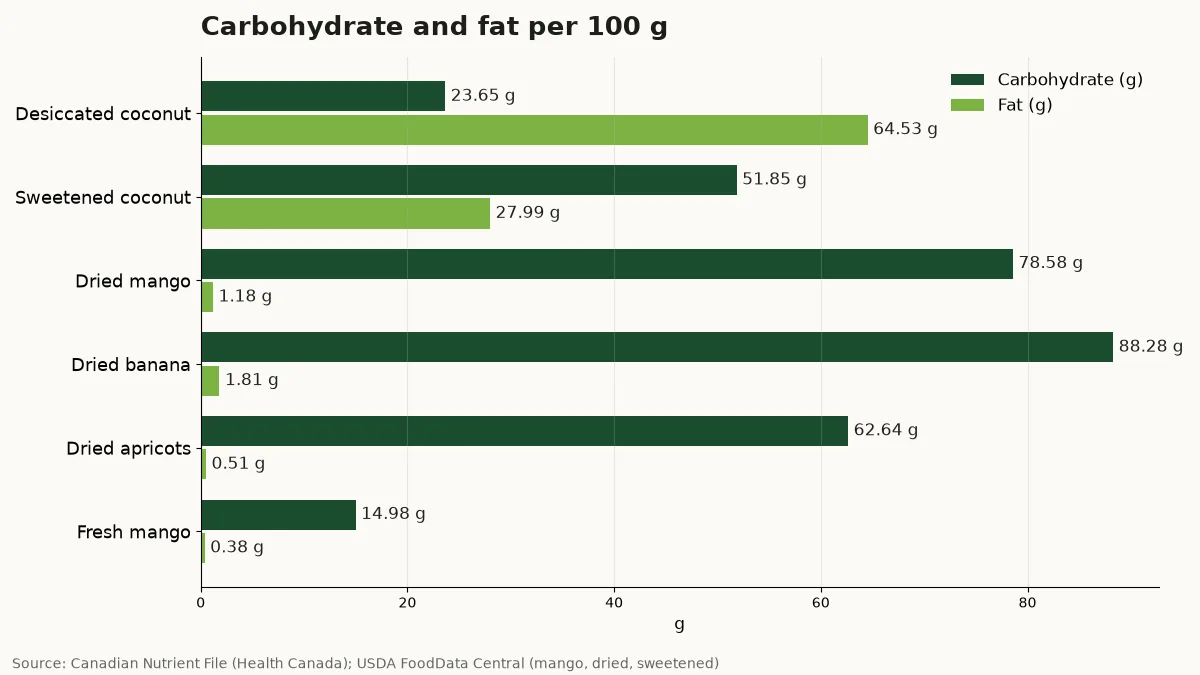
Nobody eats 100 g of dried fruit in one sitting, so the second column is the one that matters in real life. The NHS puts a portion of dried fruit at around 30 g, which is one heaped tablespoon of raisins or a single handful of dried banana chips. Everything below is that handful.
| Per 100 g / per 30 g handful | kcal | Fat (g) | Carbohydrate (g) | Fibre (g) | Potassium (mg) |
|---|---|---|---|---|---|
| Desiccated coconut, unsweetened | 660 / 198 | 64.5 / 19.4 | 23.7 / 7.1 | 16.3 / 4.9 | 543 / 163 |
| Coconut, sweetened flakes | 456 / 137 | 28.0 / 8.4 | 51.9 / 15.6 | 9.9 / 3.0 | 361 / 108 |
| Mango, dried, sweetened | 319 / 96 | 1.2 / 0.4 | 78.6 / 23.6 | 2.4 / 0.7 | 279 / 84 |
| Banana, dehydrated | 346 / 104 | 1.8 / 0.5 | 88.3 / 26.5 | 9.9 / 3.0 | 1491 / 447 |
| Apricots, dried | 241 / 72 | 0.5 / 0.2 | 62.6 / 18.8 | 7.3 / 2.2 | 1162 / 349 |
| Cranberries, dried, sweetened | 308 / 92 | 1.4 / 0.4 | 82.4 / 24.7 | 5.7 / 1.7 | 40 / 12 |
| Mango, fresh | 60 / 18 | 0.4 / 0.1 | 15.0 / 4.5 | 1.6 / 0.5 | 168 / 50 |
Sources: Canadian Nutrient File (Health Canada) for every line except dried mango, which comes from USDA FoodData Central, entry “Mango, dried, sweetened”. The 30 g column is our own arithmetic, three tenths of the 100 g figure.
Look at the dried banana row for a second. At 1491 mg of potassium per 100 g it beats dried apricots, which most people think of as the potassium fruit. A 30 g handful carries 447 mg. That is a real number from a real database, and it is the kind of thing you never see on the front of a bag because banana chips are usually sold on crunch, not on minerals.
Why desiccated coconut is the heaviest thing on the shelf
Desiccated coconut carries 660 kcal and 64.53 g of fat per 100 g, of which 57.22 g are saturates. That is nearly three times the calories of dried apricots and more than double the fat of most nuts. Coconut is not behaving like a fruit here because the part you eat is the oily flesh, not the sweet pulp.
The EU reference intake printed on food labels is 20 g of saturates a day for an adult (Annex XIII of Regulation 1169/2011). A 30 g handful of desiccated coconut comes to about 17.2 g of saturates, so a single small handful sits at roughly 86 % of that daily reference. This is not a reason to avoid coconut. It is a reason to treat it as an ingredient you measure with a spoon rather than something you eat from the bag in front of a film.
Now watch what happens when a factory sweetens it. The Canadian Nutrient File has four coconut entries, and reading them in order tells the whole story.
| Coconut, per 100 g | kcal | Fat (g) | Sugars (g) | Fibre (g) | Sodium (mg) |
|---|---|---|---|---|---|
| Fresh coconut meat, raw | 354 | 33.5 | 6.2 | 9.0 | 20 |
| Desiccated, unsweetened | 660 | 64.5 | 7.4 | 16.3 | 37 |
| Desiccated, sweetened, flaked | 456 | 28.0 | 36.8 | 9.9 | 285 |
| Desiccated, sweetened, shredded | 501 | 35.5 | 43.2 | 4.5 | 262 |
Sugars go from 7.4 g to 43.2 g. Fibre goes the other way, from 16.3 g down to 4.5 g. And sodium, in a bag of fruit, climbs from 37 mg to 285 mg, almost eight times more. Nothing was taken out of the coconut. Sugar and salt were simply added until they made up a large part of the weight, and everything else got pushed aside in the percentages.
That is the single most useful habit you can take from this article: when sugar goes up in a dried fruit, every other number goes down, because all of it is measured per 100 g of whatever is in the bag.
Dried pineapple, the one the databases do not have
There is no entry for plain dried pineapple in the Canadian Nutrient File and none in the main USDA reference tables either. That gap is not an oversight. Pineapple is acidic and fibrous, and almost everything sold as “dried pineapple” has been soaked in syrup first, so there is no single standard product to measure.
The Clemson University pH table puts pineapple at 3.20 to 4.00, while ripe mango sits at 5.80 to 6.00. That full two points of difference is why dried pineapple tastes sharp and prickly where dried mango tastes round, and it is also why producers reach for sugar: sweetness is the cheapest way to mask acid.
If you want a sourced picture of what sugar packing does to pineapple, canned pineapple is the honest stand-in, because the same fruit exists in five versions in the same database.
| Pineapple, per 100 g | kcal | Sugars (g) | Vitamin C (mg) |
|---|---|---|---|
| Fresh, raw | 50 | 9.9 | 47.8 |
| Canned in water | 32 | 7.5 | 7.7 |
| Canned in its own juice | 60 | 14.5 | 9.5 |
| Canned in heavy syrup | 78 | 16.9 | 7.4 |
| Canned in extra heavy syrup | 83 | 21.5 | 7.3 |
Between the fresh fruit and the heavy syrup version, calories go up by about 56 % and sugars by 71 %. Vitamin C drops from 47.8 mg to under 8 mg whatever the packing liquid is, because heat is what destroys it, not sugar. The NHS says it plainly in its 5 A Day guidance: choose fruit canned in natural juice rather than syrup.
One more thing about tropical fruit and vitamin C that is easy to misread. Canned pineapple juice carries 43.8 mg per 100 g, and the database name for it is “pineapple juice, canned, added vitamin C”. The vitamin was put back in by the producer, and even so it ends up below the 47.8 mg in the raw fruit. Juice is not a shortcut to fresh.
Dried mango and what sugar pushes out
Mango is where the sugar question gets interesting, because the difference between a good bag and a mediocre one shows up in numbers that have nothing to do with sugar at all.
The USDA entry for sweetened dried mango reads: 319 kcal, 78.58 g carbohydrate, 2.4 g fibre, 279 mg potassium and 162 mg sodium per 100 g. Compare that with fresh mango from the Canadian Nutrient File: 168 mg potassium, 1.6 g fibre and 1 mg sodium, at 83.46 % water.
Here is our own calculation, and it is simple enough to check on a phone. Fresh mango is 16.54 % dry matter. If you dried it and added nothing, that dry matter would carry roughly 1 016 mg of potassium and about 9.7 g of fibre per 100 g. The sweetened bag has 335 mg and 2.9 g on the same dry basis. Potassium is diluted about threefold and fibre about three and a half fold. The sugar did not only add calories. It took up space.
Then there is the sodium. Fresh mango has 1 mg per 100 g. The sweetened dried entry has 162 mg. That is a 162 fold jump, in a fruit, and it is the clearest fingerprint of processing you will find on a nutrition table.
The vitamin C figure in that USDA entry, 42.3 mg, is worth a second look for the opposite reason. It is close to fresh mango, which is more than a hot dryer normally leaves behind. Ascorbic acid is a common antioxidant in dried fruit, used to stop the slices going brown, and under EU labelling rules anything added has to appear in the ingredient list. So the ingredient list, again, is where the answer lives.
For comparison, a 30 g handful of unsweetened dried mango works out at roughly 150 g of fresh mango by dry weight, which is about two of the 5 cm slices the NHS counts as a fresh portion. That is a genuinely useful way to think about a handful: it is not a snack-sized nothing, it is most of a mango.
How big a portion is, and when to eat it
A portion of dried fruit is about 30 g. The NHS spells out what that looks like: one heaped tablespoon of raisins, currants or sultanas, one tablespoon of mixed fruit, two figs, three prunes, or one handful of dried banana chips. Dried fruit counts towards your 5 A Day, but only once a day no matter how much you eat.
The timing advice is the part people skip, and it has nothing to do with calories. The NHS recommends eating dried fruit as part of a meal, as dessert for example, rather than as a between-meal snack, because sticky sugar sitting on teeth between meals is what causes the damage. Same handful, different risk, purely because of when you eat it.
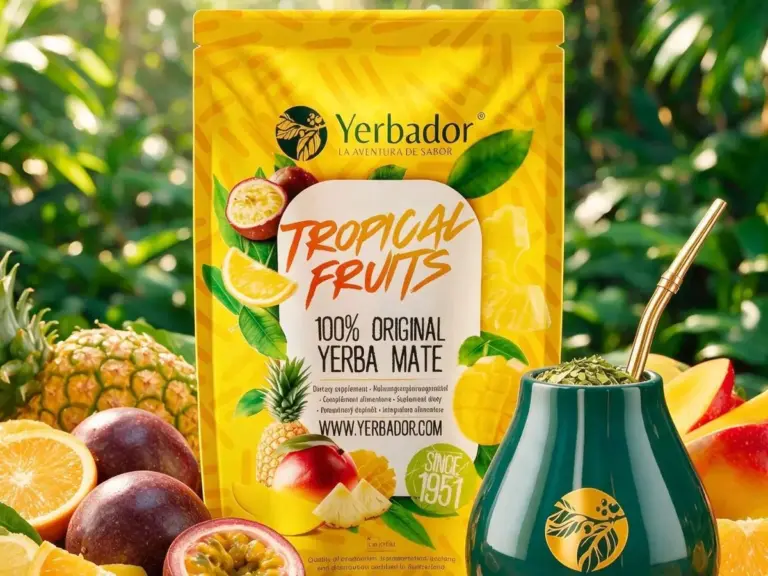
In practice that means dried mango belongs on top of your porridge or in a lunchbox next to a sandwich, not in a bowl on your desk that you pick at all afternoon. If you want something to pick at all afternoon, a flask of tea or Yerba Mate Tropical Fruits with a beech scoop (about 46.90 EUR) does the job without the sugar, and the fruit pieces in the blend give you the tropical note you were after anyway.
What people actually worry about
Is dried fruit just sweets in a healthier costume?
It depends entirely on the ingredient list. A bag that reads “100 % dried mango” is concentrated fruit, with the fruit’s own fibre and potassium still in it. A bag whose list runs “pineapple, sugar, citric acid” is a confection with fruit in it. The nutrition table alone will not always tell you, because fruit sugar and added sugar are counted together under “sugars”. The ingredient list is the only place the difference is written down.
Will dried fruit make me put on weight?
A 30 g handful of dried mango is roughly 96 kcal and a handful of desiccated coconut is about 198 kcal, which are ordinary snack numbers. The problem is never the handful, it is the bag, because dried fruit has had the water removed and water is what normally makes you feel full. Decant a portion into a small bowl and put the bag away. That one habit does more than any swap.
Is the saturated fat in coconut a problem?
Desiccated coconut carries 57.22 g of saturates per 100 g, so a 30 g handful is about 17.2 g against an EU daily reference intake of 20 g. If you are watching saturated fat on medical advice, that is a number you should know before you buy a 500 g bag for baking. If you are not, use it as a measured ingredient rather than a snack and it stays in proportion.
Why is some dried fruit so brightly coloured?
Sulphur dioxide keeps light-coloured fruit from browning, and above 10 mg/kg it has to be declared as an allergen in the ingredient list under Annex II of Regulation 1169/2011. Colour on its own is a hint, not proof. The declaration is the proof, and if you react to sulphites it is the line to check first.
Can children eat it?
Yes, in the same 30 g portions and with the same meal-time rule, which matters more for children’s teeth than for adults’. Whole dried fruit pieces are a choking risk for toddlers, so chop them. Nothing about dried tropical fruit makes it special for children either way, and anyone promising you more than that is selling something.
Which bag for which job
We sell one tropical dried fruit and several that sit next to it on the same shelf, so here is the honest mapping rather than a catalogue.
| If you want | Reach for | Why |
|---|---|---|
| Tropical sweetness with one ingredient | Dried Mango 250 g, about 10.90 EUR | Ingredient list reads 100 % dried mango, no added sugar. Soft slices, good in porridge and lunchboxes. |
| The most potassium per handful | Dried Apricots 250 g, about 9.90 EUR | 1 162 mg of potassium per 100 g, which is 349 mg in a 30 g handful. |
| Something tart against rich food | Dried Cranberries 250 g, about 8.90 EUR | Sharp enough to cut through cheese or a grain salad. Sweetened, as all dried cranberries are, so treat it as the sweet element. |
| A lighter, less sugary chew | White Mulberry 200 g, about 9.90 EUR | Mild and papery rather than sticky, which makes it easier to stop at one handful. |
| Tropical flavour with no sugar at all | Yerba Mate Tropical Fruits, about 46.90 EUR | You brew it instead of chewing it. Fruit pieces in the blend, nothing to swallow. |
Buying for a shop, a café or an office kitchen? Wholesale quantities go through Ewelina: [email protected] or +48 515 025 329, and she sends the binding offer.
Using a handful without turning it into dessert
The practical trick with dried tropical fruit is pairing it with something that slows it down. On its own a handful of mango is sweet and gone in two minutes. With protein or fat next to it, the same handful behaves differently on the plate and in your appetite.
Three combinations that work, in rough quantities:
- 30 g dried mango, chopped into strips, with 150 g plain yogurt and a tablespoon of pumpkin seeds. The acid in the yogurt softens the mango within a few minutes, so prepare it the night before and it turns into something spoonable.
- 20 g desiccated coconut toasted dry in a pan for 2 to 3 minutes, stirred through overnight oats in the morning. Toasting is the whole point: it costs nothing and changes the flavour from flat to nutty.
- 30 g dried mango soaked in 100 ml of hot water for 15 minutes, then chopped into a chicken or chickpea curry at the end of cooking. Rehydrated mango melts into the sauce and does the job of a spoonful of chutney.
Rehydrating is underrated in general. Fifteen minutes in warm water brings dried mango back to something close to the texture of fresh fruit, and because you are adding water rather than sugar, the portion gets bigger without getting sweeter.
One warning from the kitchen rather than from a database: dried fruit goes sticky and clumps once a bag has been open for a few weeks, especially in a warm room. That is moisture coming back in, not spoilage, but it is a sign the bag is no longer airtight. Clip it properly or decant into a jar.
Frequently asked questions
Does dried mango have more sugar than fresh mango?
Per 100 g, yes, by a long way, because the water is gone. Fresh mango is 13.66 g of sugars per 100 g and 83.46 % water. Any dried version concentrates that roughly fivefold before anything is added. Per portion the gap is much smaller, because a portion of fresh mango is 150 g or so and a portion of dried mango is 30 g.
How many calories are in a handful of dried mango?
About 96 kcal for a 30 g handful of the sweetened kind, based on 319 kcal per 100 g in USDA FoodData Central. An unsweetened bag lands in a similar range, since the sugar that was added is partly replacing the fruit’s own solids rather than adding to them.
What is the difference between desiccated coconut, coconut flakes and coconut chips?
Desiccated coconut is finely grated and dried to about 3 % moisture, which is why it is so concentrated at 660 kcal per 100 g. Flakes and chips are larger pieces of the same flesh, often sweetened and sometimes toasted. The thing to check is not the cut but whether sugar appears in the ingredient list, because that is what moved sodium from 37 mg to 285 mg in the database comparison above.
Is dried pineapple always sweetened?
Not always, but it usually is, and unsweetened dried pineapple is noticeably more acidic and chewier than people expect. Pineapple sits at pH 3.20 to 4.00 on the Clemson table, so without sugar the acidity is front and centre. Read the list: if sugar, glucose syrup or fruit juice concentrate appears, it was sweetened.
Does dried fruit count towards 5 A Day?
Yes, a 30 g portion counts, but only as one portion per day no matter how many different dried fruits you eat. That is the NHS rule, and the reasoning is the sugar concentration rather than any shortage of nutrients.
How long does dried fruit keep once the bag is open?
Months rather than weeks if you keep air out, since the low water content is what preserves it in the first place. Transfer it to a sealed jar away from the hob, and keep it out of direct sun. Softening, clumping or any smell of fermentation means moisture has got in, and at that point it goes in the bin rather than in the bowl.
Is coconut milk the same thing as coconut?
No, and the numbers are far apart. Canned coconut milk is 197 kcal and 21.33 g of fat per 100 g, coconut cream is 330 kcal and 34.68 g, and an enriched unsweetened coconut drink from a carton is 19 kcal and 1.79 g. All three are called coconut on the front. Only the ingredient list and the nutrition table tell you which one you have picked up.
What is the best way to start if I want one bag?
Start with Dried Mango 250 g, keep it in a jar, and measure a 30 g portion onto breakfast rather than eating it in the afternoon. If after a week you want something less sweet in the same drawer, White Mulberry 200 g is the gentler option.
Discover our TOP products!





Your dream figure



Discover new flavors




Yerba mate with tea





Accessories





Superfoods










Certified raw honeys from Poland






Check the current price
free shipping
Up to 90 days
free returns
24 H
shipping