
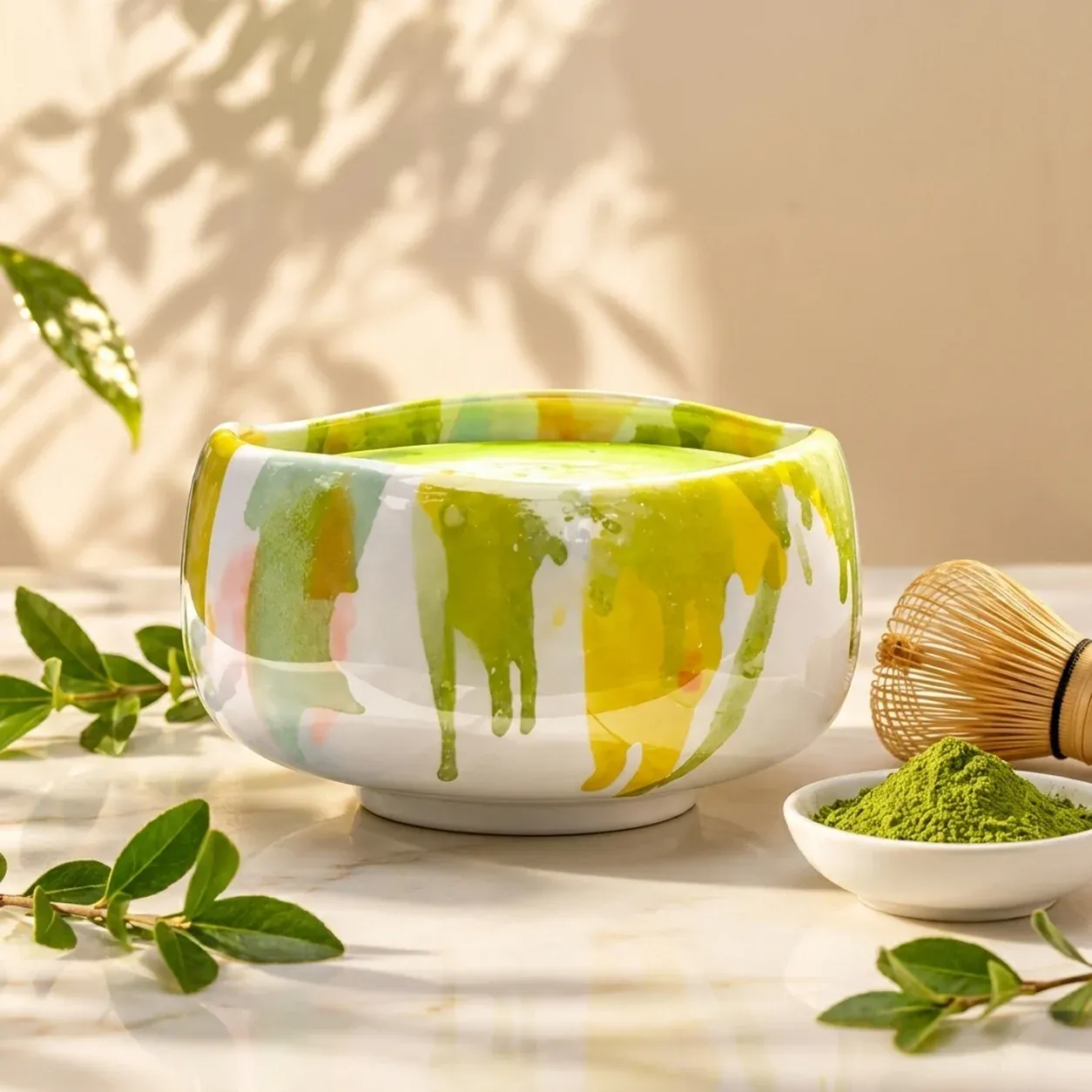
Matcha after dinner: what to serve with the bowl instead of coffee
2026-11-27
A bowl of matcha belongs at the end of a meal when the dessert is not sweeter than the tea is bitter. Dark chocolate, citrus and sesame are the three partners that work almost every time, and the serving itself is simple: 2 g of ceremonial matcha whisked with 70 ml of water at 80 °C, one bowl per guest, brought out after the plates are cleared.
That is the short answer to what to serve with matcha at a dinner table. The longer answer is about order, quantities and a few desserts that fight the tea instead of meeting it. Below you will find the grams for six people, a timetable that keeps you out of the kitchen for more than ten minutes, and the pairings we see working when people serve matcha instead of coffee.
In short
- One bowl = 2 g matcha + 70 ml water at 80 °C, whisked 20–30 seconds.
- Six guests = 12 g, which is less than a third of a 40 g tin.
- A 2 g bowl carries roughly 63 mg of caffeine, about the same as a single espresso.
- Best partners: 70% dark chocolate, citrus (yuzu, orange, lemon), black sesame.
- Serve 10–15 minutes after the last savoury plate, never alongside a strong coffee dessert.
- Whisk bowls one at a time; matcha loses its foam within two minutes of standing.
Why serve matcha instead of coffee after dinner?
Matcha after dinner gives you a warm, slightly bitter drink with about 63 mg of caffeine per 2 g bowl, close to one espresso, without the roasted flavour that flattens dessert. It also resets the palate after fat and salt, which is exactly what people want a coffee for and rarely get.
Taste first. Espresso brings roast, caramel and acidity to the table, and those notes compete with anything chocolate or sweet standing next to them. Matcha brings vegetal bitterness and a thick, savoury base, the umami that comes from amino acids in shaded tea leaves, and that base sits under a dessert rather than on top of it. One sip and the sweetness of the plate reads cleaner.
Then caffeine. People worry about tea at 22:00 and they are right to check the numbers. The European Food Safety Authority considers up to 400 mg of caffeine a day safe for healthy adults, and 200 mg a day for pregnant and breastfeeding women. A 2 g bowl sits well inside that, but it is not a decaf drink, and if a guest is sensitive you offer them 1 g in the same amount of water.
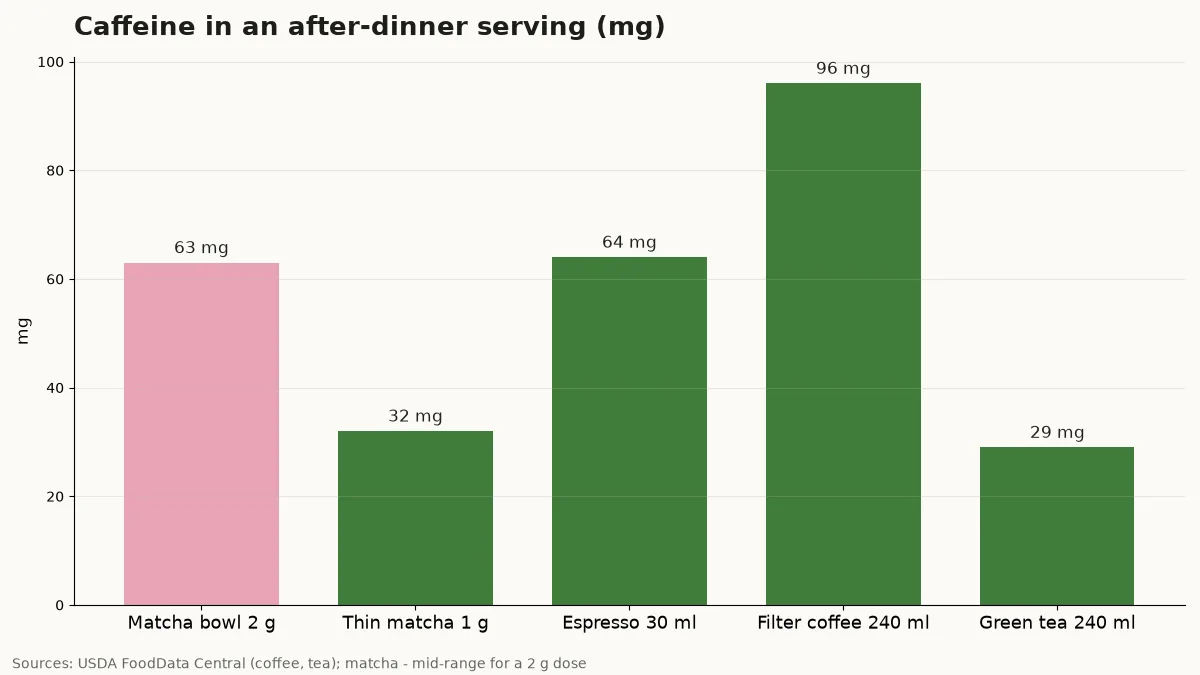
The practical conclusion: if your dinner ends at 21:00 and your guests sleep at 23:00, a bowl of matcha is roughly the same caffeine decision as the espresso they would have asked for anyway. A mug of filter coffee is a bigger one. We go through the full comparison in how much caffeine is in matcha.
How much matcha do you need for six people?
Six people need 12 g of matcha and roughly 420 ml of water at 80 °C. That is less than a third of a 40 g tin, and the whole service takes about twelve minutes from the first scoop to the last bowl on the table.
The table below is the one we use when someone writes to ask how much to buy before a dinner. The water column assumes a thin usucha bowl, the style you want at a table. Thick koicha at 4 g per person is a different evening, and most guests find it too intense after a full meal.
| Guests | Matcha | Water at 80 °C | Share of a 40 g tin | Time to serve |
|---|---|---|---|---|
| 2 | 4 g | 140 ml | 10% | 4 min |
| 4 | 8 g | 280 ml | 20% | 8 min |
| 6 | 12 g | 420 ml | 30% | 12 min |
| 8 | 16 g | 560 ml | 40% | 16 min |
| 12 | 24 g | 840 ml | 60% | 24 min (two rounds) |
Two details decide whether this is pleasant or stressful. The first is sifting: push the whole 12 g through a small sieve into one container before guests arrive, then scoop from it. Clumped matcha is the main reason a bowl tastes gritty, and no amount of whisking at the table fixes it afterwards.
The second is water temperature. Boil the kettle, pour the water into a jug, wait five minutes. In a room at 20 °C that brings a litre from 100 °C down to roughly 80 °C, close enough for tea. Water straight off the boil pulls harsh bitterness out of the leaf and the first guest gets the worst bowl of the night.
For more than eight people, split the service into two rounds rather than whisking eight bowls in a row. The foam on bowl one has collapsed by the time bowl eight is ready, and people notice.
What to serve with matcha: the three pairings that always work
Dark chocolate, citrus and sesame are the three desserts to serve with matcha. Chocolate meets the bitterness at a similar level, citrus cuts through the tea’s thickness, and sesame matches its roasted, nutty side. Each needs a different portion size and a different moment in the service.
| Dessert | Why it works with matcha | Portion per guest | When to serve | Matcha dose |
|---|---|---|---|---|
| Dark chocolate, 70% | Bitterness on both sides, cocoa fat softens the tea | 10–15 g | Chocolate first, bowl 1 min later | 2 g |
| White chocolate | Milk and sugar balance the vegetal edge | 10 g | Together | 2 g |
| Yuzu or lemon tart | Acidity clears fat, leaves the umami standing | 60–80 g slice | Tart first, bowl 3–4 min later | 2 g |
| Orange, fresh or candied | Sweet acidity, no cream to coat the mouth | 2–3 segments | Together | 2 g |
| Black sesame ice cream | Roast and fat mirror the tea’s nutty finish | 50 g scoop | Ice cream first, bowl after | 2–2.5 g |
| Halva or tahini biscuit | Sesame paste carries the bitterness instead of fighting it | 20–25 g | Together | 2 g |
| Red bean (anko) sweets | Classic Japanese pairing, mild sweetness | 30–40 g | Sweet first, then the bowl | 2–4 g |
Notice the pattern in the fourth column. Anything intensely sweet or intensely cold goes before the matcha, so the tea arrives on a clean palate. Anything in the same flavour family as the tea can sit on the table at the same time.
Chocolate: how dark and how much
For a matcha bowl, 70% dark chocolate in 10–15 g pieces is the safest chocolate on the table. Below 55% cocoa the sugar takes over and the tea tastes thin afterwards. Above 85% the two bitternesses stack and the whole thing turns dry.
White chocolate is the surprise that converts people. It has no cocoa solids, so there is no bitterness to compete, only cocoa butter, milk and sugar, and those smooth out the vegetal edge of a strong bowl. That is why matcha and white chocolate keep showing up together in baking, from our matcha Christmas cookies with white chocolate to the glaze on a sponge.
Milk chocolate is the one we would skip. At 32–38% cocoa with a lot of milk powder it coats the mouth, and the matcha that follows tastes faintly metallic. If milk chocolate is what you have, serve it with the coffee crowd and pour the matcha for everyone else.
A small thing that matters at the table: chocolate straight from the fridge has almost no aroma. Take it out twenty minutes before dessert, break it into pieces by hand, and put it on an unglazed plate rather than in a bowl.
Citrus: yuzu, orange, lemon
Citrus is the pairing for a heavy dinner. Acidity strips the fat from the palate, so the first sip of matcha reads as sweet and thick rather than bitter. Yuzu is the obvious match because it grows in the same cuisine as the tea, but a lemon tart does the same job and you can buy one anywhere.
Timing matters more here than with chocolate. Wait three to four minutes between the last forkful of tart and the first sip of matcha. Straight after a mouthful of acid the tea tastes flat and oddly salty, and guests will blame the matcha rather than the lemon.
Candied orange peel dipped in dark chocolate is the version we would put on a table for six: two or three strips each, nothing to plate, nothing to melt. Fresh orange segments work too, drained of their juice so they do not flood the palate.
Skip grapefruit. Its bitterness is in the same register as the tea’s and the two cancel each other out instead of trading places.
Sesame: the pairing people do not expect
Black sesame and matcha share the same roasted, slightly oily finish, which is why a scoop of black sesame ice cream next to a bowl of usucha tastes planned rather than improvised. Toasted sesame also brings fat, and fat makes a strong bowl rounder.
Three ways to put it on the table, from easiest to most work:
- Tahini biscuits. Any shortbread recipe with a third of the butter replaced by tahini, baked until the edges colour. 20 g each.
- Halva. Cut into 2 cm cubes, served cold, one or two per guest. Pistachio halva works; chocolate-marbled halva is too sweet.
- Black sesame ice cream. A 50 g scoop in a chilled glass, eaten first, then the matcha a minute later.
If you grind your own sesame, toast it in a dry pan until the first seeds pop, then let it cool before grinding. Hot sesame paste turns bitter in a way that does not pair with anything.
What not to serve with matcha
Five desserts that fight a matcha bowl: tiramisu and anything coffee-flavoured, mint desserts, salted caramel, heavy whipped cream, and very ripe soft cheese. In each case the problem is specific, not a matter of taste.
- Coffee desserts. Two sources of caffeine, two kinds of bitterness and a roast flavour that buries the tea. If the dessert contains espresso, serve water.
- Mint. Menthol numbs the palate for several minutes, and the matcha that follows tastes of nothing but its own astringency.
- Salted caramel. Salt plus the savoury umami of matcha is one savoury note too many, and the sugar level is usually far above the tea.
- Whipped cream in quantity. A thick coating of dairy fat flattens the foam of the next sip. A small quenelle is fine; a cloud is not.
- Ripe washed-rind cheese. Guests sometimes ask for matcha with a cheese board. The ammonia notes and the tea’s grassiness are a bad conversation.
Alcohol is a separate question. A bowl of matcha after a glass of dessert wine is fine; after a peaty whisky it is wasted, because the smoke sits on the palate for a quarter of an hour.
The running order: twelve minutes for six bowls
Serving six bowls takes twelve minutes if you prepare three things before guests sit down: sifted matcha, hot water in a jug, and six bowls out of the cupboard. Everything else happens at the table.
- Before dinner. Sift 12 g of matcha into a small jar. Put out six bowls, a chasen and a teaspoon or chashaku.
- Last savoury plate cleared. Boil the kettle, pour into a jug, leave it for five minutes while you bring out the dessert.
- Minute 0. Rinse the chasen in hot water for 20 seconds. This softens the bamboo prongs and stops them snapping.
- Minute 1. Warm each bowl with a splash of hot water, pour it out, wipe dry. A cold bowl drops the tea below 65 °C before the second sip.
- Minute 2. Scoop 2 g into the first bowl, add 70 ml of water, whisk 20–30 seconds in a brisk M shape, wrist and not arm, until the foam is fine and even.
- Minute 3 onwards. Hand each bowl over as it is ready, two rinses of the whisk between bowls. Roughly 90 seconds per guest.
- End. Rinse the chasen in warm water, no soap, and stand it prongs-up to dry.
Two habits from café service that work at home. Ask about caffeine while you are still sifting, not when the bowl is in your hand — then you know whether to make one bowl at 1 g. And hand the bowl over with the front facing the guest; if the bowl has a pattern, that is the side they should see.
What you need on the table
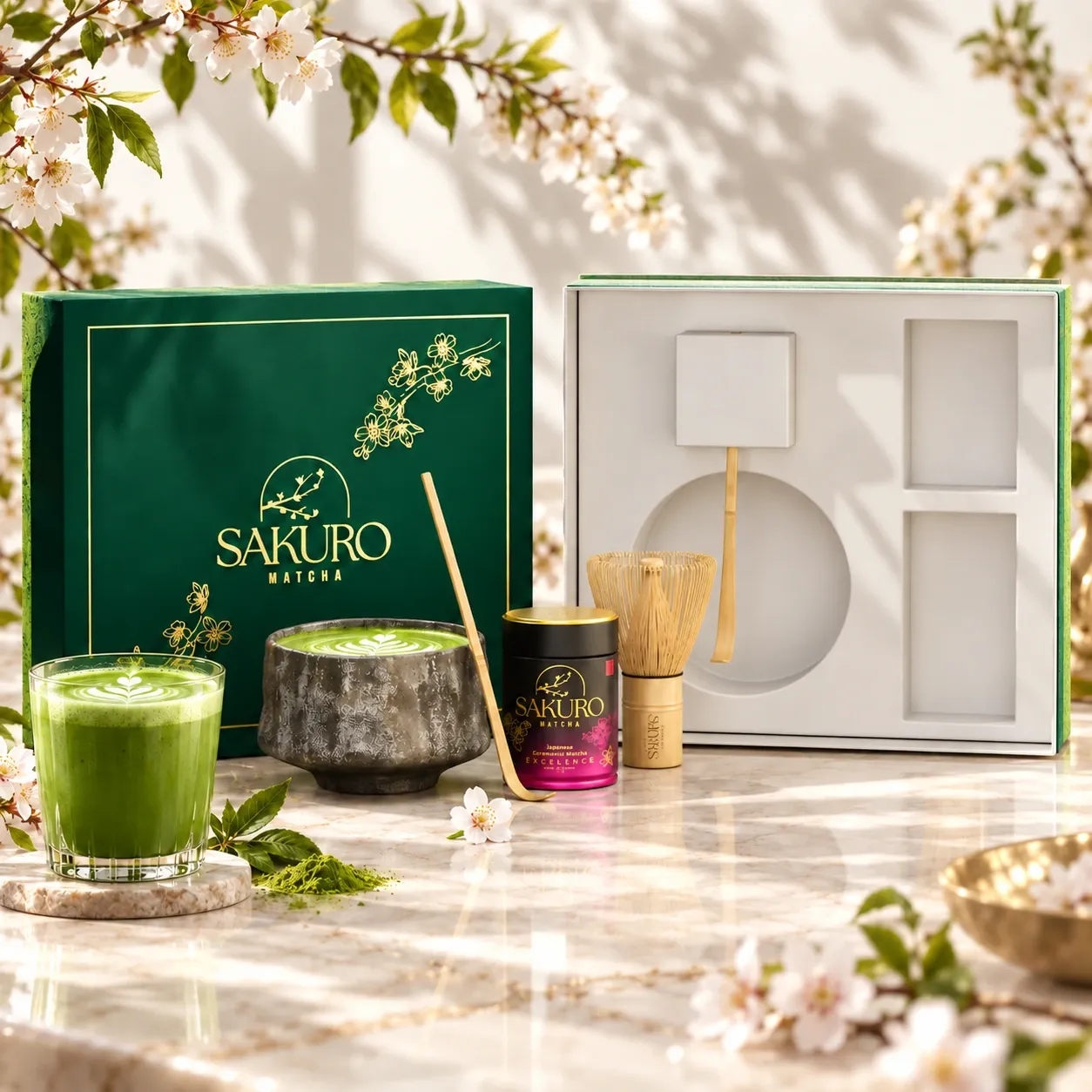
For a dinner party you need one tin of ceremonial matcha, one bamboo whisk and as many bowls as guests, or one bowl passed between them in the older way. Japanese ceremonial matcha is the grade to buy here, because the tea is drunk on its own and every fault in the powder shows.
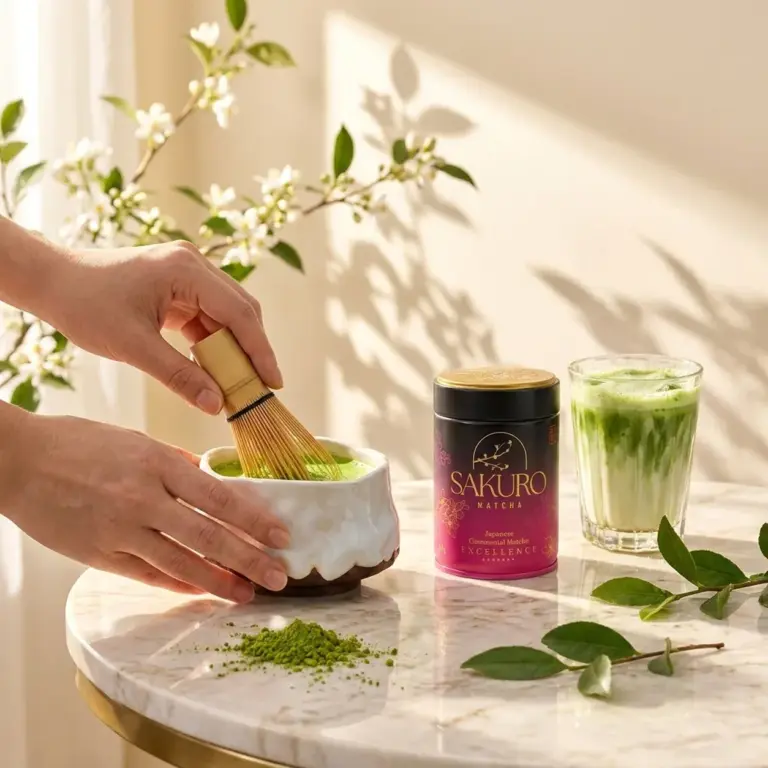
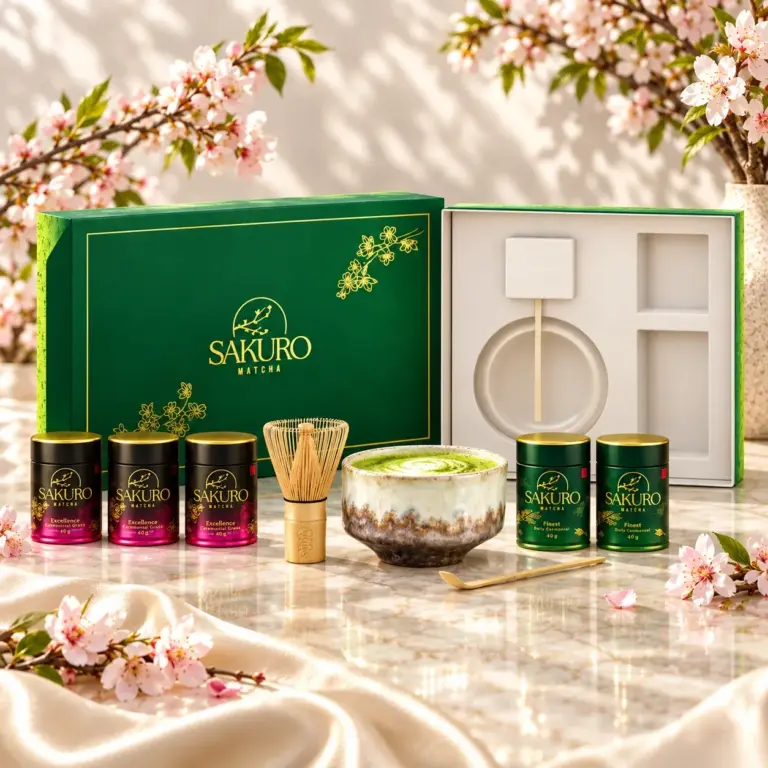
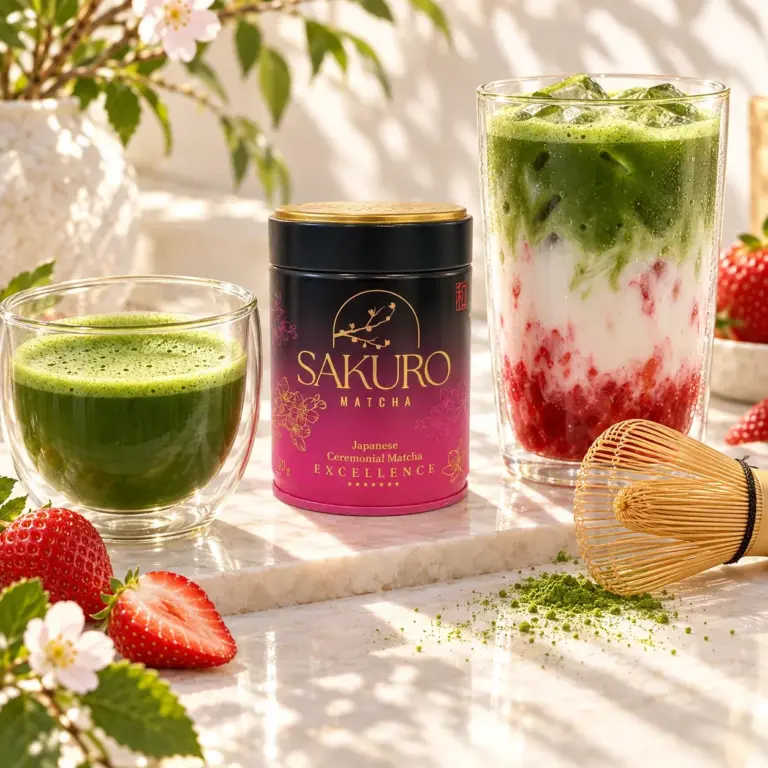
Sakuro Matcha Excellence (yerbador.com) is a Japanese ceremonial matcha from Shizuoka in a 40 g tin, about 20 bowls at 2 g, around 26.90 €. It is the one we would open for guests: the sweetest of the two, with the least astringency when whisked thin.
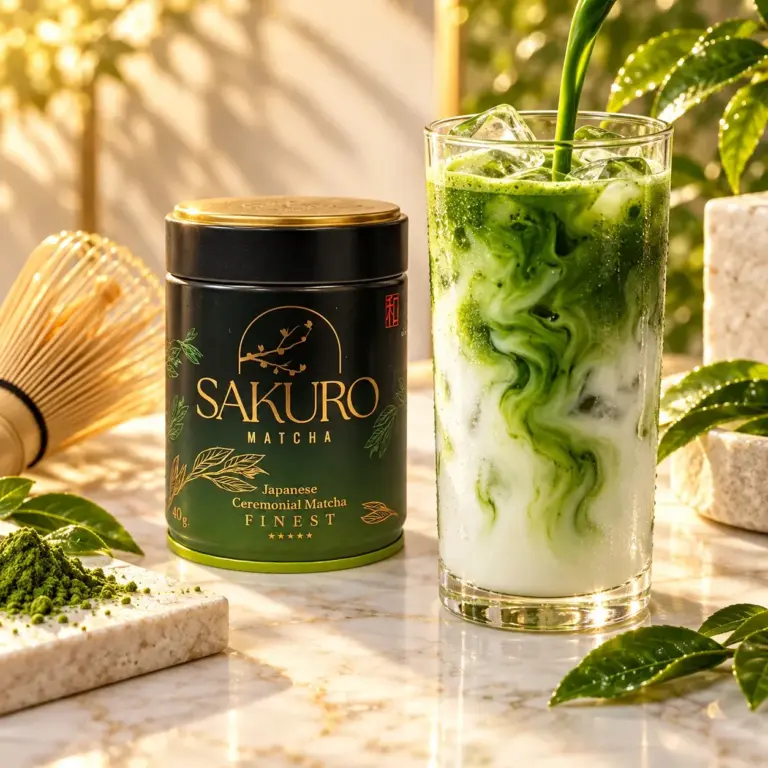
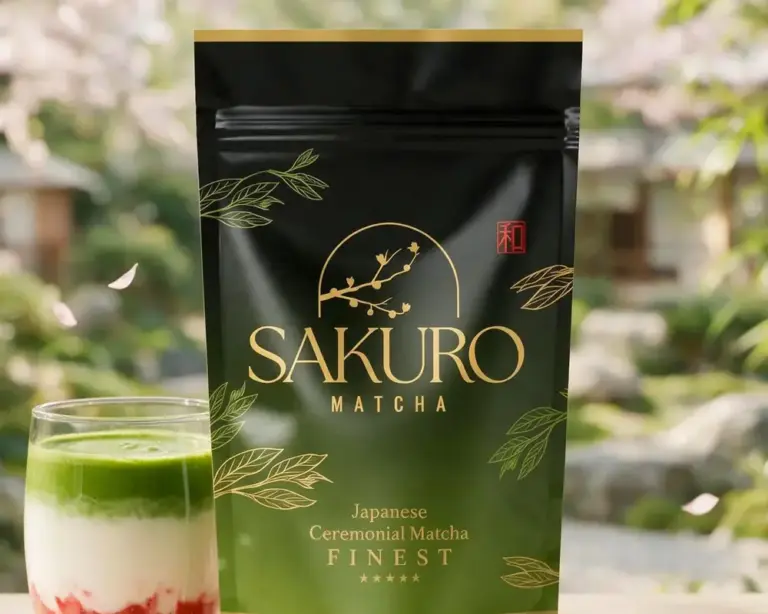
Sakuro Matcha Finest (yerbador.com), also a Japanese ceremonial matcha, 40 g tin, around 23.90 €, is the everyday tin and the one to use if you are also baking the dessert. The difference between the grades, and when it stops mattering, is laid out in ceremonial vs culinary matcha.
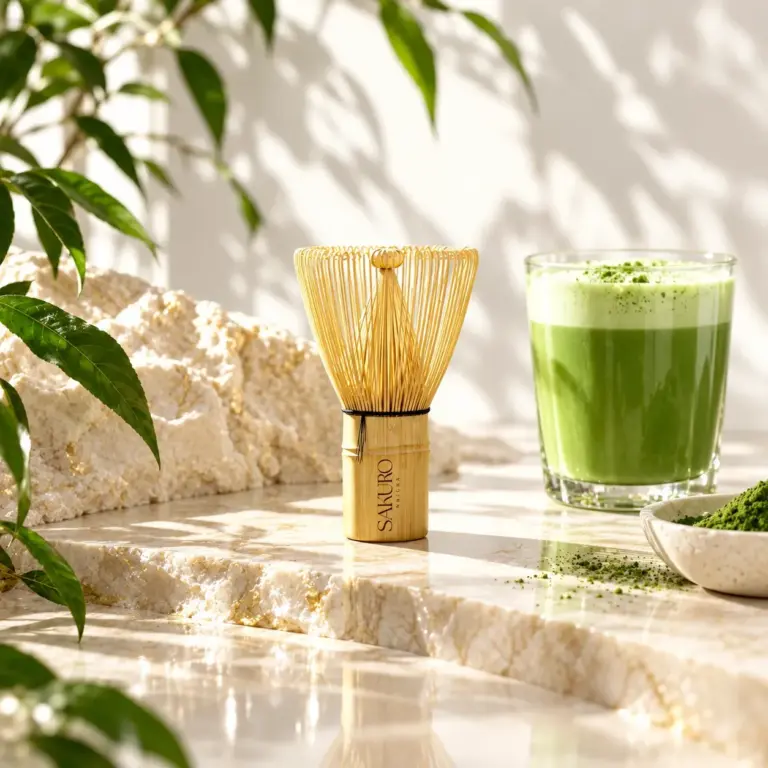
A proper bowl is wider than a cup for a reason: the chasen needs room to move. The BONSAI matcha bowl is around 23.90 €, and a bamboo chasen around 14.90 €. One whisk serves the whole table; you do not need six.
If you run a restaurant and want matcha on the after-dinner list instead of a third espresso, we sell it by the kilo from EU stock: 1 kg bags, discounts from 3 kg, and a quote from Ewelina at [email protected] or +48 515 025 329.
Serving matcha to guests who have never tried it
Give a first-timer 1.5 g rather than 2 g, warn them that the drink is bitter the way strong dark chocolate is bitter, and hand it over with something sweet already in front of them. Nine times out of ten the bad first impression comes from a bowl served on its own, hot and alone, with no reference point.
What we say at the table is roughly this: drink it in three or four mouthfuls, not sips, because the powder settles; the foam is supposed to be there; and the slightly grassy finish is the tea, not a mistake. It takes fifteen seconds and it changes how people taste the first bowl.
Two more things worth setting up in advance. Put a small glass of plain water next to each bowl, which gives nervous guests an exit and makes the second mouthful taste better anyway. And keep one dessert on the table that is unambiguously sweet, usually the white chocolate, because a guest who finds the tea too strong needs a bite that fixes it immediately.
If someone asks for milk, give them milk. A bowl of ceremonial matcha with 30 ml of warm oat milk stirred in is a perfectly good drink, and the alternative is a polite guest holding a full bowl for twenty minutes.
Frequently asked questions
Can you drink matcha after a meal?
Yes. Matcha is served at the end of a meal in Japan, and a thin 2 g bowl is light enough to follow dessert. If you eat a lot of iron-rich food and you know tea with meals bothers you, leave 20–30 minutes between the plate and the bowl.
Will matcha in the evening keep me awake?
A 2 g bowl has roughly 63 mg of caffeine, about one espresso, so it affects sleep the same way an after-dinner coffee does. Caffeine-sensitive guests should get 1 g in the same 70 ml of water, which halves the dose without making the bowl taste weak.
How much matcha do I need per person at a dinner party?
2 g per guest for a thin bowl, so 12 g for six people and 16 g for eight. A 40 g tin covers a table of six with enough left for a week of mornings.
Which matcha should I serve to guests?
Ceremonial grade, Japanese, bought in a tin rather than a sachet. Drunk without milk, the tea has nowhere to hide: culinary grade turns sharp and dusty in a bowl, even though it bakes perfectly well.
Can I whisk the matcha in advance for six people?
Not with any good result. Foam collapses in about two minutes and the powder settles after five, so a jug made ten minutes early arrives grey and separated. Sift the powder in advance, heat the water in advance, whisk at the table.
Hot or iced matcha after dinner?
Hot, at around 70 °C in the bowl. Cold matcha tastes sweeter and thinner, which is why it works in the afternoon with milk (the recipe for that is in our matcha latte guide), but at the end of a dinner the warm bowl does the work of the coffee it replaced.
Pick one dessert from the three families, sift the powder before anyone arrives, and keep the kettle honest at 80 °C. That is the whole trick to what to serve with matcha, and the first evening you do it someone will ask where to buy a bowl of their own.
Discover our TOP products!




Your dream figure




Discover new flavors




Yerba mate with tea




Accessories



Superfoods












Certified raw honeys from Poland

Check the current price
free shipping
Up to 90 days
free returns
24 H
shipping