
Which matcha bowl to choose: nine Sakuro chawan compared
2026-11-25
Pick the matcha bowl by its glaze, not by its shape. All nine Sakuro chawan hold 500 ml, share the same profiled interior and are fired above 1200 °C, so the only real differences are what the bowl looks like and what it costs: €23.90 for Niwa, Bonsai, Biwa, Shōji and Hisseki, €26.90 for Hisui, Asagiri, Shizuku and Fuji. That sounds like an anticlimax until you use two of them side by side. A pale interior shows you the true colour of your matcha. A dark one hides it. Over a year of mornings, that turns out to matter more than the price gap.
In short
- Nine bowls, one body: every Sakuro chawan is a 500 ml bowl with an interior profiled for a bamboo whisk.
- Two price tiers: €23.90 (Niwa, Bonsai, Biwa, Shōji, Hisseki) and €26.90 (Hisui, Asagiri, Shizuku, Fuji).
- Pale glazes (Asagiri, Shōji, Niwa, Bonsai) let you judge whether your powder is fresh green or tired olive. Dark glazes (Fuji, Shizuku) make the green look dramatic but hide its faults.
- A classic chawan measures about 15 cm across the rim and 8 cm high, according to JAANUS at Columbia University. Summer bowls are shallower, winter bowls narrower.
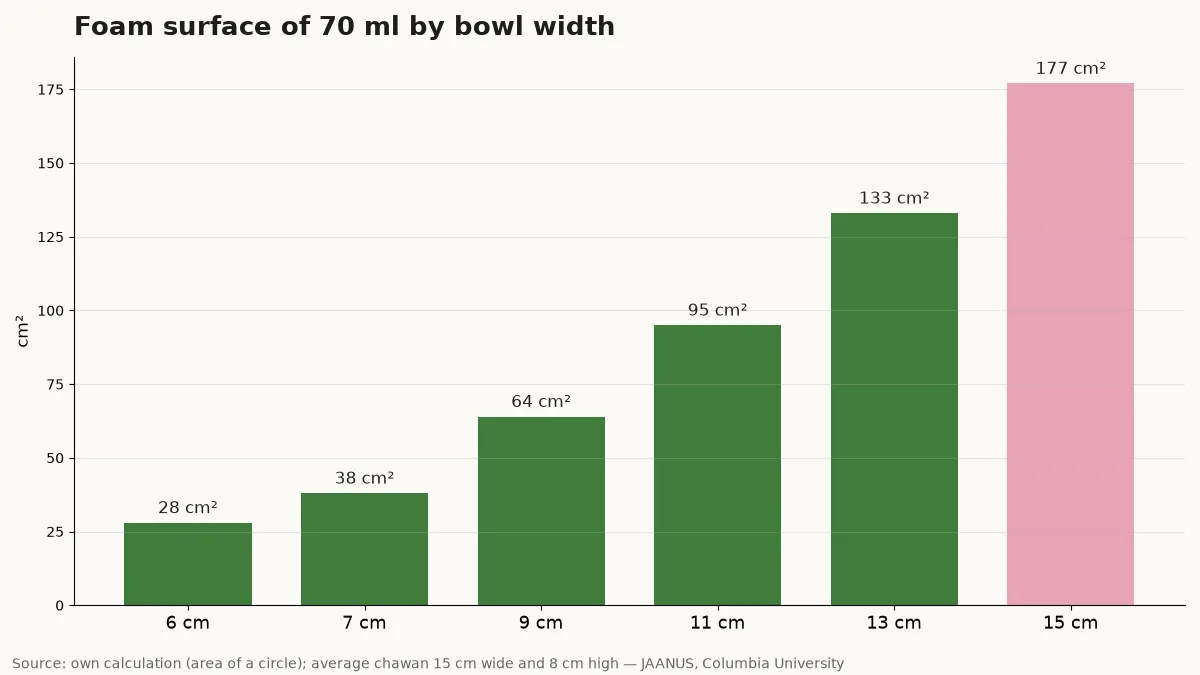
- Width is what makes foam: 70 ml of usucha spreads over roughly 28 cm² in a 6 cm espresso cup and 177 cm² in a 15 cm bowl.
- Every bowl is dishwasher-safe, free of cadmium and lead, compliant with EU food-contact rules, and covered by a 25-year Sakuro material guarantee.
Which matcha bowl should you choose?
If you are buying your first chawan and want to learn what good matcha looks like, choose a pale bowl: Asagiri, Shōji or Niwa. If you already know your powder and want the ritual to look the part, a dark bowl like Fuji is the better theatre. Everything else, the capacity, the interior shape, the firing, the guarantee, is identical across the range.
That is unusual, and it is worth saying plainly because most bowl guides on the internet spend three paragraphs on shapes you cannot actually buy. Japanese tea culture does distinguish between a flat summer bowl and a narrow winter one, and we will come back to that. But when you are choosing from one European-made collection, you are choosing a surface, not a geometry.
So the honest question is not “which shape do I need” but “what do I want to see when I look down into the bowl at seven in the morning”.
Nine bowls, one body: what is actually different
All nine Sakuro bowls are chawan of 500 ml capacity, made in European ceramic workshops, glazed by hand and fired at over 1200 °C. Each is finished individually, so two bowls of the same name are never a perfect match. What separates them is colour, contrast and the texture you feel under your thumb.
| Bowl | Name means | What it looks like | Price | Choose it if |
|---|---|---|---|---|
| Niwa | Garden | Pastel streaks and green flecks on white, like petals on water | €23.90 | You want calm colour and an honest view of the green |
| Bonsai | Tree | Pink, green and gold running down white porcelain like watercolour | €23.90 | You want the most colourful bowl in the range |
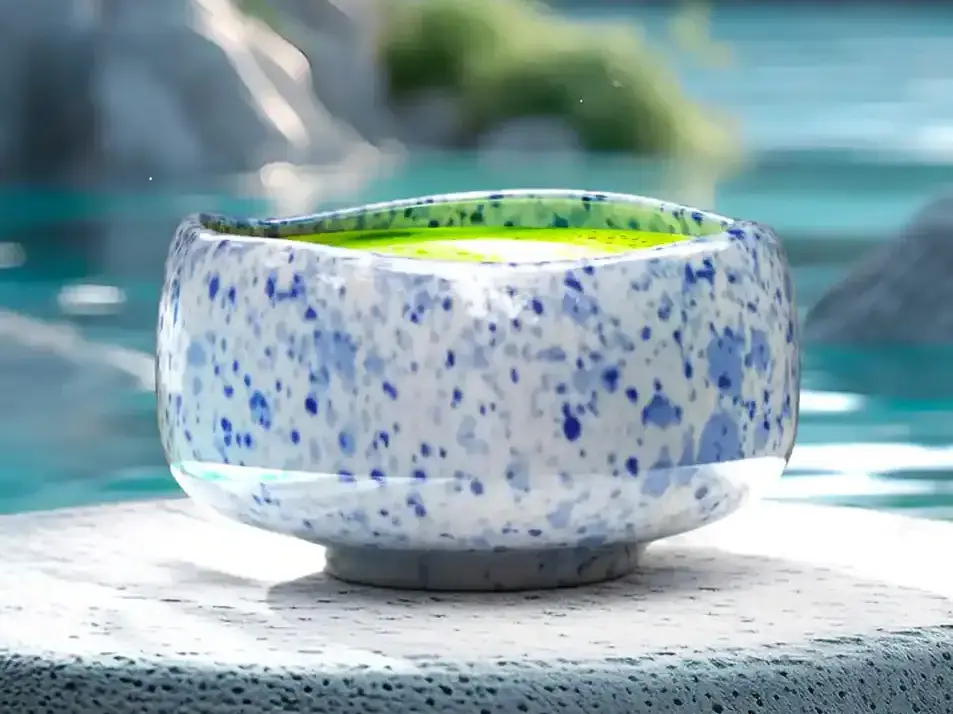
| Biwa | Lake | Blue and navy freckles scattered across a pale body | €23.90 | You like blue, and the sharpest contrast with green |
| Shōji | Silence | Minimal beige with the texture of Japanese paper walls | €23.90 | You want the quietest bowl on the shelf |
| Hisseki | Brush strokes | Black calligraphic strokes, deliberately asymmetric | €23.90 | You like graphic, high-contrast ceramics |
| Hisui | Jade | Jade green above, raw unglazed foot below | €26.90 | You want green on green, with a rough base to hold |
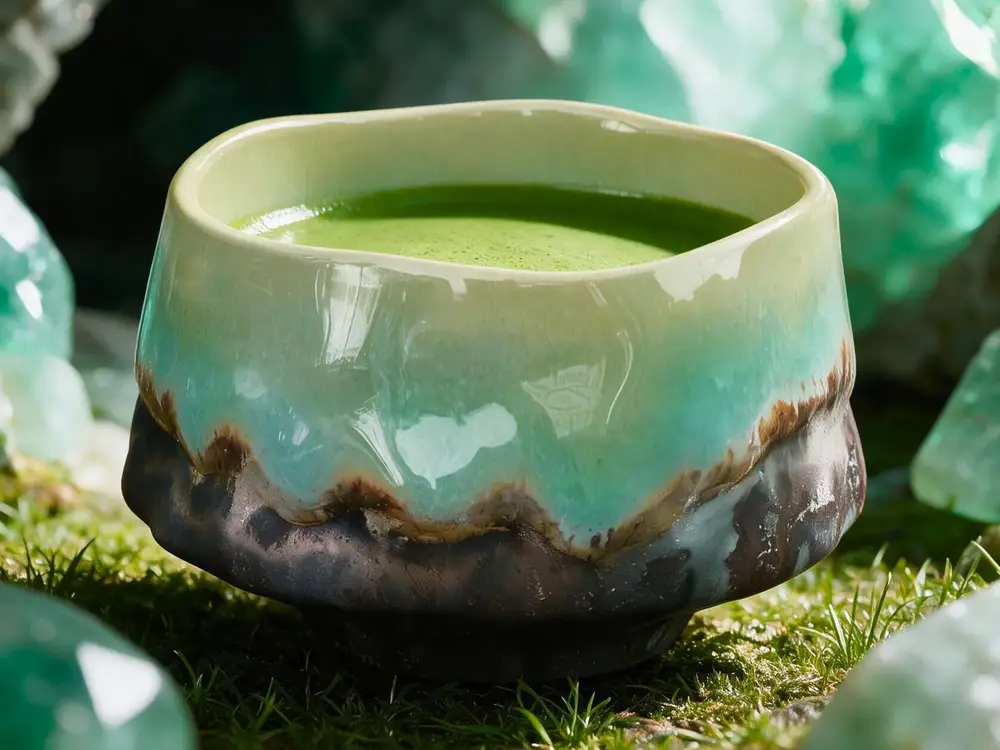
| Asagiri | Morning mist | Milky, semi-translucent glaze over a dark clay foot | €26.90 | You want the palest interior and the truest colour reading |
| Shizuku | Drop | Glaze shifting from blue to brown, like water meeting soil | €26.90 | You want earth tones without going fully dark |
| Fuji | Mountain | Dark, raw, textured like cooled lava; the heaviest look in the set | €26.90 | You want maximum drama and do not mind losing the colour cue |
The €3 difference between the tiers buys a more complex glaze, not a better bowl. A Shōji holds the same 500 ml as a Fuji and whisks exactly as well.
Why a wide bowl beats a mug
A proper chawan is wide because foam needs surface. Whisking 2 g of matcha into 70 ml of water in a narrow mug produces a column of liquid roughly 25 mm deep and barely 28 cm² across, which is the footprint of an espresso cup. The same 70 ml in a 15 cm bowl sits 4 mm deep and spreads over 177 cm². The chasen can reach the bottom, the wrist can move, and the air you beat in has somewhere to go.
How wide should a matcha bowl be?
JAANUS, the Japanese art and architecture dictionary hosted by Columbia University, gives the average chawan as 15 cm across the rim and about 8 cm high. It also notes the seasonal habit: a shorter, flatter bowl in summer, so the tea cools faster, and a narrower, barrel-shaped bowl of about 10 cm in winter, so it stays warm. Collectors in Japan own both. You probably do not need to.
Anything from roughly 11 cm upward gives you enough room. Below that you are whisking in a jar.
Is 500 ml too big for 70 ml of tea?
No, and the number is deliberately generous. A single usucha fills a 500 ml chawan to about one seventh of its volume. The empty space above the liquid is the working room: it is where the whisk travels, where the splash goes, and where the foam builds up without climbing over the rim. Pour 70 ml into a 100 ml cup and the first hard stroke redecorates your worktop.
It also means one bowl covers more than tea. A 500 ml chawan takes a double serving of koicha, a breakfast bowl of yoghurt, or a scoop of ice cream with matcha dusted over it, without looking odd.
The glaze decides what you can see
Here is the thing nobody mentions when they sell you a beautiful dark bowl: matcha is one of the few drinks you judge with your eyes before your tongue. Fresh, well-stored, shade-grown powder whisks up a vivid spring green. Powder that has sat open on a sunny shelf turns dull, flat and faintly olive. In a pale bowl that change is obvious from the first pour. In a dark bowl it is invisible.
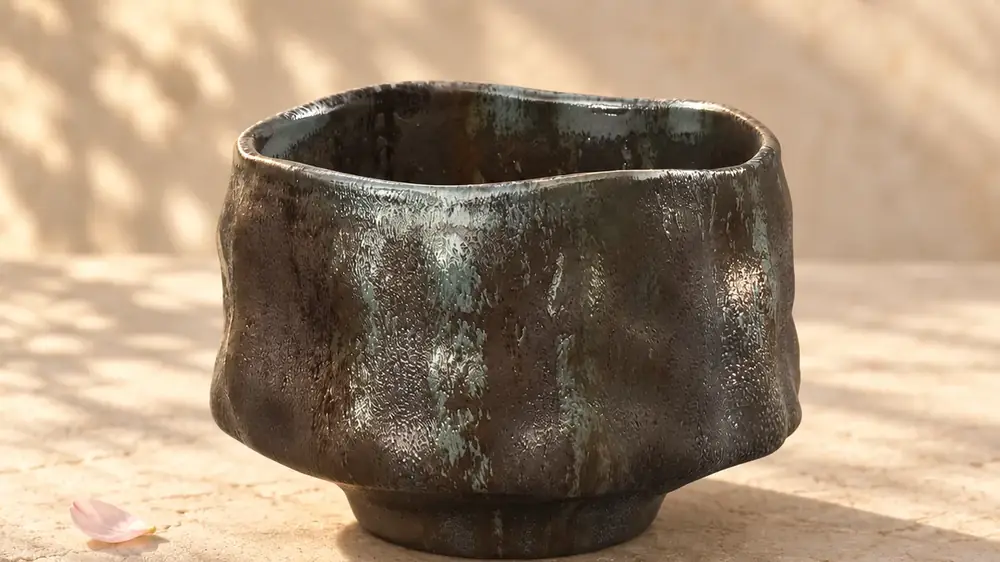
This is not an argument against Fuji or Shizuku. Both are beautiful, and a dark interior makes a bright green look electric, which is exactly why photographers reach for them. It is an argument for knowing which one you own. If your only bowl is dark, check the colour of the dry powder against a white saucer every few weeks instead.
If you are still learning what good matcha looks like, our guide to ceremonial and culinary grades covers what the colour is actually telling you.
Which bowl for usucha, koicha, latte and dessert
All nine bowls handle all four jobs, because they are the same bowl. What changes is how good the result looks and how easy it is to read.
| What you are making | What the bowl needs to do | Our pick |
|---|---|---|
| Usucha, the everyday thin matcha | Show the foam and the colour | Asagiri, Shōji or Niwa |
| Koicha, thick matcha, 4 g to 30 ml | Let you see a dense paste, not foam | Hisui or Shizuku |
| Whisking a base for iced latte | Take a vigorous whisk and pour cleanly | Any of them; Biwa pours well |
| Dessert bowl, yoghurt, ice cream | Look good with food in it | Bonsai or Hisseki |
One practical note on latte. You do not drink a matcha latte from a chawan; you whisk the concentrate in the bowl and pour it over cold milk in a glass. The bowl is a tool at that point, not the serving vessel, which is why a 500 ml body with high walls is an advantage: you can whisk hard without wearing it.
What goes in the bowl
A good bowl will not rescue bad powder. For drinking straight, the rule is simple: the fewer things between you and the tea, the better the tea needs to be.
Sakuro Matcha Excellence is the ceremonial grade in the range, a 40 g tin at €26.90, and it is what we would whisk into a pale bowl when the matcha is the point. Sakuro Matcha Finest, also 40 g, at €23.90, is the deeper, more robust powder: better value for lattes, smoothies and baking. Both are Japanese ceremonial-style matcha from Shizuoka. If you cannot decide, the Finest and Excellence pair at €46.90 lets you taste them side by side, which is more useful than any description we could write.
A 40 g tin gives about 20 servings at 2 g. That works out at roughly €1.20 a bowl for Finest and €1.35 for Excellence, which is a third of what the same drink costs across a café counter.
| Your situation | What to buy | Price |
|---|---|---|
| First chawan, you already own matcha | Asagiri bowl | €26.90 |
| First chawan on a budget | Niwa bowl | €23.90 |
| You want to compare the two matchas first | Finest and Excellence pair | €46.90 |
| Everything at once, as a gift | Excellence set with the Niwa bowl | €55.90 |
| You drink matcha daily and keep running out | Three tins of Finest, 2+1 | €46.90 |
The mistake we see most often: people buy a beautiful bowl and keep using a teaspoon to measure. A level teaspoon of matcha is nowhere near 2 g, and a heaped bamboo scoop is nearer 1.3 g than 1 g, so two heaped scoops put about 30 % more powder in the bowl than the recipe intends. That is usually what people are tasting when they decide ceremonial matcha is “too strong”. A €5.90 chashaku and a kitchen scale on their first week together fix it permanently.
Usucha in a 500 ml bowl, step by step
- Sift 2 g of matcha into the dry bowl. Sifting is not optional; it is the single biggest difference between smooth and lumpy.
- Add 60 to 70 ml of water at 80 °C. Boiling water scalds the powder and pushes it bitter.
- Whisk briskly in a W motion for about 15 seconds, keeping the chasen just off the bottom.
- Stop when the surface turns to fine, even foam. Ippodo, the Kyoto tea house, is clear that matcha can be over-whisked and that longer whisking brings out more bitterness.
- Drink it within a minute or two. Matcha is a suspension, not an infusion, and it starts settling immediately.
Total time: under two minutes. If yours comes out gritty or harsh, the fix is almost always one of six things, and we worked through all of them in why matcha turns bitter and clumpy. For the full traditional method, including koicha, see how to make matcha the traditional way.
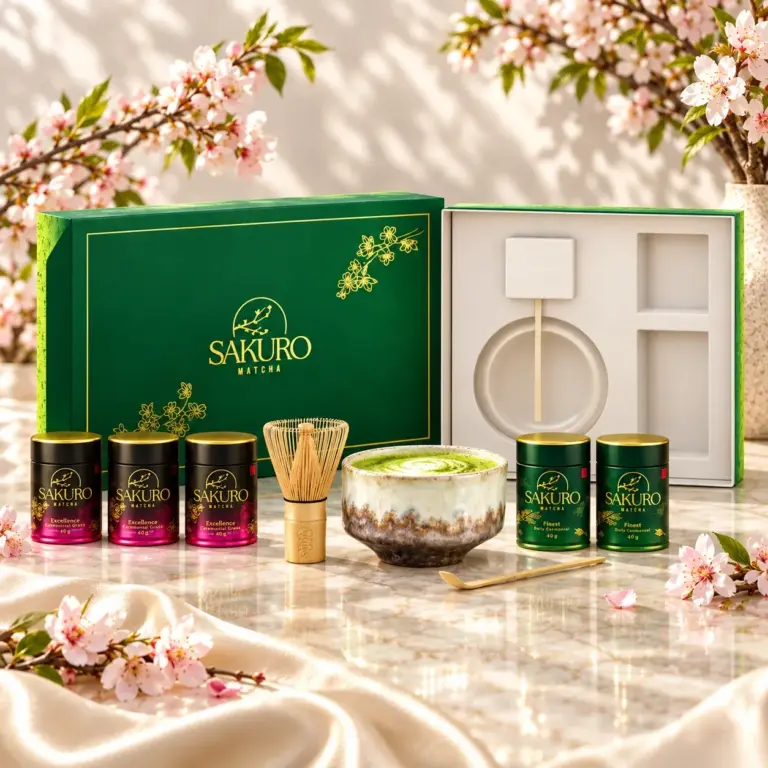
You will also want a bamboo whisk. The chasen costs €14.90 and a chashaku scoop €5.90. If you would rather buy the whole thing at once, the ready-made sets pair a 40 g tin with a bowl, a whisk and a scoop in a gift box, for example Finest with the Hisui bowl at €55.90.
What people worry about before buying a chawan
Is glazed ceramic safe for daily drinking?
Sakuro states that its bowls are made without cadmium, lead or heavy metals, use non-toxic glazes and comply with European Union standards for food-contact tableware. That is the right set of questions to ask of any ceramic you drink from daily, particularly brightly coloured imports sold without documentation. If a seller cannot answer it, assume they have not checked.
Will it survive the dishwasher?
These are fully dishwasher-safe, which is not true of every hand-glazed bowl. In practice we still rinse the bowl by hand straight after use, because a chawan takes ten seconds and the dishwasher takes a day. Never put the bamboo whisk in there.
Is €26.90 a lot for a bowl?
It is more than a cereal bowl and less than a decent frying pan. Spread across a 25-year material guarantee, or even across a single year of daily matcha, the ceramics cost a few cents a cup. The powder is the recurring expense, not the bowl.
Can a European-made bowl be authentic?
The honest answer: the matcha is Japanese, the ceramics are European. We say that openly rather than implying a Kyoto kiln. A chawan is defined by what it does, a wide, deep vessel you can whisk in, and these do it. If owning Japanese-fired pottery matters to you, buy Japanese pottery; that is a legitimate preference and a different purchase.
What if I chip it?
A chip on the rim is a reason to retire a bowl from drinking, because you put your lip there. A chip on the outside is cosmetic, and in Japanese aesthetics not necessarily a flaw at all. The 25-year guarantee covers material durability, not accidents involving stone floors.
Looking after the bowl
Rinse it with hot water straight after drinking. Matcha dries into a thin green film that comes off in seconds while wet and needs scrubbing an hour later. No detergent is needed for tea; the residue is just tea.
Dry it the right way up, not stacked, so the unglazed foot can dry too. Asagiri, Hisui and Fuji all have raw clay at the base, and raw clay holds water. Stacking a damp bowl under another one is how you end up with a musty smell that no amount of washing fixes.
Avoid thermal shock. Do not take a bowl out of a cold cupboard in January and pour 80 °C water straight in. Warm it with a splash of hot water first, pour that away, then make the tea. It takes five seconds and it also keeps your usucha hotter.
Dry the bowl properly before it goes back in the cupboard. This matters more than it sounds: the bamboo whisk that lives next to it is the part that grows mould, and a damp shelf is what starts it. Stand the chasen on its holder, tines up, in open air, and give the bowl the same courtesy.
One habit worth copying from tea rooms: keep the bowl somewhere you can see it. A chawan in a cupboard behind the mixing bowls gets used twice. A chawan on the counter next to the kettle gets used every morning, which is the whole point of buying one.
For cafés and tea rooms
These bowls are rated for professional use, and a tea room serving whisked matcha at the table needs a consistent set rather than nine different ones. For bowls in quantity alongside matcha in 1 kg bags, write to Ewelina at [email protected] or call +48 515 025 329. For reference, wholesale Finest works out at roughly €108 per kg and Excellence at about €155 per kg, which is around €0.22 and €0.31 per 2 g serving, converted from the Sakuro catalogue at the National Bank of Poland rate of 4.4633 PLN/EUR on 24 November. Treat those as indicative; Ewelina sends the binding offer. Orders go in whole kilograms, with 5 % off from 3 kg and 10 % off from 5 kg, shipped from Poland within the EU.
Frequently asked questions
What is the difference between a chawan and a regular bowl?
A chawan is wide enough and deep enough to whisk in, with walls high enough to contain the splash. A soup bowl is usually too shallow and a cereal bowl too narrow at the base for a chasen to move properly. If you only have a kitchen bowl, pick the widest one with the steepest sides and accept slightly less foam.
Which Sakuro bowl is best for beginners?
Asagiri or Shōji. Both are pale inside, so you can see exactly what your whisking is doing, and seeing the foam form is how you learn the motion. Niwa is the same idea at €23.90.
How much matcha fits in a 500 ml bowl?
Comfortably 2 g of powder in 60 to 70 ml of water for usucha, or 4 g in 30 ml for koicha. You can double a usucha to 140 ml and it still whisks well. Filling a chawan to the brim is not a thing anyone does.
Do I need a bowl at all for matcha latte?
You need something to whisk the concentrate in, and a chawan is the best tool for it. The latte itself goes in a glass. A wide bowl plus a bamboo whisk gives a smoother base than a jar and a hand frother, mainly because you can see the lumps.
Can I use a matcha bowl for other drinks?
Yes. A 500 ml chawan works for hojicha, for a breakfast yoghurt bowl, for soup. The only caution is strongly coloured or oily food in a crackled glaze, which can stain over years. Tea will not.
Which bowl makes the best gift?
Bonsai, for the colour, and it is in the lower price tier. If you are giving matcha with it, the gift-boxed sets with a tin, bowl, whisk and scoop solve the whole problem in one parcel. Delivery is free on orders over €69.
Where to start
If you are buying one bowl and you drink matcha to taste it, take Asagiri and a tin of Excellence. If you are buying one bowl and you drink matcha because the morning needs a ritual, take Fuji, and enjoy the fact that it looks like a piece of a volcano. If you are buying for someone else, Bonsai is the one people photograph.
Discover our TOP products!





Your dream figure




Discover new flavors






Yerba mate with tea




Accessories



Superfoods













Certified raw honeys from Poland

Check the current price
free shipping
Up to 90 days
free returns
24 H
shipping