
What Goes Well With Matcha: 10 Pairings, Ranked
2026-11-23
If you want to know what goes well with matcha, the short version is this: fat and gentle sweetness beat everything else. White chocolate, vanilla and toasted sesame sit at the top because they cover the tannic edge of the tea without burying its savoury, almost broth-like depth. Fruit works, nuts work, salt works in tiny amounts. Dark chocolate, banana and mint mostly do not.
Below is the ranking we use behind our own counter, with the amount to add per 2 g serving, the reason it works, and the point where each pairing falls apart. All of it is written for Japanese ceremonial matcha from Shizuoka, which is what we sell as Sakuro Finest and Sakuro Excellence; a cheap, dull, olive-coloured powder behaves differently and usually needs twice the sugar to be drinkable.
The ranking at a glance
Ten pairings, ordered by how often they produce a drink or a dessert we would serve again. Amounts are per one 2 g serving of matcha, which is a 250 ml drink or one bowl.
| # | Pairing | Per 2 g matcha | Why it works | Where it fails |
|---|---|---|---|---|
| 1 | White chocolate | 15 g, melted | Cocoa butter coats the tongue and blunts astringency; the milk solids echo the tea’s sweetness | Cheap coating chocolate tastes of vanillin and sugar only |
| 2 | Vanilla | 1 g paste, or half a pod | Rounds the grassy top note and makes the finish longer | Synthetic vanilla flavouring turns the drink into a milkshake |
| 3 | Toasted sesame | 8 g pale tahini, or 5 g seeds | Roasted and savoury, the same register as the tea’s umami | Dark, bitter tahini doubles the bitterness |
| 4 | Strawberry | 40 g purée | Acidity lifts the tea, the perfume fills the gap milk leaves | Hot milk plus fruit acid equals curdled drink |
| 5 | Coconut | 30 g coconut cream | Fat without dairy, mild sweetness, holds iced drinks together | Thin coconut drink from a carton adds water, not flavour |
| 6 | Citrus | 1 g zest, or 10 g juice | Zest oils read as fresh; yuzu and bergamot are the best of them | Juice in a milk drink, always |
| 7 | Honey | 8 g | Dissolves at drinking temperature and keeps some floral character | Buckwheat or chestnut honey walks straight over the tea |
| 8 | Pistachio | 10 g unsweetened paste | Green on green, buttery, the most restaurant-looking pairing on the list | Price, and the sugary pistachio creams sold for crêpes |
| 9 | Salt | 0.3 g (a pinch) | Suppresses bitterness and makes the sweetness read louder | 0.6 g and the drink tastes like soup |
| 10 | Ginger | 2 g fresh, grated | Heat and sharpness that survive ice | Ground dried ginger goes dusty and muddy |
How the list was built
Four questions decide where a flavour lands.
Does it cover the astringency without erasing the umami? Matcha is whole leaf, so you drink everything in it: the catechins that give the dry, tea-ish grip at the back of the mouth, and the amino acids that give the savoury depth. Fat and a little sugar mute the first. Too much sugar mutes both, and then you are drinking a green milkshake.
Can you dose it in grams? Anything you can weigh is repeatable. That is why paste beats “a squeeze” and zest beats “a splash of juice”.
Does it survive both hot and iced? White chocolate and vanilla do. Strawberry only works cold. That difference alone moved fruit down the ranking.
What does it cost per cup? Pistachio paste is wonderful and expensive. If a pairing doubles the cost of the drink, it belongs on a special, not on the everyday list.
The three-minute test before you start
Whisk 2 g of matcha with 70 ml of water at 80 °C and drink half of it plain. Note two things: how sweet it is at the front, and how long the dry feeling lasts afterwards. Then add your candidate flavour to the other half. If the drink gets rounder and you can still taste the tea at the end, it is a keeper. If the tea disappears, you have found a cover-up, not a pairing. The whole thing takes three minutes and saves a lot of wasted milk.
The top three in detail
1. White chocolate
This is the pairing that converts people who “don’t like matcha”. Cocoa butter melts at body temperature and leaves a film on the tongue that physically softens the tannic grip, while the milk solids bring a dairy sweetness that sits very close to the tea’s own.
Use 15 g per 250 ml drink, chopped and melted into the hot milk before the matcha goes in, not stirred in at the end as cold chips. Pick a chocolate with at least 28 % cocoa butter and a short ingredient list; the cheap stuff is sugar held together with vegetable fat and it tastes like it. In baking the same logic holds, and 10 g of matcha to 100 g of white chocolate in a cookie dough is a ratio that works; we wrote it up in the matcha and white chocolate cookies recipe.
One warning. White chocolate brings its own sugar, so skip the syrup entirely the first time, taste, and only then decide whether anything else is needed. Nine times out of ten it is not.
2. Vanilla
Vanilla does almost nothing on its own and everything in combination. One gram of real vanilla paste, or half a scraped pod infused in the milk, softens the green, slightly leafy top note and stretches the finish by a couple of seconds. People describe the result as “smoother”, which is usually what they mean when they ask for less bitterness.
Real paste or pod only. Vanilla sugar from a sachet and the flavouring in syrup bottles both push the drink towards dessert, and with matcha that direction gets cloying fast. If you only ever add one thing to your morning bowl of tea, make it this.
3. Toasted sesame
The surprise of the list for most people, and a classic in Japanese sweets. Sesame is roasted, nutty and savoury, so it lands in the same part of the palate as the tea’s umami instead of fighting it. Eight grams of pale, loose tahini whisked into the matcha paste before the milk gives a drink that tastes closer to a praline than to a tea.
Buy the pale, runny kind made from hulled seeds. Dark tahini is roasted harder and carries its own bitterness, which stacks on top of the tea’s. Toasted black sesame, ground in a mortar, is excellent on a matcha ice cream but too assertive in a glass.
Fruit, nuts and sweeteners: the reliable middle
4. Strawberry
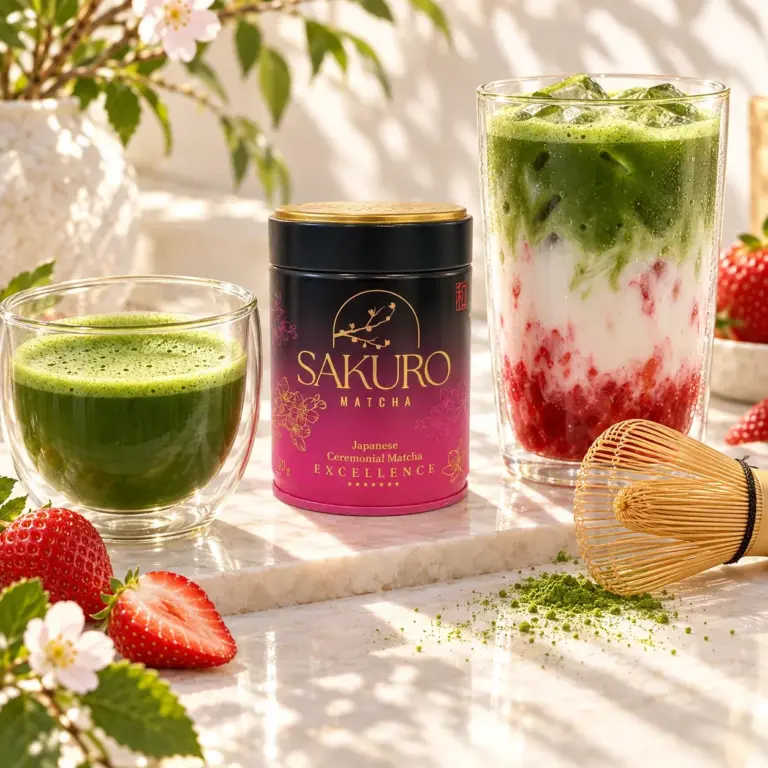
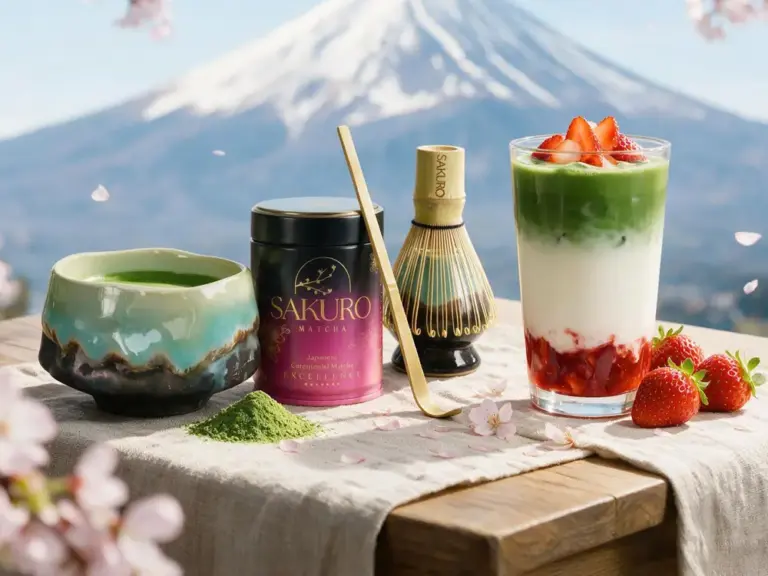
The best fruit pairing by a distance, and the reason is temperature. In a cold drink, strawberry acidity sharpens the tea and the perfume covers the thin, watery stretch that iced matcha sometimes has. Use 40 g of purée per serving: fresh berries mashed with 5 g of sugar, left for ten minutes, work better than a smooth shop purée because the little lumps keep the drink interesting.
Build it in layers, purée at the bottom, cold milk over ice, matcha poured last. The full method is in our iced strawberry matcha latte.
5. Coconut
Coconut is the pairing to reach for when you want fat without dairy. Thirty grams of tinned coconut cream, the thick layer from the top, whisked into 200 ml of oat or rice drink gives an iced matcha that holds together for twenty minutes instead of separating into green water and milk.
Avoid the chilled coconut drinks in cartons. They are mostly water, they add no body, and the flavour reads as sunscreen rather than coconut. Desiccated coconut toasted in a dry pan and scattered over a matcha dessert is a different, very good use of the same ingredient.
6. Citrus
Zest, not juice. One gram of finely grated lemon, yuzu or bergamot zest, rubbed into the sugar first so the oils come out, gives a lift that nothing else on this list provides. Yuzu is the classic partner in Japan and the most interesting if you can get it; bergamot is the easiest to find in Europe, usually as candied peel.
Juice is a different matter. Ten grams of lemon juice in a water-based iced matcha is refreshing. The same ten grams in a milk drink curdles it, every time, because the acid drops the pH below the point where milk proteins stay apart. If you want both milk and citrus, put the zest in the drink and keep the juice out.
7. Honey, and 8. pistachio
Honey at 8 g per cup is the most forgiving sweetener here. It dissolves at 60–70 °C, which is exactly the temperature a matcha latte should be served at, and a mild acacia or orange blossom honey leaves a floral note that suits the tea. Strong honeys, buckwheat or chestnut, are a different drink entirely and not a better one.
Pistachio paste, 10 g of the unsweetened kind sold for pastry work, is the pairing people photograph. Green on green, buttery, slightly salty. It also costs more per cup than the matcha does, which is why it sits at number eight rather than number three. Use it on a weekend, not on a Tuesday.
9. Salt, and 10. ginger
A pinch of salt, about 0.3 g, is the cheapest upgrade in this article. Salt suppresses bitter perception, so the sweetness and the umami both read louder without adding sugar. Weigh it the first few times. Double the dose and the drink tastes savoury in a way nobody wants.
Two grams of finely grated fresh ginger, squeezed into the cup through a tea strainer, gives heat that survives ice and milk. Ground dried ginger does not work; it stays grainy and tastes dusty against a tea this clean.
How much to add per 2 g serving
The quantities matter more than the choice. A pairing that works at 15 g turns into a dessert at 40 g, and most home drinks fail on dose rather than on idea. These are the amounts we actually use, all for one 2 g serving in a 250 ml glass or cup.
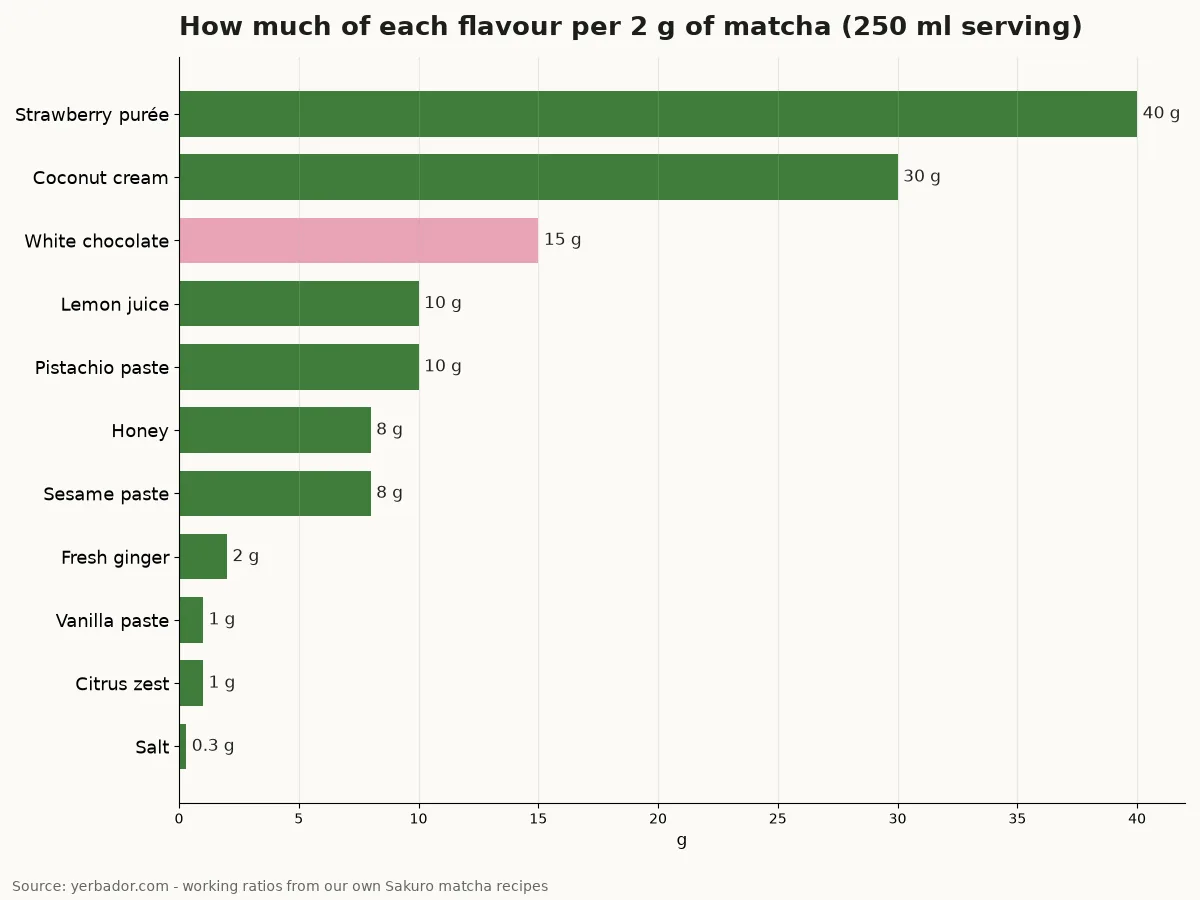
Two things to read out of that chart. First, the span is enormous, from 40 g of fruit purée down to 0.3 g of salt, so a teaspoon is not a unit of measurement here. Second, the pairings at the top replace part of the liquid, while the ones at the bottom only season it. Strawberry purée and coconut cream go into the 250 ml budget; salt, zest and vanilla sit on top of it.
Scaling up for a café is simple arithmetic as long as you keep the matcha fixed at 2 g a cup. Ten white chocolate lattes need 150 g of chocolate and 20 g of tea. One kilo of matcha covers 500 of those drinks.
Pairings that go wrong, and why
Dark chocolate and cocoa. Both are bitter, both are astringent, and they compete for the same place on the palate. The result is muddy and brown. If you want chocolate with matcha, white is the answer, or a layer of each kept physically separate in a dessert.
Banana. It flattens everything around it and, in a blended drink, turns the colour grey-green within a minute. Mango does the same at a slower pace.
Mint. Fresh mint and matcha produce a toothpaste effect that is hard to unlearn. We have tried it in mocktails more than once and always gone back to ginger or citrus zest.
Boiling water. Not a pairing, but the most common cause of a drink that no amount of syrup saves. Water at 95 °C or above pulls the harshest compounds out of the leaf. Eighty degrees, or 70 °C for a first-harvest matcha, is the window.
Acid in hot milk. Lemon juice, passion fruit, raspberry purée: all of them curdle a hot latte. In a cold drink the same acid behaves, which is why every fruit recipe here is iced.
Too much sugar in general. Above roughly 12 g per 250 ml the umami stops coming through, and at that point the matcha is only a colour. If you need more sugar than that, the powder is probably the problem, not the recipe. Our comparison of ceremonial and culinary grades explains what to look for on the tin.
Three drinks that use the top pairings
White chocolate matcha latte, hot, 250 ml, 5 minutes
Ingredients: 2 g Sakuro Finest, 60 ml water at 80 °C, 15 g white chocolate (chopped), 180 ml whole milk or barista oat drink, 0.3 g salt.
- Sift the matcha into a bowl or a wide cup. Thirty seconds, and it removes every lump before they become a problem.
- Add the water and whisk hard with a chasen for 15–20 seconds, in a W shape, until the surface is covered in fine foam.
- Heat the milk to about 65 °C and melt the chopped chocolate into it, stirring until there is no grain on the bottom.
- Pour the milk into the matcha from a height of 10 cm, add the salt, taste. Add nothing else.
Iced strawberry matcha, 350 ml, 6 minutes
Ingredients: 40 g strawberries, 5 g sugar, 2 g Sakuro Finest, 50 ml water at 80 °C, 150 ml cold milk or oat drink, 120 g ice.
- Mash the strawberries with the sugar and leave them for 10 minutes. Do not blend; the texture is part of it.
- Whisk the matcha with the hot water for 15 seconds, then let it cool for a minute so it does not melt the ice on contact.
- Spoon the purée into the glass, fill with ice, pour the milk over it.
- Pour the matcha last, slowly, down the inside wall of the glass. Stir before drinking.
Sesame matcha, hot or iced, 250 ml, 4 minutes
Ingredients: 2 g Sakuro Finest, 60 ml water at 80 °C, 8 g pale tahini, 170 ml milk, 6 g maple syrup, 0.3 g salt.
- Whisk the matcha with the water until smooth.
- Stir the tahini and the syrup into 40 ml of the milk in a separate cup until the paste is loose and pourable. This step is the one people skip, and then the sesame sits at the bottom in lumps.
- Combine everything, add the salt, and either warm it to 65 °C or pour it over ice.
Which tin for which pairing
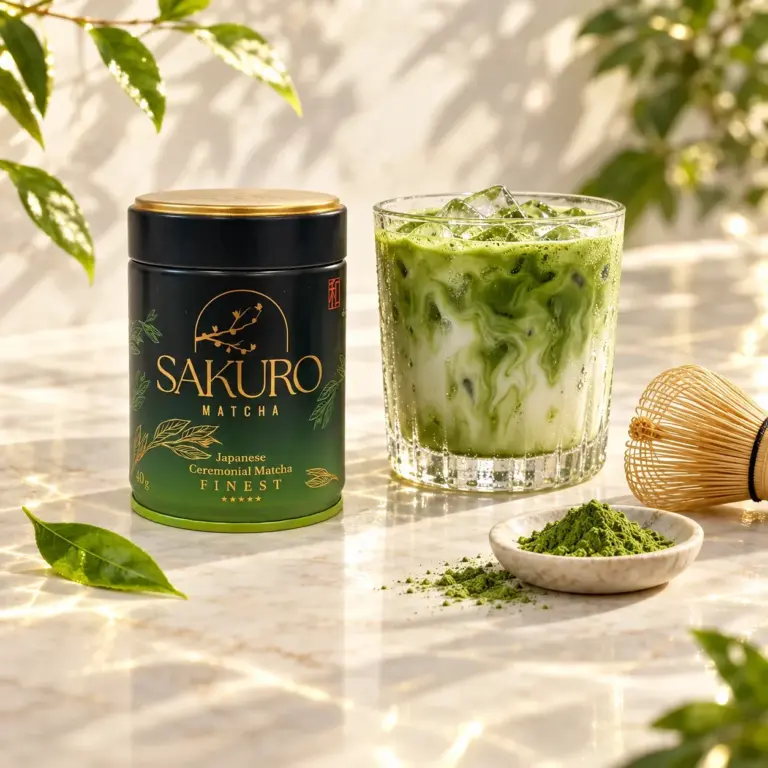
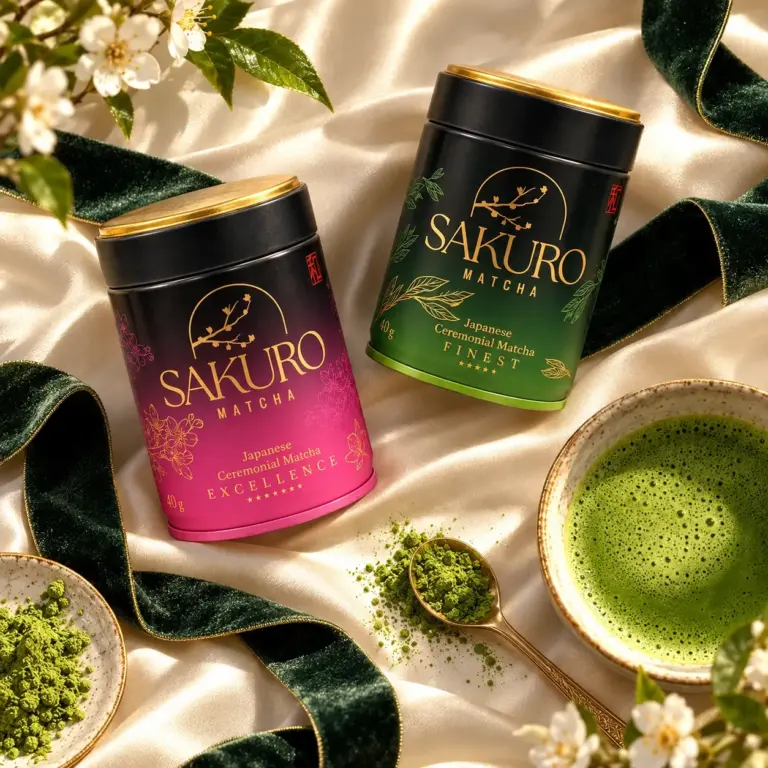
Both of our tins are ceremonial Japanese matcha from Shizuoka, so this is not a quality ladder, it is a question of what each one does under milk and sugar.
| Use | Grade we would reach for | Price | Per 2 g serving |
|---|---|---|---|
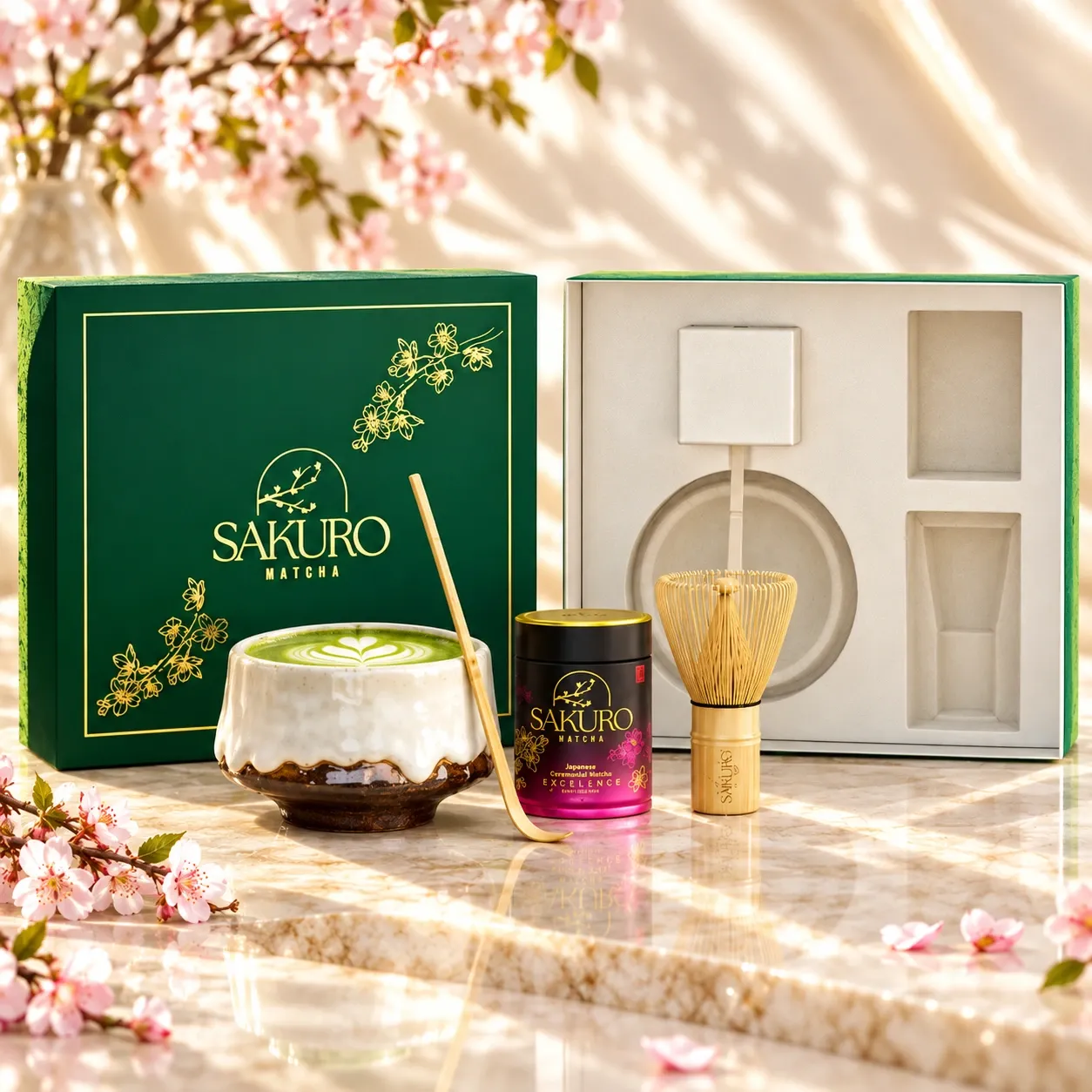
| Plain, in a bowl, with nothing added | Sakuro Matcha Excellence 40 g (first harvest, floral, velvety) | 26,90 € | approx. 1,35 € |
| Vanilla, zest, salt: light seasoning only | Excellence | 26,90 € | approx. 1,35 € |
| White chocolate, sesame, fruit, any milk drink | Sakuro Matcha Finest 40 g (deep umami, light tannic edge that cuts through milk) | 23,90 € | approx. 1,20 € |
| Baking, ice cream, anything with 100 g of sugar in it | Finest | 23,90 € | approx. 1,20 € |
If you want to run the comparison yourself, the Finest 40 g + Excellence 40 g set is 46,90 € and gives you 40 servings to play with. The tools matter less than people think, but a bamboo chasen at 14,90 € makes a better foam than any electric frother, and a chashaku scoop at 5,90 € holds roughly 1 g per level scoop, which is handy when the scales are in the dishwasher.
If you are buying by the kilo
For cafés, bakeries and offices we sell the same two matchas in 1 kg bags. As an indication, Finest works out at about 108,90 € per kg net and roughly 0,22 € per 2 g serving, Excellence at about 156,60 € per kg net and roughly 0,31 € per serving. Those figures are our Polish catalogue prices converted at the National Bank of Poland rate of 4,4070 PLN per euro from 13 November 2026, so treat them as orientation; the binding offer comes from Ewelina, who also sends samples. Volume discounts start at 3 kg (−5 %) and 5 kg (−10 %), and we ship from Poland within the EU.
Write to [email protected] or call +48 515 025 329.
Questions people ask
What fruit goes best with matcha?
Strawberry, then peach, then yuzu. All three in cold drinks only. Berries with a lot of acid, raspberry and passion fruit, curdle milk and are better in a sorbet next to a matcha cream than in the same glass.
Why does my matcha latte curdle when I add lemon?
Acid lowers the pH of the milk until the proteins clump together, and heat speeds that up. Use zest instead of juice in milk drinks, or keep the citrus for a water-based iced matcha.
Can I mix matcha and coffee?
Yes, a shot of espresso under a matcha latte is a real drink and a popular one. Remember that the caffeine adds up: EFSA puts the level of no concern at 400 mg a day for healthy adults and 200 mg a day in pregnancy, and both the tea and the coffee count towards it. We broke the numbers down in how much caffeine is in matcha.
What is the best sweetener for matcha?
Mild honey at 8 g, or maple syrup at 6 g, both stirred into the hot matcha paste before the milk. White sugar works but tastes flat. Keep the total under about 12 g per cup or the tea stops showing through.
Does matcha go with chocolate?
With white chocolate, better than with anything else on this list. With dark chocolate, badly, because the two bitternesses stack. Milk chocolate is a middle case: usable in a dessert, muddy in a drink.
Which matcha should I buy for baking with white chocolate?
Finest. It keeps its colour and its umami under sugar and butter, and at 23,90 € for 40 g you are not putting the expensive tin into a cookie dough.
Pick one pairing from the top of the table and make it tonight, with scales. If it works, you know your dose; if it does not, change one thing, not three. The basic matcha latte method is the base recipe for all of them.
Discover our TOP products!

Your dream figure

Discover new flavors
Yerba mate with tea
Accessories
Superfoods



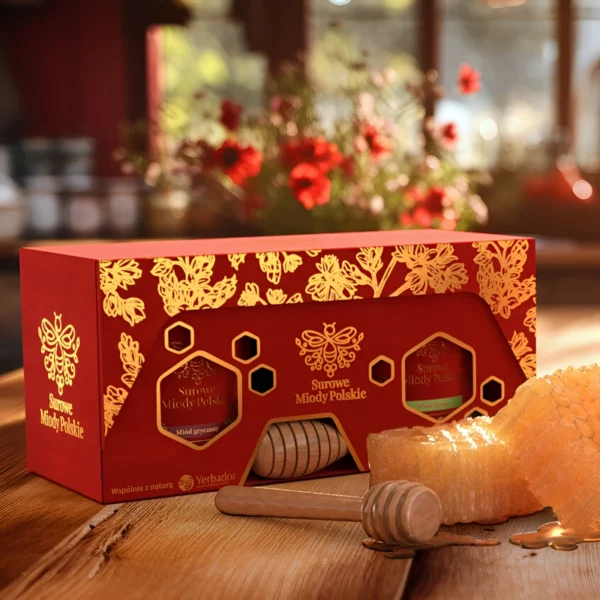
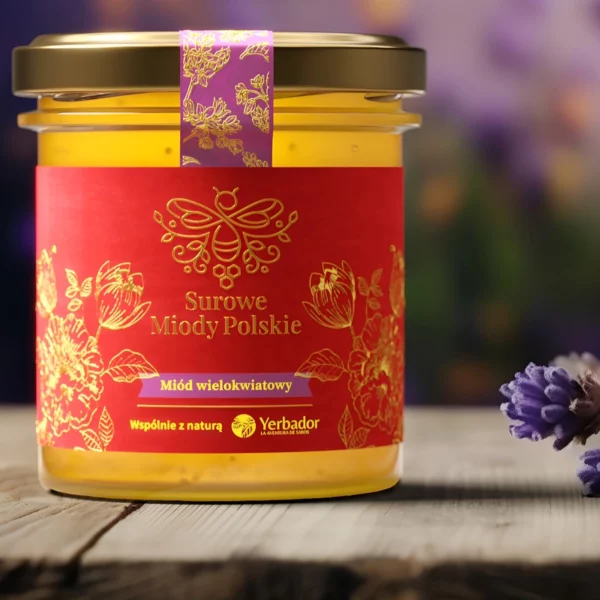
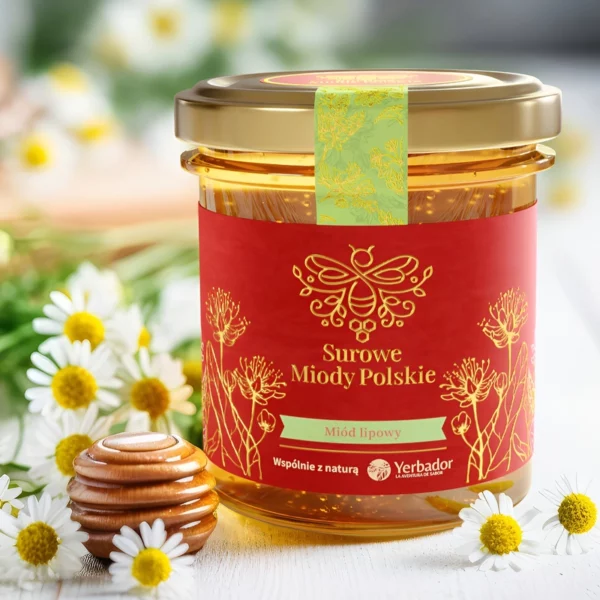
Certified raw honeys from Poland

Check the current price
free shipping
Up to 90 days
free returns
24 H
shipping