
How many nuts is a handful? Pieces, grams and calories, counted properly
2026-11-28
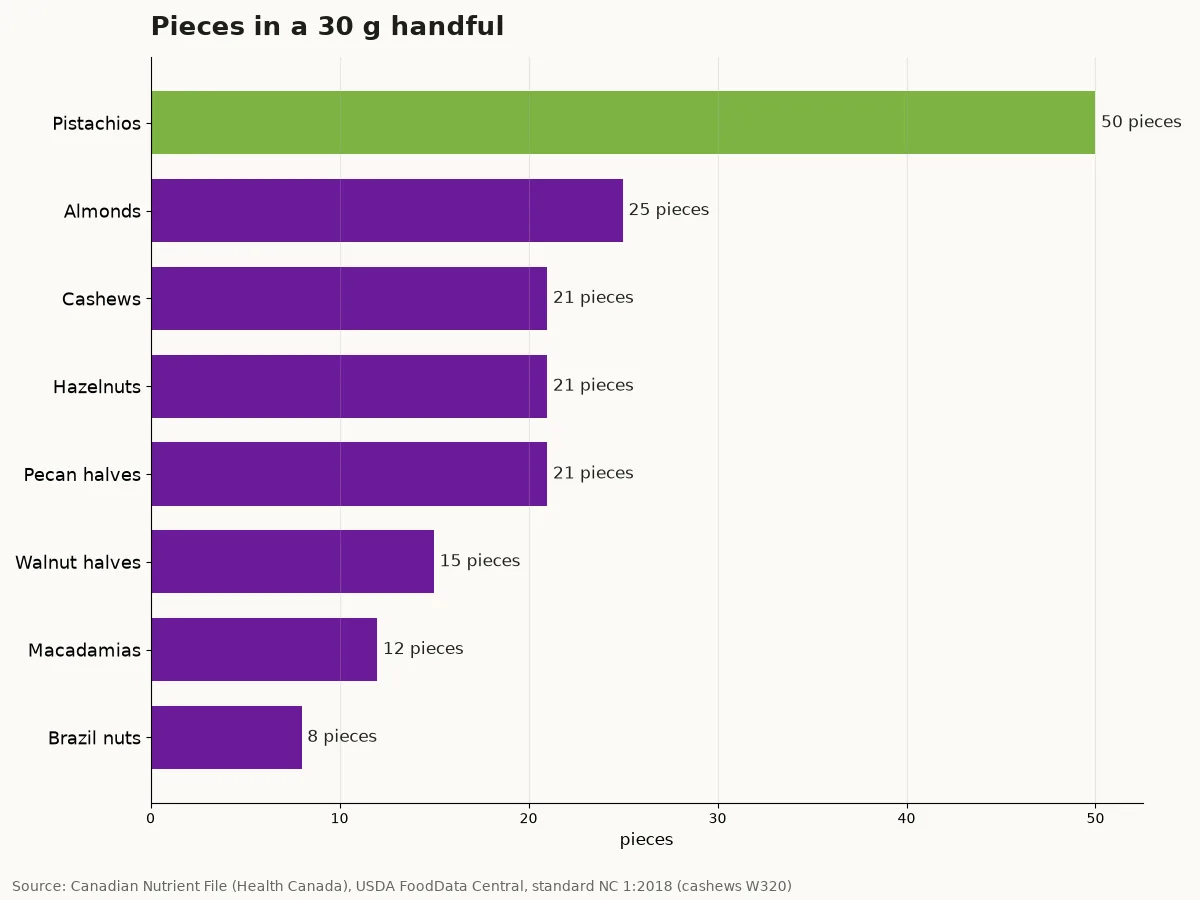
A handful of nuts is 30 g. Counted out, that is roughly 50 pistachio kernels, 25 almonds, 21 cashews, 21 pecan halves, 15 walnut halves, 12 macadamias or just 8 Brazil nuts, and whichever of those you pour into your palm, you land somewhere between 164 and 222 kcal.
Nobody weighs nuts. People grab them, count them out onto a plate, or eat straight from the bag until it feels like enough. Yet every piece of advice you read is written in grams, which is why the two never meet. This article does the conversion properly, piece by piece, using the only two databases that publish per-piece weights: the Canadian Nutrient File and USDA FoodData Central.
In short
- One portion of nuts = 30 g in the Dutch, Italian and Spanish guidelines; Germany and France say “a small handful” and give no number at all.
- One almond weighs 1.2 g, one pistachio kernel 0.60 g, one Brazil nut 3.54 g. That is a sixfold spread between pieces.
- 100 g of pistachio kernels is about 166 pieces, 100 g of almonds about 83, 100 g of Brazil nuts about 28.
- Every 30 g handful in this article lands between 164 and 222 kcal, no matter which nut you count.
- Brazil nuts are the exception you really do have to count: one nut carries about 68 micrograms of selenium, which is 124 % of the EU reference intake.
- A 250 g bag is about 8 handfuls. In pieces: 208 almonds, 177 cashews, 97 macadamias or 71 Brazil nuts.
How many nuts is a handful?
A handful of nuts is 30 g, and in pieces that is about 50 pistachio kernels, 25 almonds, 21 cashews, 15 walnut halves or 8 Brazil nuts. The 30 g figure is not folklore: the Dutch Voedingscentrum writes that “the advice for adults is to eat 30 grams of unsalted nuts a day”, the Italian CREA guidelines put a portion of shelled nuts at 30 g, and the Spanish AESAN scientific committee lists nuts with a flat “portion weight: 20-30 g. Example: 1 handful”.
What makes the number feel slippery is that your hand is not a measuring cup. A large hand holding macadamias and a small hand holding pistachios differ by a factor of three in pieces and by very little in grams, because the big nuts are heavy and the small ones are light. That is the quiet logic behind the handful: it self-corrects. Counting does not. If you decide you will eat “twenty nuts a day”, twenty Brazil nuts is 71 g and twenty pistachio kernels is 12 g.
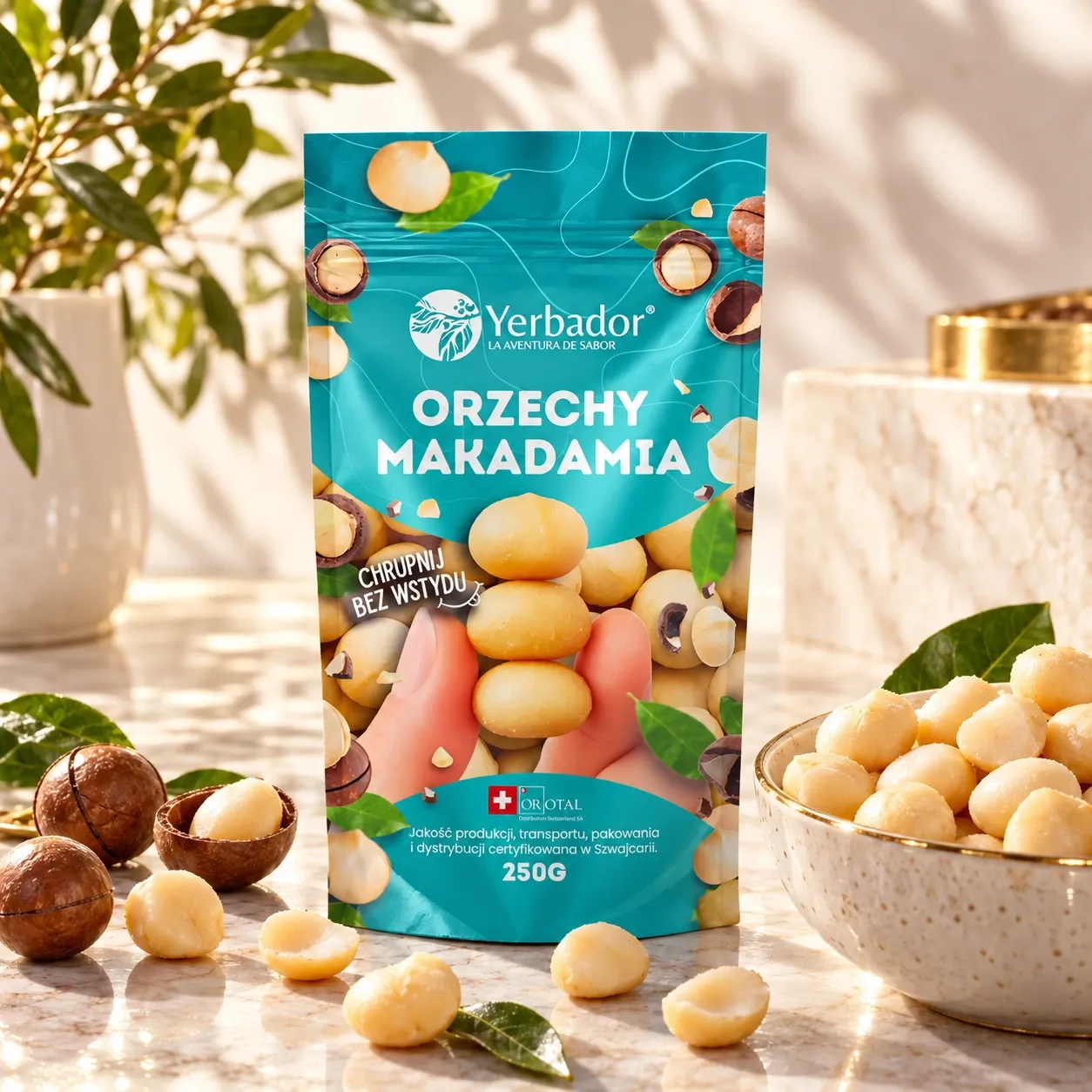
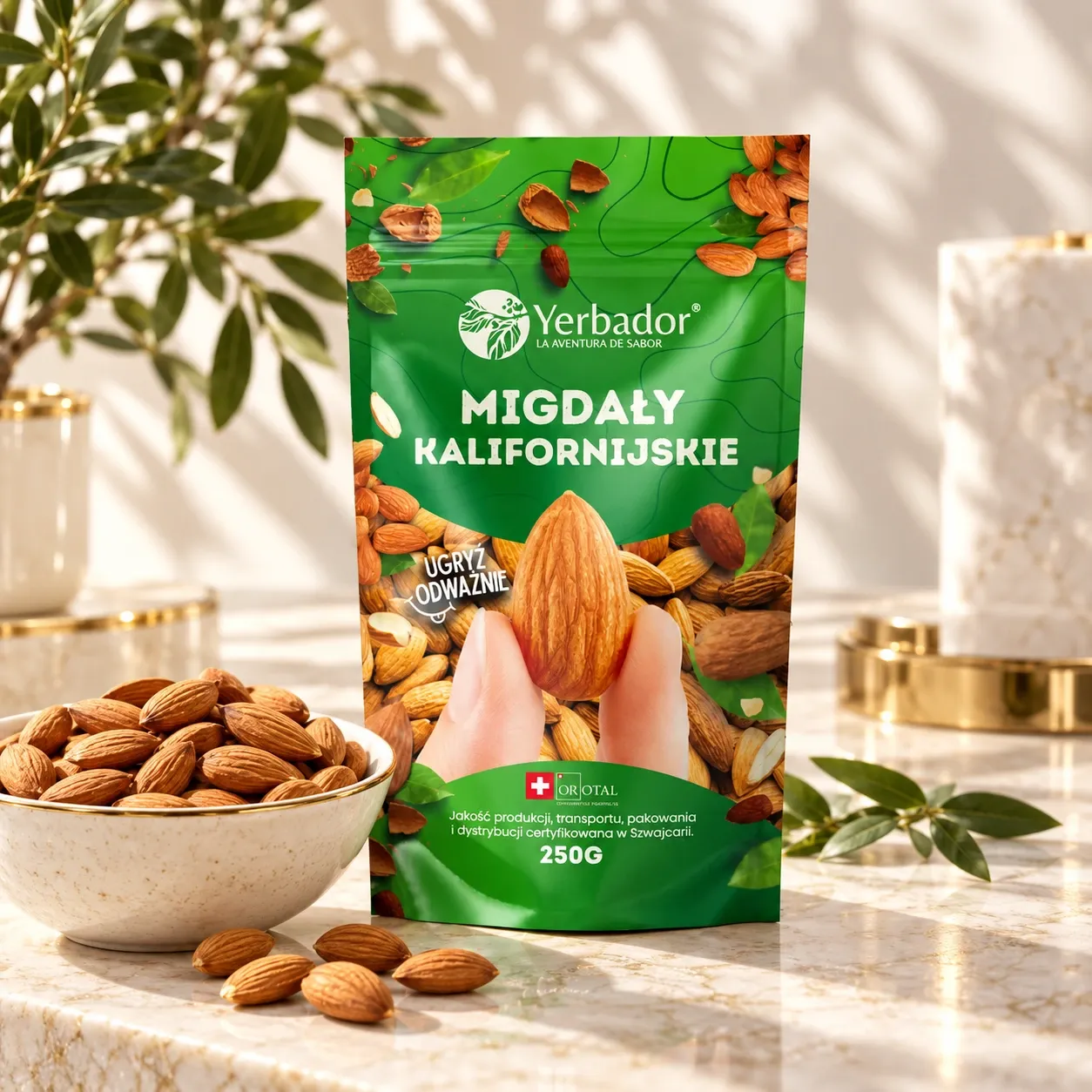
If you want to see what 30 g looks like without doing arithmetic, the easiest thing is to pour one portion once, look at it, and then trust your eye. Our Californian Almonds 250 g are the simplest nut to start with, because the per-piece weight is almost exactly round: 25 almonds, 30 g, done.
One piece, in grams and in calories
Here are the per-piece weights that the two public databases actually publish. The Canadian Nutrient File has a serving-size endpoint with conversions such as “50 kernels” and “5 medium”; USDA FoodData Central publishes ounce portions with piece counts in the modifier, such as “1 oz (14 halves)”. Everything else in the table follows from those two numbers and the energy per 100 g.
| Nut | One piece | Pieces in 30 g | kcal per piece | kcal in 30 g | Pieces in 100 g |
|---|---|---|---|---|---|
| Pistachio kernel | 0.60 g | 50 | 3.4 | 170 | 166 |
| Almond | 1.20 g | 25 | 6.9 | 174 | 83 |
| Cashew (grade W320) | 1.42 g | 21 | 7.8 | 164 | 66 to 71 |
| Hazelnut | 1.40 g | 21 | 8.8 | 185 | 71 |
| Pecan half | 1.42 g | 21 | 9.8 | 206 | 71 |
| Walnut half | 2.02 g | 15 | 13.2 | 199 | 50 |
| Macadamia | 2.58 g | 11 to 12 | 18.5 | 222 | 35 to 42 |
| Brazil nut | 3.54 g | 8 | 23.3 | 187 | 28 |
Read the last two columns together and the point of the whole exercise appears. The piece count swings from 8 to 50, a factor of six. The calories swing from 164 to 222, a factor of 1.35. A handful is a far better unit than a number of nuts, because the heavy nuts are also the fatty ones, and the two errors cancel.
Why “a handful” is not a unit anywhere in Europe
Five European food agencies publish advice on nuts and not one of them agrees with the others on how to express it. Two give grams, one gives grams and pieces, and two give neither. If you have ever felt that the advice is vague, you were reading it correctly.
| Country and agency | What it actually says | Grams | Pieces |
|---|---|---|---|
| Netherlands, Voedingscentrum | “The advice for adults is to eat 30 grams of unsalted nuts a day” | 30 g | no |
| Spain, AESAN (report AESAN-2022-007) | “Portion weight: 20-30 g. Example: 1 handful”, 3 or more portions a week, up to one a day | 20 to 30 g | no |
| Italy, CREA dietary guidelines | 30 g = “7-8 walnuts, 15-20 almonds or hazelnuts, 3 level tablespoons of peanuts, pine nuts or sunflower seeds” | 30 g | yes |
| Germany, DGE | “Eat pulses at least once a week and a small handful of nuts daily” | no | no |
| France, PNNS via Manger Bouger | “Eat a small handful a day of unsalted nuts (and unsweetened, without chocolate)” | no | no |
The Italian guideline is the most generous, and it is also the one that quietly contradicts itself. The portion table in the back gives 30 g as 15 to 20 almonds. The running text, a few hundred pages earlier, gives the same 30 g as 10 to 15 almonds. Our own arithmetic from the Canadian database says 25. All three are defensible, because a Californian almond and a Mediterranean almond are not the same object, and nobody is wrong by more than the size of the nut.
That is the honest version of the answer, and it is more useful than a false precision: count if you want a habit, weigh once if you want a number. Thirty grams on a kitchen scale takes ten seconds and then you never have to do it again.
The nut trade counts pieces too, and it is strict about it
Here is the fact most people do not expect: in the cashew business, the grade name is the piece count. A bag marked W320 means white whole kernels of which there are about 320 to the pound. The East African standard NC 1:2018, notified to the WTO, writes the same thing in metric and makes it binding.
| Grade | Kernels per kg | Kernels per 100 g | One kernel |
|---|---|---|---|
| W180 | 265 to 395 | 27 to 40 | 2.5 to 3.8 g |
| W240 | 485 to 530 | 49 to 53 | 1.9 to 2.1 g |
| W320 | 660 to 706 | 66 to 71 | 1.4 to 1.5 g |
| W450 | 880 to 990 | 88 to 99 | 1.0 to 1.1 g |
| W500 | 990 to 1100 | 99 to 110 | 0.9 to 1.0 g |
The same standard allows no more than 5 % of broken kernels and kernels from the next grade down, and caps moisture at 5 %. So when someone says a handful of cashews is 21 nuts, that is true for W320, which is the common retail grade. Buy W180 and the same 30 g is 9 to 12 nuts, each of them noticeably bigger on the tongue. Nothing nutritional changed. Only the counting did.
This is also why the per-piece numbers in the big table should be read as centres of a range, not as constants. A nut is an agricultural object. It varies by cultivar, by season and by how long the tree had water.
What is actually inside a 250 g bag
A 250 g bag is about eight portions. Put the piece weights against our shop prices and the bag stops being an abstraction, because you can see what one nut costs you.
| Product | Price | Pieces in the bag | Portions of 30 g | Cost of one piece |
|---|---|---|---|---|
| Californian Almonds 250 g | 10.90 € | about 208 | 8 | about 5 cents |
| Cashew Nuts 250 g | 13.90 € | about 177 | 8 | about 8 cents |
| Pecan Nuts 250 g | 16.90 € | about 176 halves | 8 | about 10 cents |
| Brazil Nuts 250 g | 20.90 € | about 71 | 8 | about 29 cents |
| Macadamia Nuts 250 g | 22.90 € | about 97 | 8 | about 24 cents |
One almond costs five cents, one Brazil nut costs twenty-nine. That ratio explains more about snacking behaviour than any nutrition table: people pick at macadamias one at a time and eat almonds by the handful, and the price per piece is why.
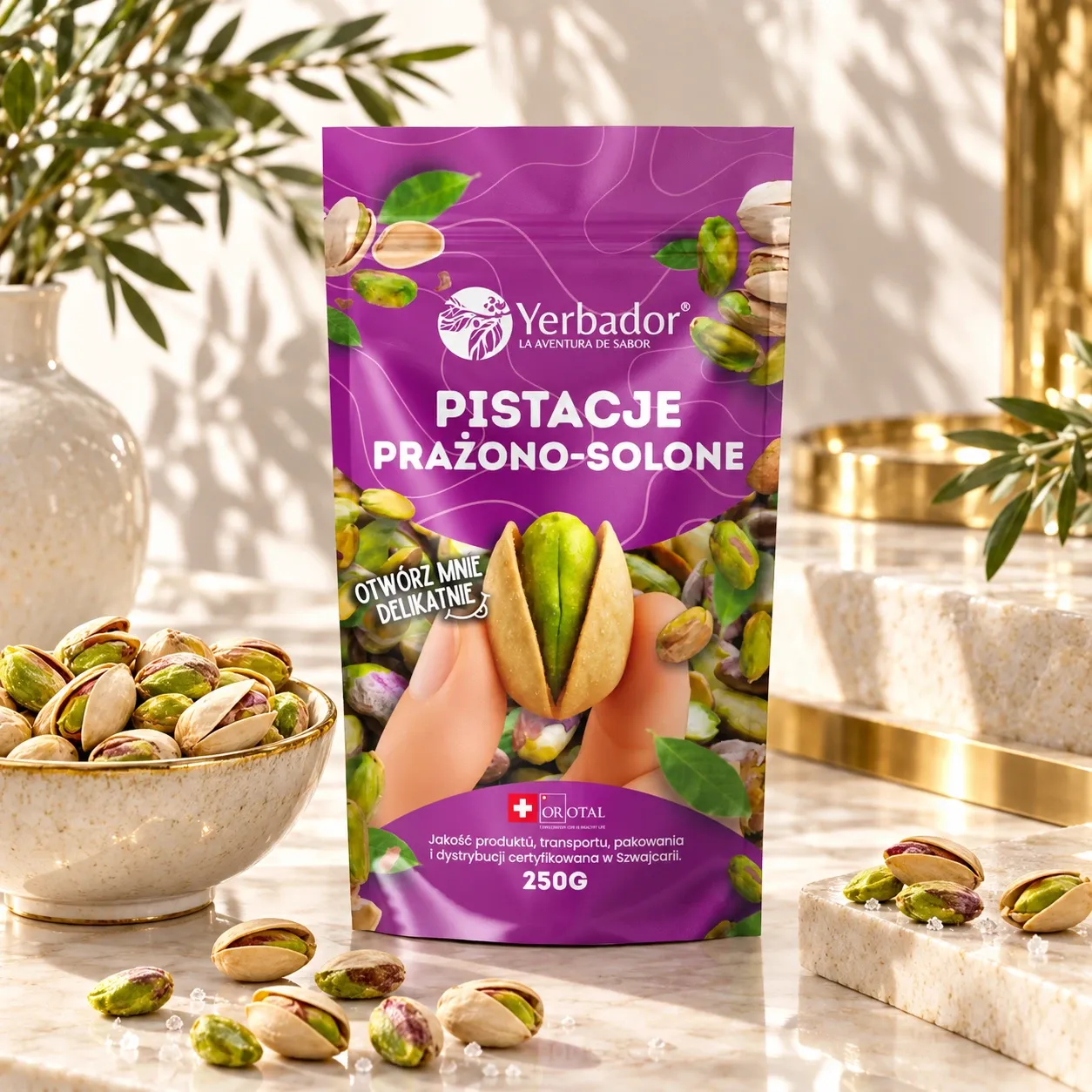
One line of small print on pistachios. Our Roasted and Salted Pistachios 250 g come in shell, which is half the fun and part of the weight. The 50-kernel portion is 50 kernels, not 50 shells, so you will work through more of the bag than the number suggests. The flip side is well known in cafés: a bowl of in-shell pistachios slows everyone down, because opening is part of eating.
Brazil nuts: the one nut you must count
With every other nut, counting is a convenience. With Brazil nuts it is the point. One average Brazil nut weighs 3.54 g, and Brazil nuts carry roughly 1,917 micrograms of selenium per 100 g in the Canadian Nutrient File, so a single nut delivers about 68 micrograms. The EU reference intake on a label is 55 micrograms, which means one nut is already 124 % of it.
EFSA’s 2023 opinion puts the safe level of selenium intake for adults at 255 micrograms a day. That is under four nuts. A full 30 g handful is eight, which is roughly 575 micrograms, and the Dutch Voedingscentrum says it in plain language on its nuts page: with a handful of Brazil nuts you take in more than the acceptable upper limit.
None of this makes Brazil nuts a problem food. It makes them a counted food. Two a day is a sensible habit; two handfuls a day for a month is not. If you buy them, buy them to eat two at a time, and keep the mixed bowl for everything else.
What people worry about
Will a daily handful make me gain weight?
A handful is 164 to 222 kcal, so it is a snack with real energy in it, not a free one. The Spanish committee says the same thing in careful language: raising nut intake towards a daily portion “should be balanced by a reduction in other foods in order to maintain a healthy body weight”. If the handful replaces a biscuit, nothing bad happens. If it is added on top of everything else, it is 60,000 to 80,000 kcal across a year.
Is the salt on roasted nuts a problem?
Check the number rather than the word. Our roasted and salted pistachios declare 1 g of salt per 100 g, so a 30 g portion is 0.3 g of salt. Against the usual adult target of under 5 to 6 g a day, that is small. It stops being small if the bowl on the table is the whole bag, which with salted nuts it often is. Every agency quoted above says the same thing: choose unsalted when nuts are a daily habit.
Are nuts too expensive for an everyday snack?
Per bag they look expensive, per portion less so. A 250 g bag of almonds at 10.90 € is eight portions, so roughly 1.30 € a day, which is less than a takeaway coffee. Macadamias at 22.90 € are about 2.75 € a portion, and they are the one in the range that genuinely is a treat. Mixing the cheap base with a few expensive pieces is how most people end up buying.
Can small children eat whole nuts?
No, and this is the one piece of advice in the article that is not about counting. The French PNNS page is explicit: before a child’s sixth birthday, do not give whole nuts because of the risk of choking, and instead blend them into preparations as a powder. Ground almonds in porridge or a nut butter on bread give the same food without the hazard.
Which of these count as allergens on a label?
Annex II of Regulation (EU) No 1169/2011 lists tree nuts as a closed set of eight: almond, hazelnut, walnut, cashew, pecan, Brazil nut, pistachio and macadamia. Every nut in this article is on that list, so it must be declared in the ingredients. Peanuts sit in a separate entry because they are a legume, and sesame has its own. Sunflower and pumpkin seeds are not on the list at all, which is exactly why sunflower butter turns up in schools and nurseries.
How to measure 30 g without scales
If you do not want to count and do not own a scale, use volume. The Canadian database publishes millilitre conversions for every nut, and once you know them, an espresso cup becomes a measuring tool. A standard espresso cup holds about 50 ml.
| Nut | 100 ml weighs | 50 ml espresso cup | One level tablespoon (15 ml) |
|---|---|---|---|
| Whole almonds | 60.0 g | 30 g | 9.0 g |
| Brazil nuts | 59.2 g | 30 g | 8.9 g |
| Hazelnuts | 57.1 g | 29 g | 8.6 g |
| Macadamias | 56.6 g | 28 g | 8.5 g |
| Cashews | 54.9 g | 27 g | 8.2 g |
| Pistachio kernels | 52.0 g | 26 g | 7.8 g |
| Walnut halves | 42.3 g | 21 g | 6.3 g |
| Pecan halves | 41.8 g | 21 g | 6.3 g |
The dense nuts sit close to 30 g in an espresso cup. The big hollow halves, pecans and walnuts, come out a third short because so much of the cup is air between the pieces. If your snack is pecans, fill the cup and add five more halves. That is the whole trick.
Which bag to pick
Four situations, four answers. All prices are our shop prices on the day of writing; the product page always shows the current one.
| If you want | Pick | Why |
|---|---|---|
| A simple daily portion you never have to think about | Californian Almonds 250 g, 10.90 € | 25 pieces is 30 g, almost exactly. Eight portions a bag. |
| Something soft to eat at a desk, no shells, no crumbs | Cashew Nuts 250 g, 13.90 € | Mild, sweetish, and at grade W320 a portion is a tidy 21 pieces. |
| A nut that slows down the snacking | Roasted and Salted Pistachios 250 g, 13.90 € | In shell, so each piece costs you a few seconds. 0.3 g salt per portion. |
| Baking, or a few expensive pieces on top of a bowl | Pecan Nuts 250 g, 16.90 € | Halves hold their shape, 21 of them is a portion, and they toast well. |
If you buy for a café, an office or a shop and need nuts by the kilogram rather than by the bag, write to Ewelina at [email protected] or call +48 515 025 329, and she will send a quote. Shipping goes out from Poland, inside the EU.
Start with one portion today: pour 25 almonds, look at the pile, and stop guessing. If you also keep dried fruit in the cupboard, the piece-versus-gram problem repeats there in a different form, and we went through it in our guide to dried mango, pineapple and coconut.
Frequently asked questions
How many pistachios are in 100 g?
About 166 kernels. The Canadian Nutrient File gives 50 kernels as 30.2 g, which puts one kernel at 0.60 g. If the pistachios are in shell, 100 g of bag is far fewer kernels, because you are weighing the shells too.
How many almonds should I eat a day?
Twenty-five almonds is the 30 g portion that the Dutch, Italian and Spanish guidelines describe. The Italian guidelines give the same portion as 15 to 20 almonds, which is the same weight in larger nuts. Both answers are fine; the weight is the thing that matters.
How many Brazil nuts a day is sensible?
Two. One nut is about 68 micrograms of selenium, which is already 124 % of the EU reference intake, and EFSA sets a safe level of 255 micrograms a day for adults. A whole handful of eight goes well past that, which is why the Dutch agency warns about this nut specifically.
How many walnuts make 30 g?
About 15 halves, which is 7 to 8 whole shelled walnuts. That matches the Italian guideline almost exactly, which lists a portion as 7 to 8 walnuts.
Do roasted nuts weigh the same as raw ones?
Not quite. Roasting drives off water, so the same piece is slightly lighter and 100 g of roasted nuts is slightly more nut. You can see it in the numbers on our own pistachio pouch: 586 kcal per 100 g for roasted and salted kernels against 562 kcal per 100 g for raw kernels in the Canadian database.
Are peanuts nuts?
Botanically no, legally no. Regulation (EU) No 1169/2011 lists peanuts in their own allergen entry, separate from the eight tree nuts. For counting purposes they behave like small nuts: the Italian guidelines put a portion at three level tablespoons.
Does drinking tea with nuts change anything?
Tea polyphenols reduce the absorption of non-haem iron from a meal, and the effect has been measured for black and green tea in isotope studies. If you eat nuts and seeds partly for the iron, leave an hour between the snack and the pot. If you eat them for the fat and the crunch, it changes nothing.
How should an opened bag be stored?
Cool, dark and closed. Nuts are mostly fat, and fat goes stale with warmth, light and air. The Dutch Voedingscentrum suggests around 10 to 15 degrees and gives a shelf life of half a year to a year for nuts kept that way. A clip on the bag beats a bowl on a sunny windowsill.
Sources
Per-piece weights and energy values: Canadian Nutrient File (Health Canada) and USDA FoodData Central. Cashew grading: NC 1:2018, Cashew kernels, Specification. Portion advice: Voedingscentrum, DGE, CREA, AESAN and Manger Bouger. Reference intakes and allergens: Annex XIII and Annex II of Regulation (EU) No 1169/2011.
Discover our TOP products!

Your dream figure


Discover new flavors


Yerba mate with tea




Accessories





Superfoods





Certified raw honeys from Poland



Check the current price
free shipping
Up to 90 days
free returns
24 H
shipping