
How to make matcha the traditional way
2026-11-19
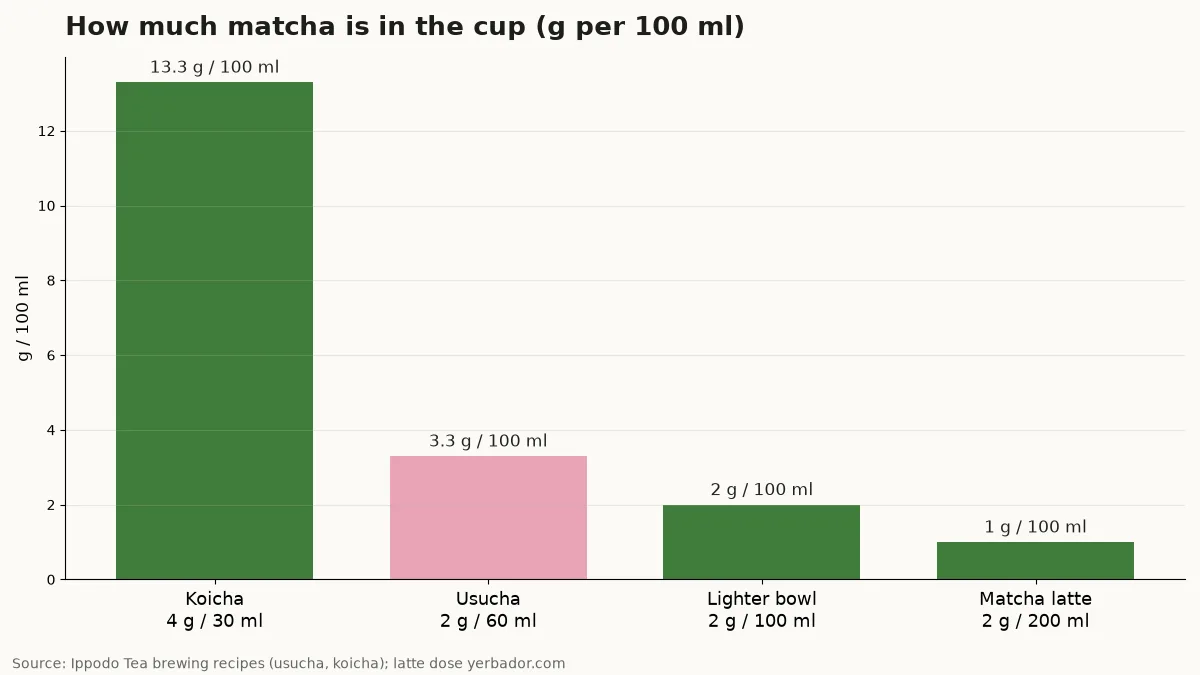
Making matcha the traditional way means two grams of sifted powder, 60 ml of water at 80 °C and about fifteen seconds of fast whisking with a bamboo chasen. That bowl is called usucha. Double the powder, halve the water, stir slowly instead of whisking, and you get koicha, the thick version served at the centre of a formal tea gathering.
Both come from the same tin. The difference is the ratio, the temperature discipline and what your wrist does for those fifteen seconds. Below you get the numbers, the two recipes step by step, the mistakes that ruin a bowl, and an honest answer to the question of what you actually need to buy.
- Usucha (the everyday bowl): 2 g sifted matcha, 60 ml water at 80 °C, whisk fast for 15 seconds. Light foam, espresso-like concentration.
- Koicha (thick matcha): 4 g sifted matcha, 30 ml water at 80 °C, fold slowly for 15 seconds. No foam, a glossy paste somewhere between maple syrup and warm honey.
- Water: 80 °C, never straight from a boiling kettle. Boiling water scalds the powder and pushes out bitterness.
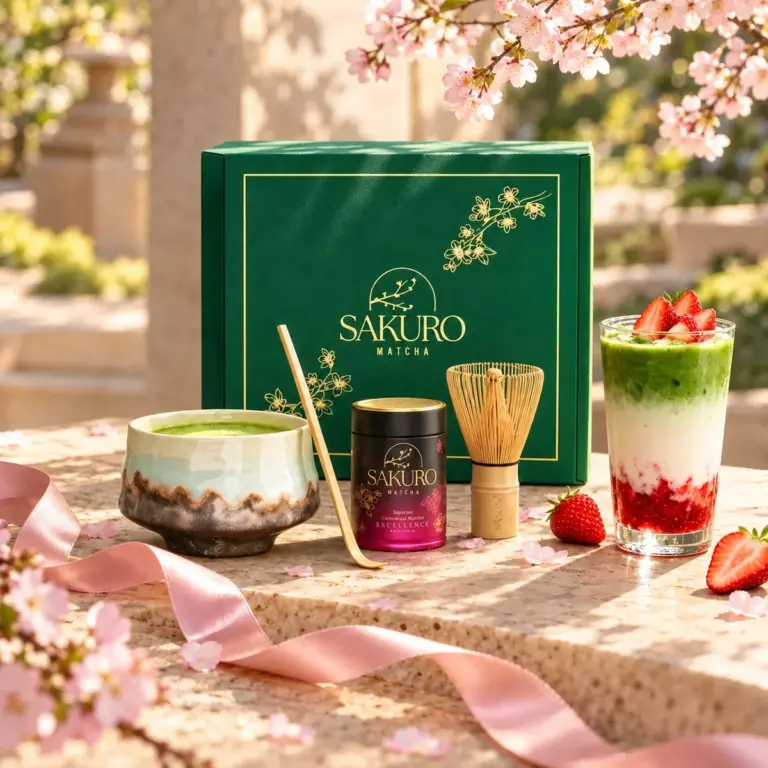
- Three tools: a wide bowl (chawan), a bamboo whisk (chasen), a bamboo scoop (chashaku). A fine strainer is the useful fourth.
- A 40 g tin gives you 20 bowls of usucha or 10 bowls of koicha.
- Caffeine: 2 g of matcha carries roughly 38 to 89 mg (Kochman et al., Molecules 2021). EFSA puts the adult daily reference at 400 mg, and 200 mg a day in pregnancy.
What the three traditional tools actually do
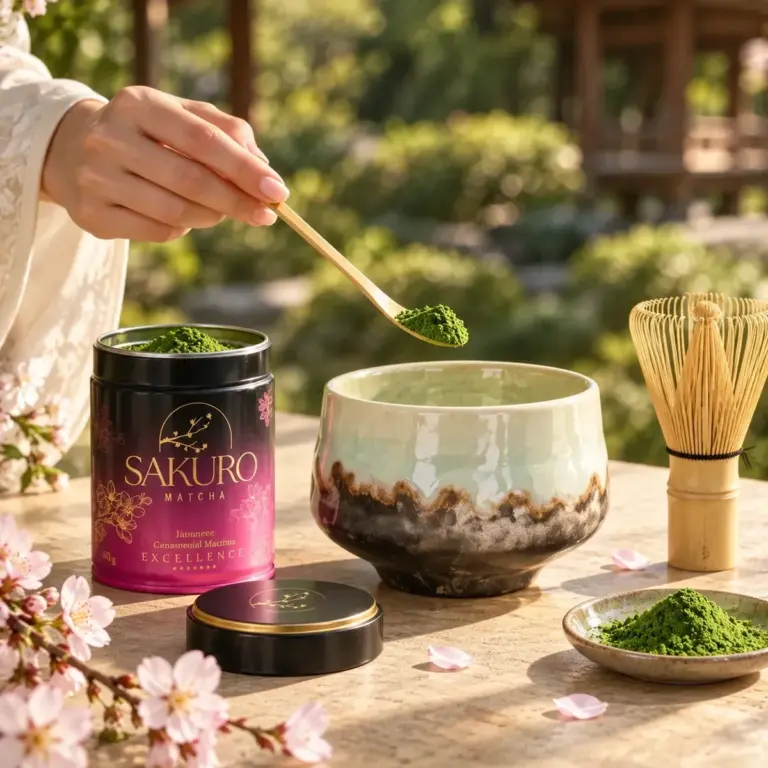
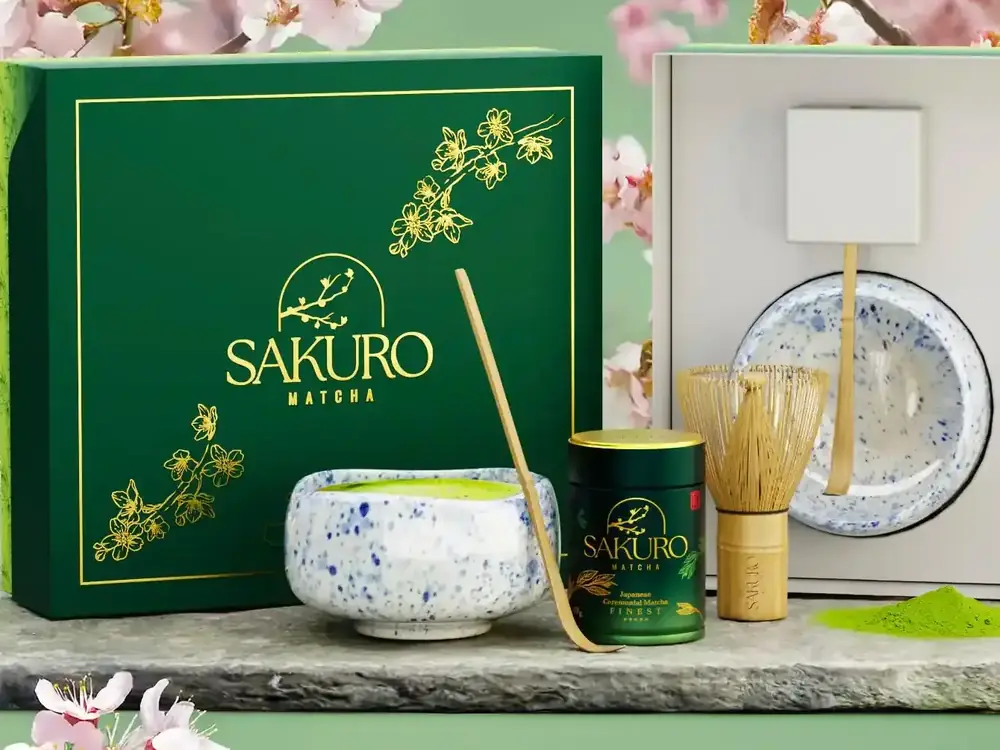
The traditional kit is three objects: a chawan (a wide, deep bowl), a chasen (a bamboo whisk cut from a single piece) and a chashaku (a thin bamboo scoop). Each exists because of a physical problem. The bowl is wide so the whisk can move; the whisk has dozens of thin tines because matcha is a suspension, not an infusion; the scoop is flat so the powder slides off instead of packing.
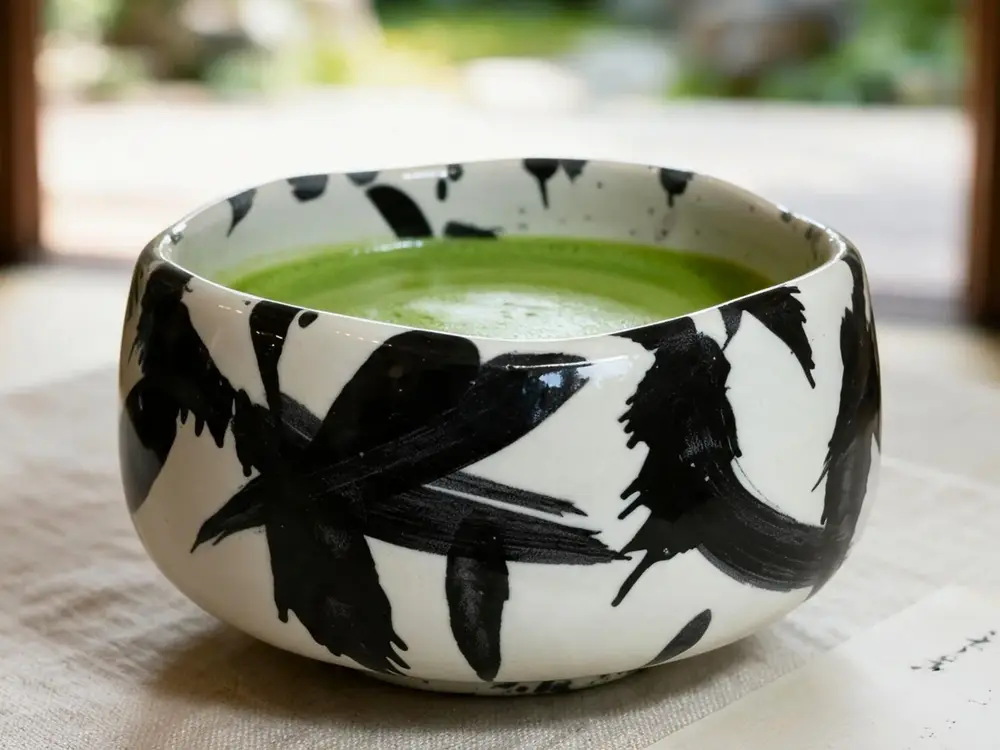
The chawan is the one people underestimate. A mug is too narrow at the bottom: the tines hit the walls, the powder hides in the corner and you end up stirring rather than whisking. A matcha bowl is roughly 11 to 13 cm across with a flat inner base and a curve that sends the liquid back towards the middle. Our Matcha bowl HISSEKI with its black brush strokes (23,90 €) has exactly that shape, and the dark glaze shows you the colour of the foam, which is genuinely useful feedback while you learn.
The chasen is the piece with the most craft in it. The ones used across Japan have been made in Takayama, in Ikoma in Nara Prefecture, since the middle of the Muromachi period (1336–1573), and the craft association that documents the trade (kogeijapan.com) lists more than sixty types. The number printed on the box is worth understanding: an 80-prong whisk starts as 16 thick splits that become 160 thin prongs, of which 80 form the outer ring you can see and 80 are folded inwards. The bamboo is seasoned for one to two years before anyone cuts it. Ours is a plain bamboo chasen (14,90 €), the standard shape for usucha.
The chashaku is a measuring tool with a built-in warning: it is not precise. Ippodo Tea in Kyoto counts 1.5 heaping scoops for a 2 g bowl and 3 heaping scoops for a 4 g koicha, which tells you a scoop lands somewhere between 1 and 1.5 g depending on how you heap it. If you care about repeating a good bowl, weigh the powder on a 0.1 g scale for a week and then calibrate your scoop by eye. A chashaku (5,90 €) is still better than a teaspoon, because the flat blade does not compress the powder.
The fourth item is not traditional in the ceremonial sense but it saves you every time: a fine strainer. Stone-milled matcha has a median grain of about 15 to 20 micrometres (Sawamura et al., 2010), far smaller than any kitchen sieve hole, so the strainer does not make the powder finer. It breaks the clumps that static and the pressure inside the tin have pressed together.
Usucha and koicha: the two bowls worth knowing
Usucha means thin tea and koicha means thick tea, and the distinction is the single most useful thing a new matcha drinker can learn. Usucha is the bowl you drink daily: liquid, lightly foamed, about as concentrated as espresso. Koicha is a small, intense, almost chewable paste made with twice the powder and half the water, drunk slowly and usually after something sweet.
| Preparation | Matcha | Water | Temperature | Whisking | What you get | Bowls per 40 g tin |
|---|---|---|---|---|---|---|
| Usucha (classic) | 2 g | 60 ml | 80 °C | 15 s, fast, M-shaped | Even foam, concentrated, drinks in three or four sips | 20 |
| Lighter bowl | 2 g | 100 ml | 80 °C | 15 s fast, then top up | Milder, less foam, closer to a mug of tea | 20 |
| Koicha (thick) | 4 g | 30 ml | 80 °C | 15 s, slow, back and forth | Glossy paste, no foam, sweet and heavy | 10 |
The figures for usucha and koicha are the published recipes of Ippodo Tea, a Kyoto tea house trading since 1717 (usucha, koicha). The lighter bowl is not traditional. It is what most people in Europe actually want on a Tuesday morning, and the honest way to make it is to whisk the strong version first and then add water, because a thin mixture never foams properly.
Why 80 °C and not boiling water
Matcha is whisked at about 80 °C because the whole leaf goes into the cup. There is no infusion step to control, no way to pull the leaves out when the extraction has gone far enough. Everything the powder contains ends up in your mouth, so the only lever you have is temperature, and boiling water pushes the bitter, drying compounds forward while flattening the sweetness that shaded tea is grown for.
| Water temperature | What happens in the bowl | Verdict |
|---|---|---|
| 70 °C | Very soft, sweet, little bitterness; foam is thin and the bowl cools fast | Good for a delicate ceremonial matcha, risky in a cold kitchen |
| 80 °C | Sweetness and savoury depth both present, foam builds in about 15 seconds | The reference point. Start here. |
| 90 °C | Sharper, more astringent, foam still forms but the finish dries the mouth | Acceptable for a culinary grade hiding under milk |
| 95–100 °C | Bitterness dominates, aroma turns flat and slightly cooked | Avoid. This is the single most common mistake. |
You do not need a temperature-controlled kettle, although it helps. Ippodo’s own instruction is charmingly low-tech: pour the boiling water into a teacup first, let it stand, then pour it into the bowl. A ceramic cup takes roughly 15 to 20 °C off freshly boiled water in under a minute. If you prefer arithmetic to patience, boil, then add about a tablespoon of cold water per 60 ml.
Usucha step by step
What you need
- 2 g ceremonial matcha (about 1.5 heaped chashaku, or 1 level teaspoon)
- 60 ml water at 80 °C
- Chawan, chasen, fine strainer
Method — about 2 minutes
- Warm the bowl and soften the whisk (30 s). Pour a little hot water into the bowl, stand the chasen in it for 20 seconds, then tip the water out and wipe the bowl dry. Warm ceramic keeps the drink hot; soaked bamboo tines are less likely to snap.
- Sift 2 g of matcha into the dry bowl (15 s). Straight through a tea strainer. This is the step people skip and then blame the whisk for.
- Add 60 ml of water at 80 °C (10 s). Pour down the side of the bowl rather than onto the powder, so it does not blast the matcha up the walls.
- Whisk fast for 15 seconds. Hold the chasen lightly, wrist doing the work, not the elbow. Move in an M or W shape across the surface, tines just below the surface rather than scraping the bottom.
- Finish with a slow circle (5 s). One gentle lap around the rim, then lift the whisk out through the centre. Large bubbles collapse into a fine, even foam.
- Drink it now. Usucha is at its best within a minute or two. After five minutes the foam goes and the powder begins to settle.
If you want a mug rather than a bowl, whisk exactly as above and then add 100 to 150 ml of hot water or steamed milk. That is also the correct starting point for a matcha latte: the paste first, the milk after.
Koicha step by step
Koicha asks more of the powder than any other preparation, which is why it is the real test of a matcha. Four grams with almost no water to hide in will expose any bitterness or staleness instantly. Use your best tin, never a culinary grade.
What you need
- 4 g ceremonial matcha (about 3 heaped chashaku, or 2 level teaspoons)
- 30 ml water at 80 °C
- Chawan, chasen, fine strainer
Method — about 2 minutes
- Warm the bowl, soften the whisk, dry the bowl (40 s). Same as usucha, only here a wet bowl matters more, because every millilitre counts.
- Sift 4 g of matcha (20 s). Non-negotiable. A clump in koicha stays a clump.
- Add just 30 ml of water at 80 °C (10 s). Enough to cover the powder and no more. Pour it in one go.
- Fold slowly for about 15 seconds. Press the tines gently against the bottom of the bowl and move back and forth, almost like stirring thick honey. No speed, no foam, no M shape.
- Check the texture. Properly made koicha runs off the whisk in a ribbon and sits between maple syrup and warm honey. If it is grainy, add 5 ml of water and fold again.
- Drink in three sips, slowly. Have plain water beside you, and something to eat beforehand; 4 g of matcha is roughly 76 to 178 mg of caffeine on an empty stomach.
The whisking motion, and what the foam is telling you
The classic instruction is to whisk in an M or W shape, fast, for about fifteen seconds. The reason is mechanical: a circular motion makes the liquid spin as one body and shears nothing, while a back-and-forth zigzag keeps breaking the surface and dragging air under. The tines should sit just below the surface. If you hear the whisk hitting the bottom of the bowl, you are too deep, you are blunting the bamboo, and you are whisking water rather than aerating it.
Foam is feedback, not decoration. An even layer of tiny bubbles means the powder is fresh and fully dispersed. Large, soapy bubbles that collapse within seconds usually mean the water was too hot or the bowl held a trace of fat from yesterday’s milk. No foam at all, from powder that used to foam, is a storage problem: in a Japanese study of matcha storage conditions, foaming held up fine at 5 °C, dropped after six months at 30 °C and after only two months at 45 °C (Ikeda, Sonoda and Sawamura, 2012). A tin left next to the hob ages years in weeks.
One more point that saves a lot of frustration: foam is not quality. Plenty of excellent matcha foams modestly, and a hard, high-grown powder with a coarse grind can foam beautifully and taste like hay. Judge the bowl by colour, smell and taste.
Six mistakes we see most often
- Boiling water. The most common one by a distance. Give the kettle three minutes, or pour through a cup.
- Too much water for the powder. Two grams in 200 ml will never foam. Whisk concentrated, dilute afterwards.
- Stirring in circles. A circular motion is right for koicha and wrong for usucha.
- Skipping the strainer. Twenty seconds of sifting removes the dusty lumps that would otherwise sit on your tongue.
- Using culinary grade for a plain bowl. Drunk neat with nothing to hide behind, a culinary matcha tastes harsh. Our guide to ceremonial and culinary grades explains which to buy for what.
- Leaving the chasen in the bowl. Wet bamboo in standing water goes mouldy and the tines lose their curve within weeks.
Looking after the chasen
A chasen lasts anywhere from three months to two years depending entirely on how it is treated, and the routine takes twenty seconds. Rinse it in warm water straight after use, never with soap, swirl the tines to flush out the powder, shake off the excess and stand it to dry on a ceramic whisk holder (a kusenaoshi) so the tines hold their shape and the air gets inside the cage. No dishwasher, no drawer while damp, no squeezing the tines together.

Broken tines are normal, by the way. One or two will go over the life of the whisk; fish them out of the bowl and carry on. Replace the chasen when the tines have lost their spring and no longer sweep back together, which you notice first as a bowl that suddenly takes thirty seconds to foam. The full routine is in our guide to cleaning and caring for a chasen.
Which matcha, and what a bowl costs
For usucha and especially for koicha you want a ceremonial grade: shaded leaf, stone-milled, bright green, with sweetness rather than bite. Sakuro Matcha Finest is a Japanese ceremonial matcha from Shizuoka in a 40 g tin, which is 20 bowls of usucha, and it is the one we whisk most often at the shop. Sakuro Matcha Excellence is the higher grade from the same region, sweeter and rounder, and it is the one to reach for when you make koicha, because there is nothing to hide behind in a 4 g bowl.
| Product | Price | Per bowl | When to choose it |
|---|---|---|---|
| Sakuro Matcha Finest, 40 g tin | 23,90 € | approx. 1,20 € (2 g) | Daily usucha, and anything with milk |
| Sakuro Matcha Excellence, 40 g tin | 26,90 € | approx. 1,35 € (2 g) | Koicha, and usucha when you want it sweeter |
| Finest 40 g + Excellence 40 g | 46,90 € | — | Tasting both side by side in the same bowl |
| Chasen, bamboo whisk | 14,90 € | — | The one tool with no real substitute |
| Matcha bowl HISSEKI | 23,90 € | — | Wide base, dark glaze, easy to whisk in |
| Chashaku, bamboo scoop | 5,90 € | — | Nice to have; a 0,1 g scale is more accurate |
A bowl of traditional matcha at home therefore costs between one and one and a half euro in powder, which is the part most people find surprising after paying five euro for a latte. Prices above are from yerbador.com on the day this was written; the product pages always show the current figure.
If you are reading this as a café or tea room rather than at your own kitchen table, the arithmetic changes: a 1 kg bag is 500 servings at 2 g, and at our net wholesale prices that works out at roughly 109 € per kilo for Finest, about 0,22 € a serving, and roughly 157 € per kilo for Excellence, about 0,31 € a serving. Those are indicative conversions from our net list in Polish zloty at the National Bank of Poland rate on the day of writing, not a quote. Bags are 1 kg, discounts start at 3 kg (−5 %) and 5 kg (−10 %), and we ship from Poland within the EU. The details are on our wholesale page for cafés and restaurants, and for a binding offer write to Ewelina at [email protected] or call +48 515 025 329.
Frequently asked questions
How much matcha do I use for one traditional bowl?
Two grams for usucha with 60 ml of water, four grams for koicha with 30 ml. In scoops that is roughly 1.5 heaped chashaku for usucha and 3 for koicha, but scoops vary, so weigh the powder the first few times.
What water temperature is right for matcha?
80 °C. Boiling water brings out bitterness and dulls the aroma, and below about 70 °C the powder disperses sluggishly and the bowl goes cold while you drink it. Pour boiled water into a cup for a minute if you have no temperature setting on your kettle.
What is the difference between usucha and koicha?
Usucha is thin matcha: 2 g whisked fast into 60 ml, lightly foamed, drunk every day. Koicha is thick matcha: 4 g folded slowly into 30 ml, no foam, the texture of warm honey. Koicha needs a higher grade because there is nothing to mask a harsh powder.
Can I make traditional matcha without a chasen?
You can get a drinkable bowl with a small electric frother or a jar shaken hard, and for a latte nobody will tell the difference. For usucha it is not the same: the chasen produces finer, more stable foam and a smoother body because it disperses the powder without whipping air into big bubbles.
How much caffeine is in a traditional bowl of matcha?
Matcha contains roughly 18.9 to 44.4 mg of caffeine per gram according to a review in Molecules (Kochman et al., 2021), so a 2 g usucha carries about 38 to 89 mg and a 4 g koicha about 76 to 178 mg. EFSA considers up to 400 mg a day unproblematic for healthy adults, and 200 mg a day during pregnancy. More detail is in our article on caffeine in matcha.
Why does my matcha taste bitter even at 80 °C?
Three usual causes: too little water for the powder, a culinary grade drunk neat, or an old tin. Matcha that has been open for months in a warm kitchen loses its sweetness first and its colour second. Buy 40 g at a time rather than 100 g, keep it closed, cool and away from the hob.
Do I have to sift the powder every time?
For usucha it is optional but it saves you whisking time. For koicha it is compulsory: with 30 ml of water, a clump never dissolves and you will find it with your tongue.
Start with usucha this week: 2 g, 60 ml, 80 °C, fifteen fast seconds. Once that bowl is reliably smooth, make koicha once with your best tin and you will understand what everything in the traditional kit is for.
Discover our TOP products!





Your dream figure




Discover new flavors





Yerba mate with tea




Accessories



Superfoods













Certified raw honeys from Poland

Check the current price
free shipping
Up to 90 days
free returns
24 H
shipping