
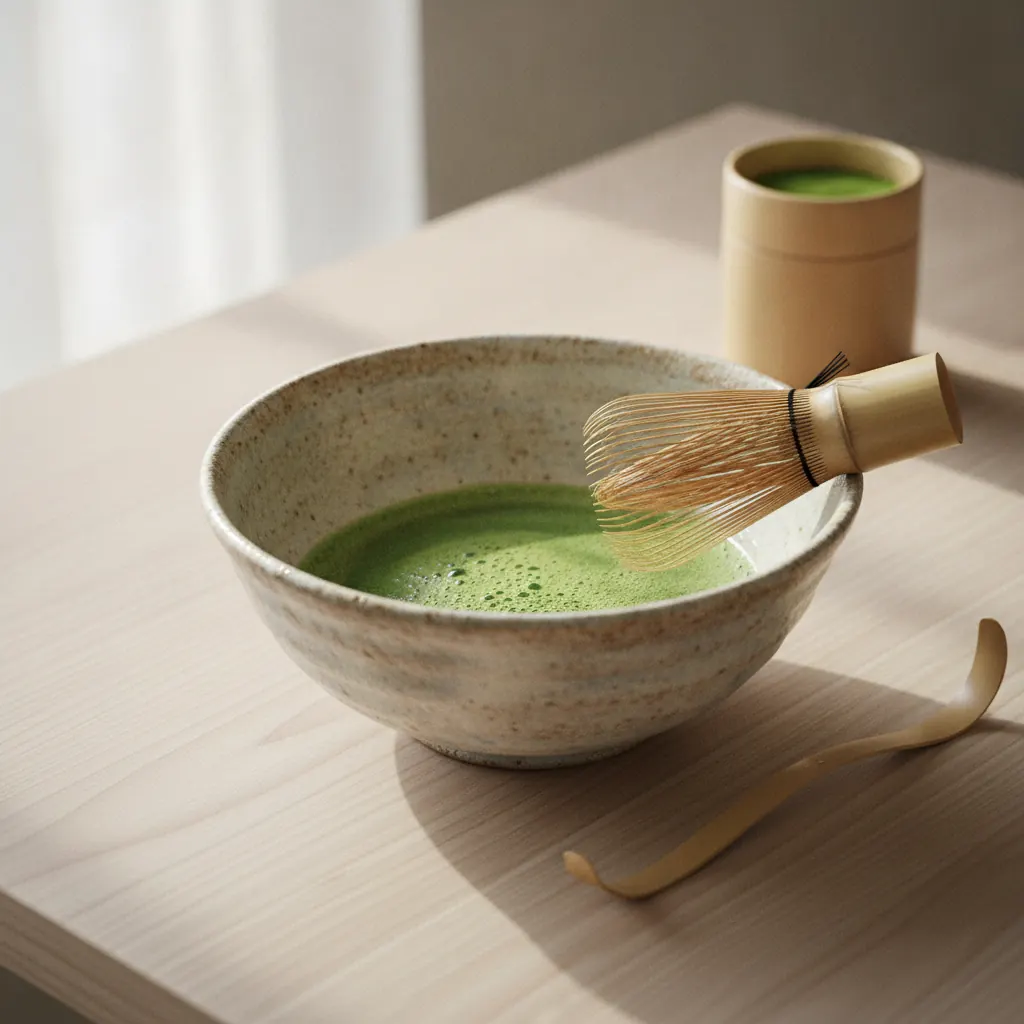
Chasen and chashaku – how to whisk matcha without lumps and how much powder to measure
2026-08-14
Chasen is a bamboo whisk for whisking matcha, and chashaku is a bamboo spoon you use to measure the powder. One heaped chashaku scoop is roughly 1 gram of matcha, so a standard bowl takes two scoops, meaning about 2 g per 60–70 ml of water at a temperature of 70–80°C. You whisk with a quick motion shaped like a W or M, from the wrist, for a dozen or so seconds – never in a circle, because a circle just spreads the lumps around the walls.
It sounds trivial, yet most people who write to us saying that “the matcha came out bitter and lumpy” make one of three mistakes: they pour boiling water, they don’t sift the powder, or they press the chasen against the bottom of the bowl. Below you’ll find the whole technique – quantity, temperature, hand movement, and what to do with the bamboo after drinking so it lasts longer than two months.
What is a chasen and why an ordinary whisk won’t replace it
A chasen is carved from a single piece of bamboo. The bottom part remains a solid handle, the top is split into dozens of thin bristles, curled inward and separated by a thread. You’ll find versions with 60, 80, 100 and 120 bristles. The more bristles, the finer and denser the foam, because the tool aerates the infusion at many points at once instead of simply stirring it.
This is the whole difference compared to a metal whisk. Matcha doesn’t dissolve in water – it’s a ground leaf, a suspension of particles a few micrometres in size. You can’t just “stir” it, you have to break it up and suspend it. Rigid wires have too much space between them and too little contact with the bottom of the bowl, so the powder stays at the bottom as a dark green sludge. The flexible bamboo prongs bend near the bottom and sweep up everything that has settled there.
Second reason: bamboo doesn’t scratch ceramics and doesn’t add a metallic aftertaste. With ceremonial-grade matcha, you can really taste it.
Chashaku – how many grams does a bamboo matcha spoon hold?
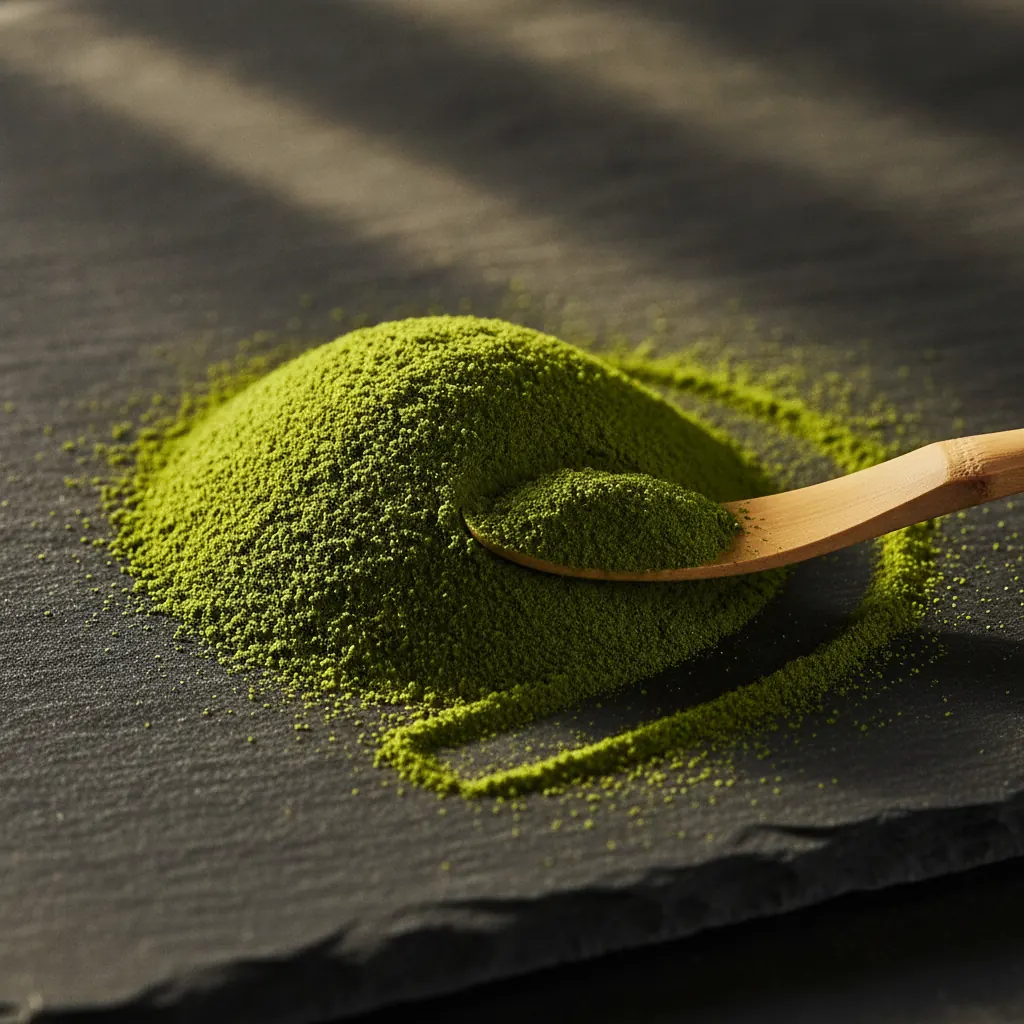
One heaped scoop of chashaku is about 1 gram of powder. This is the value on which the entire Japanese preparation tradition is based: two scoops for thin matcha (usucha), three to four for thick matcha (koicha). If you like it stronger, add two and a half scoops – the difference between 2 and 2.5 g is perfectly noticeable in the cup.
How many scoops for a bowl, and how many for a latte
For a classic bowl: 2 g of powder per 60–70 ml of water. For matcha latte: 2–3 g, because milk absorbs some of the flavour and a weaker portion will simply disappear. For koicha, i.e. thick matcha drunk during a ceremony, you need 4 g for just 30–40 ml of water, and then you don’t whisk it into foam, but knead it with the chasen to the consistency of thick paint.
Practical calculation: a 40 g tin at two grams per bowl gives twenty servings. With daily drinking, that’s about three weeks per package – and that’s good, because opened matcha loses its colour within a few weeks, not months.
What to do when you don’t have a chashaku or a scale
A regular teaspoon levelled off holds about 2 g of matcha, heaped – even 3 g. The problem is that everyone understands “levelled off” differently, and matcha is light and fluffy, so the discrepancy with a teaspoon can reach 50%. A chashaku has a fixed, shallow bowl and is therefore surprisingly consistent – you always scoop the same amount, even without looking.
How to whisk matcha with a chasen so there are no lumps?
The whole procedure takes less than two minutes, and each step solves a different problem.
Sift the powder – this is not optional
Matcha clumps on its own. The particles are so fine that they stick together from moisture in the air and static charges, and every tap of the tin packs them even tighter. A lump that ends up in the bowl will survive whisking and float to the top as a dark speck.
Sift two grams through a fine sieve straight into the bowl, spreading the powder with a chashaku or your finger. Ten seconds of work, and you can feel the difference in the smoothness of the drink from the very first sip.
Water: 70–80°C, never boiling
Boiling water instantly draws tannins out of the leaf and turns good matcha into something astringent and bitter. Boil the water and let the kettle sit for 3–5 minutes, or pour the water once into another container – each pour drops the temperature by about 5 degrees. For koicha, you go even lower, around 70°C.
Start with a small amount: pour in 30–40 ml first and grind the powder into a smooth paste, only then add the rest up to 60–70 ml. This one change in order eliminates most lumps before you even start whisking.
Also warm up the bowl itself – pour in boiling water, swirl it, pour it out, wipe it dry. Warm ceramic won’t suck the temperature out of sixty millilitres of water in half a minute, and at the same time it will soften the tips of the chasen.
W or M motion – from the wrist, not the elbow
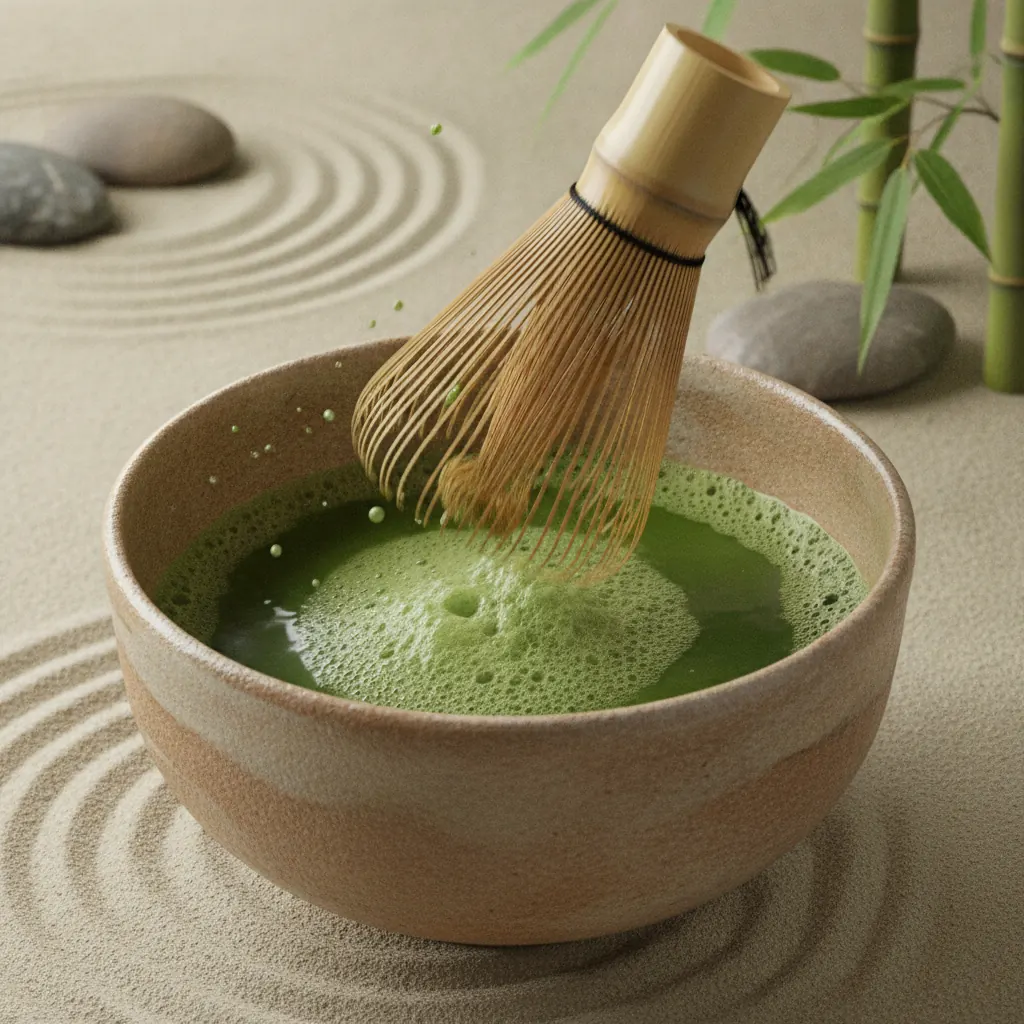
Hold the chasen upright, loosely, with the tips of the prongs just above the bottom – literally a millimetre or two above the ceramic. Don’t press down. Pressing doesn’t whisk the matcha faster, but it breaks the prongs, and that’s the most common reason a whisk wears out after a few weeks.
Move your hand quickly back and forth, tracing the letter W or M. Only the wrist works, the forearm stays still. Circles are tempting, because that’s how we stir coffee, but a circular motion pushes the powder onto the walls and doesn’t aerate the infusion. The point is for air to get in with every pass.
How long does it take and how do you know it’s done
A dozen or so to twenty seconds of energetic whisking, roughly a hundred strokes. The foam is first thin and full of large bubbles, then it thickens and becomes finer, until it covers the surface with a light green, creamy layer. Then slow down, run two or three circles across the top to gather the biggest bubbles, and pull the chasen straight up through the centre.
If the foam collapses immediately, there are usually two reasons: the water was too cold or the powder was too old. Matcha that has turned brown in an open tin won’t foam even with perfect technique.
Why is my matcha bitter and lumpy?
The most common causes, in order from most to least frequent:
- Water too hot. Above 85°C the infusion becomes astringent. Boiling water alone can ruin even very good matcha.
- No sifting. Lumps won’t disappear from whisking – they’ll just break into smaller lumps.
- Too much powder for too little water. 3 g per 60 ml is already leaning heavily towards koicha, and such an infusion can be unpleasantly thick if you’re expecting a light bowl.
- Wrong powder colour. Good matcha is bright green. Grayish-green or olive means old or weak tea – it will taste flat and grassy in the cup.
- Tall, narrow cup. The chasen needs a wide bottom to be able to spread out. In a coffee mug you’ll manage to whisk at most half the volume.
How to prepare a new chasen before first use?
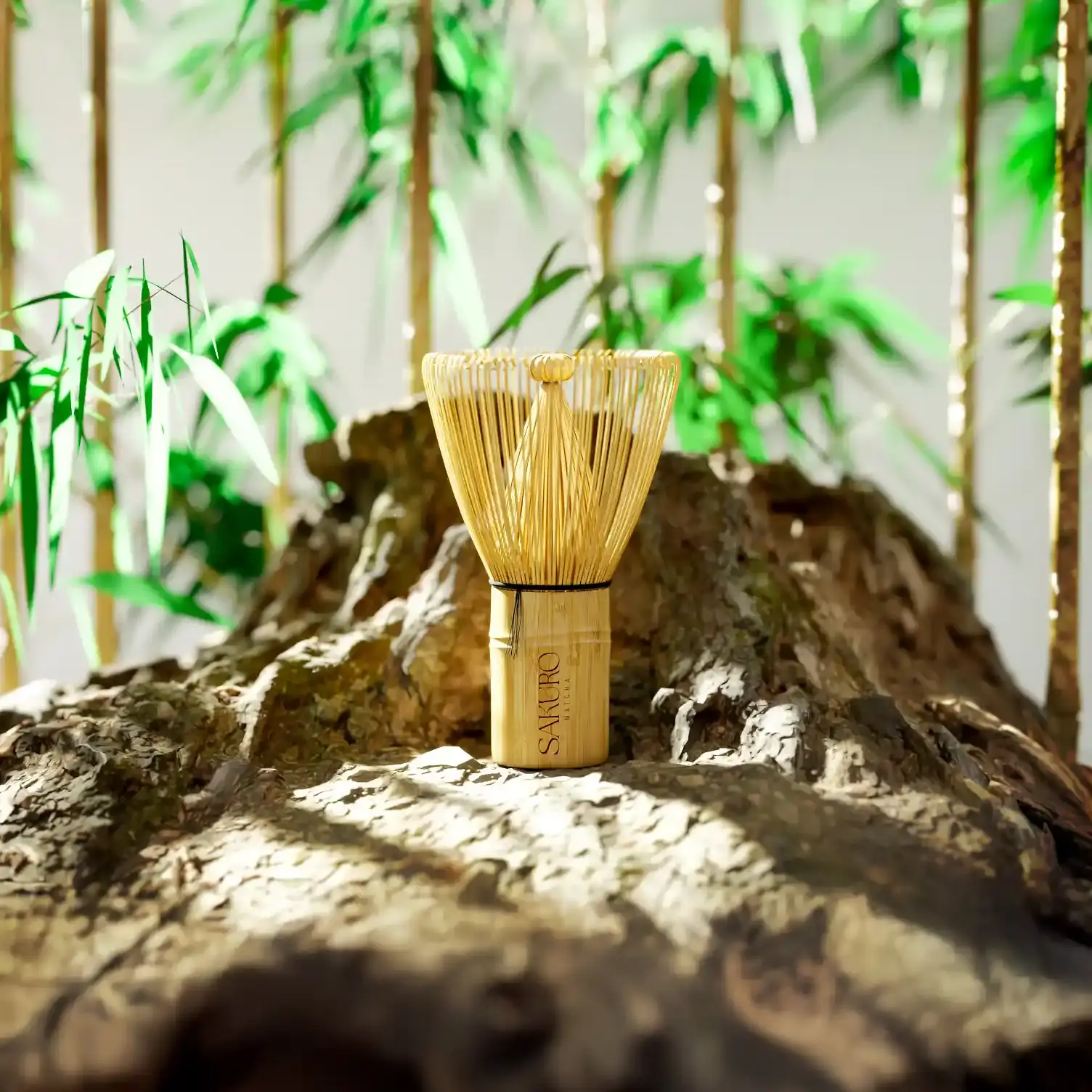
A new whisk arrives with its tines tightly curled inward, often on a plastic frame to keep its shape. Dry, it’s brittle. Submerge just the head in warm water – not boiling – for two to three minutes and gently swirl it in the vessel. The tines will soak up water, soften and spread outward into the characteristic fan shape.
Repeat this every time you reach for the chasen after a longer break. Bamboo that has dried out completely and is immediately put to energetic whisking simply breaks.
How to wash and dry a chasen so it doesn’t go moldy?
The rule is one and short: water only. No dish soap, no dishwasher, no scrubbing with a sponge. Detergent soaks into the bamboo and comes back in the next bowl, and the dishwasher will loosen the thread binding the tines within a few cycles.
After whisking, rinse the head under lukewarm water, gently turning it – the matcha residue comes off on its own. Shake off excess water and stand the whisk head up: on a dedicated kusenaoshi stand, or even just resting its handle against the edge of a cup. Never put a wet chasen away flat in a drawer or in a closed container – moisture stays between the tines and after a few days you’ll have mold that can no longer be removed. We wrote more about caring for natural materials in the guide on how to clean and care for accessories – bamboo and wood follow the same rules regardless of whether you drink matcha or yerba mate.
How long does a bamboo whisk last
With daily use and reasonable care – a few months. The occasional broken tine is normal wear, not a defect; you fish it out of the bowl and keep drinking. Replace the chasen when roughly a third of the tines are gone, or when it starts losing its fan shape, because from that point on the foam gets thinner and thinner while you press harder and break even more tines.
Chashaku is practically indestructible, as long as you don’t soak it. Just wipe it with a dry cloth after each use. Water sitting in the spoon’s bowl is a sure way to crack it along the grain.
Can you whisk matcha without a chasen?
You can, though the result is different. An electric frother will make foam in five seconds, but the bubbles are larger and settle faster, and sediment still collects at the bottom because the spiral doesn’t sweep the whole surface. Shaking matcha with water in a sealed jar works well when travelling and for cold versions – first blend the powder with a bit of lukewarm water, then add ice. A sieve is still needed with each of these alternatives, since none of them will break up clumps that end up whole in the vessel.
What to whisk with and what to measure with – our bamboo accessories
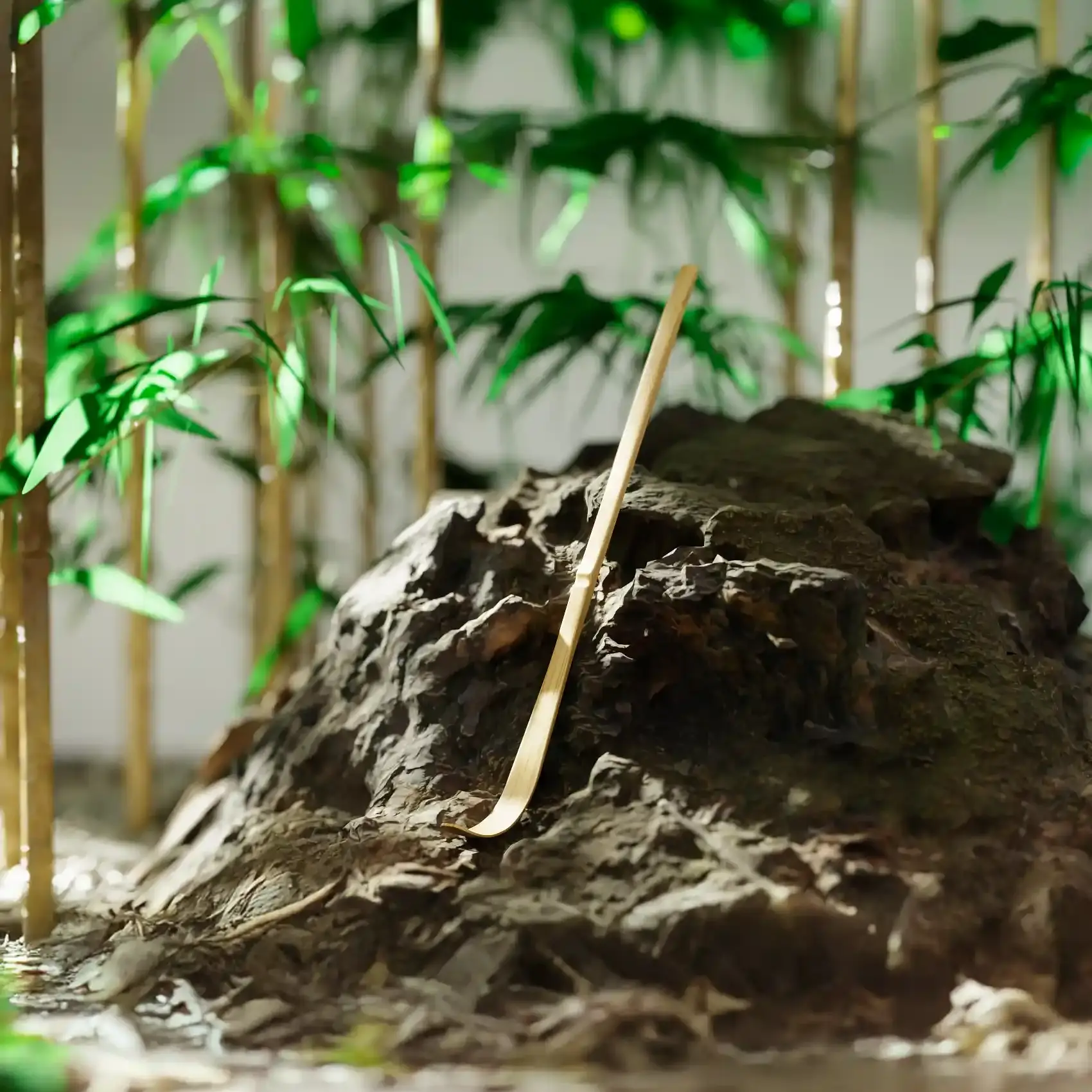
Sakuro Chasen – bamboo matcha whisk is the one part of the kit it pays least to skimp on, because it decides whether you get foam in the bowl or just a suspension. Chashaku – a bamboo spoon is a small outlay and the simplest way to stop guessing the dose.
On top of that, you need powder that’s actually suitable for whisking. Sakuro Matcha Finest 40g + Excellence 40g is a set of two tins to compare: Excellence from the first harvest is milder and sweeter, while Finest has a more pronounced, stronger umami with a light tannic edge. If you’re still putting together your equipment, also check out how to choose a matcha set – there we break down the differences between the variants and bowls.
Matcha is a leaf ground in its entirety, so you drink it together with the polyphenols and caffeine it contains – exactly how much, we show in our comparison of coffee, tea and yerba mate. And if you’re torn between two green rituals: yerba mate or matcha.
Frequently asked questions about chasen and chashaku
How many grams of matcha does a chashaku hold?
About 1 gram per heaped scoop. A standard bowl uses two scoops, meaning 2 g per 60–70 ml of water. For thick koicha, four scoops are used per 30–40 ml.
How do you whisk matcha with a chasen – in circles or side to side?
With quick forward-and-back movements, tracing a W or M shape, working from the wrist alone. Circular motions spread the powder along the walls and don’t aerate the infusion, so they won’t produce foam.
Can a chasen be washed with dish soap?
No. Bamboo absorbs the detergent and releases it back into the next batch of tea. Lukewarm water, a shake, and drying head-up is all it needs.
Why does my matcha have lumps despite whisking?
Because it wasn’t sifted. Matcha clumps are compacted and a chasen won’t break them up – sift the powder through a fine sieve directly into the bowl, then work it first into a paste with 30–40 ml of water.
How many prongs should a good chasen have?
For everyday thin matcha, whisks with 80–100 prongs work best. Denser ones, with 120 prongs, produce finer foam, but they’re more delicate and wear out faster.
Discover our TOP products!





Your dream figure




Discover new flavors





Yerba mate with tea




Accessories



Superfoods













Certified raw honeys from Poland


Check the current price
free shipping
Up to 90 days
free returns
24 H
shipping