
My bamboo whisk is losing prongs: how to clean a matcha whisk and make it last
2026-11-14
You lift the whisk out of the bowl and two pale slivers of bamboo stay behind, floating on the foam. The next morning there is a third one in the sink. The whisk still works, more or less, but the foam takes longer and looks thinner, and you start to wonder whether you bought a bad one.
You probably did not. Losing prongs is how a chasen ends its life, but almost every whisk I have seen die early was killed by the same handful of habits — boiling water, washing-up liquid, and being left face-down on a wet worktop overnight. Knowing how to clean a matcha whisk is most of the fix, and it takes about two minutes a day.
Why the prongs snap in the first place
A chasen is carved from one piece of bamboo. The outer wall is split into fine tines, curled by hand over a form, and held at the base by a thread. At the very tip, each prong is thinner than a toothpick. Depending on the model there are roughly sixty to a hundred and twenty of them, arranged in an outer ring and an inner spiral.
Dry bamboo is stiff and brittle. Warm, wet bamboo bends and springs back. That single fact explains nearly everything that goes wrong:
- Whisking dry. Tips at their stiffest, hitting glazed ceramic at speed. They do not bend — they break.
- Water off the boil. Around 100 °C the thinnest sections dry out and craze. Repeat daily and they go glassy.
- Pressing into the base. The tips are bent past their range and split lengthways, down the grain.
- Drying tip-down. Water pools where the prongs meet, which is also where mould starts.
- Detergent. Bamboo is porous. It swells, the binding thread slackens, and the whole head loses its shape.
The soak before you whisk: twenty seconds that pays for itself
Before the powder goes anywhere near the bowl, stand the whisk in hot water:
- Fill the bowl with water at 70–80 °C — boiled, then left to stand for two or three minutes.
- Stand the chasen in it, prongs down, for 20–30 seconds. Swirl it twice.
- Tip the water out and wipe the bowl dry with a cloth. A damp bowl makes the powder clump before you have touched it.
Two things happen. The tips take up water and go flexible, so they survive the next minute of abuse. And the bowl comes up to temperature, which matters more than people expect for the foam.
A brand new chasen wants a little longer — a minute or two in warm water the first time. The prongs come off the form pressed tightly together; the soak opens them out into the fan shape they are supposed to hold.
Whisk from the wrist, not from the shoulder
Most prong damage happens during the twenty seconds of whisking, and it comes from pushing down rather than from speed.
Sift 2 g of matcha — two heaped chashaku scoops — into the dry bowl. Add 60 ml of water at 70–80 °C. Hold the handle loosely, near the top. Whisk briskly in a W or M shape for 15–20 seconds, keeping the tips just under the surface. Finish with a slow circle and lift the whisk out through the middle of the foam.

If you can hear the whisk ticking against the bottom of the bowl, you are pressing. Lift it a few millimetres. The foam comes from shearing air into the liquid near the surface, not from scraping the glaze.
Vessel shape matters too. A proper matcha bowl is wide, with a rounded inner corner the prongs can sweep through. A straight-sided mug or a jam jar traps the outer prongs against a vertical wall and bends them against the grain — it is the fastest way to wreck a new whisk. If you want the full method, including a matcha latte recipe that starts from the same paste, the technique is identical; only the milk changes.
The two minutes after you drink
This is the part that decides whether your whisk lasts a season or three years.
- Rinse immediately under warm running water — hand-warm, not hot. Spin the whisk between your palms so the water passes through the prongs.
- No soap, no sponge, no scrubbing. Matcha leaves no grease. Water alone takes it off, as long as you do it before the residue dries.
- Shake the water out and run a fingertip gently around the outside of the prongs to open the fan again.
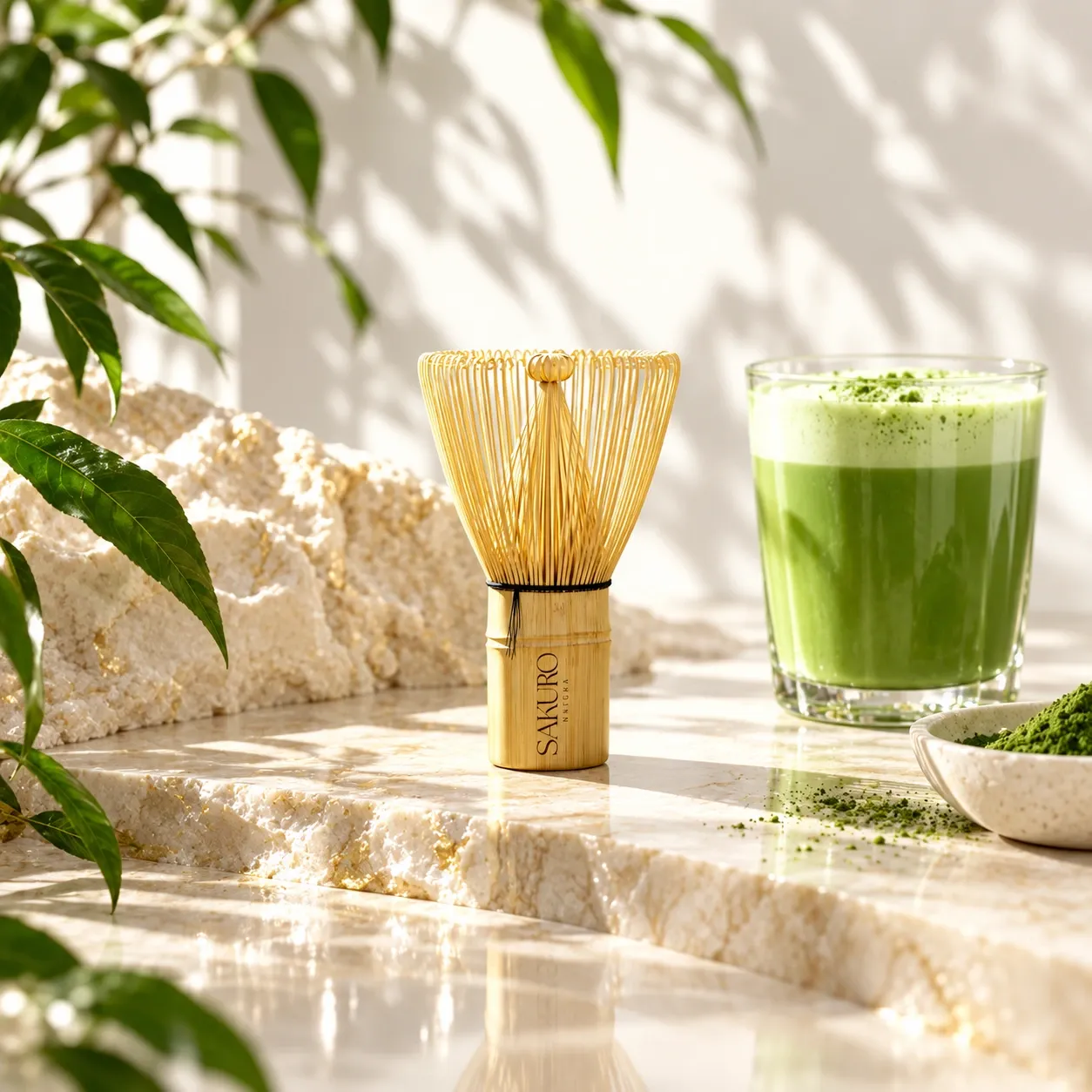
- Dry prongs up, with air underneath. A ceramic whisk holder (kusenaoshi) is the classic answer; standing the whisk on the flat end of its handle, as in the photo at the top, works just as well. What matters is that nothing presses the tips and nothing traps water.
- Leave it out. Not in a drawer, not back in the gift box, and never in the matcha tin. A damp whisk in a closed container grows mould at the base of the prongs within days.
| Habit | What it does to the bamboo | Do this instead |
|---|---|---|
| Dishwasher | Heat and detergent swell the fibres; the binding thread slackens and the head loses shape | Thirty seconds under warm running water, by hand |
| Washing-up liquid | Porous bamboo keeps the scent; your next bowl tastes faintly of lemon | Water only — there is nothing greasy to remove |
| Water at 100 °C | The thinnest tips dry out, craze and snap | 70–80 °C, for the soak and for the tea |
| Whisking a dry whisk | Stiff tips strike glazed ceramic at full force | Soak 20–30 seconds first |
| Pressing into the base of the bowl | Prongs bend past their range and split along the grain | Whisk at the surface, from the wrist |
| Using a tall mug or a jar | Outer prongs grind against a vertical wall | A wide bowl with a rounded inner corner |
| Drying tips-down on the worktop | Water pools in the centre of the head; black spots follow | Prongs up on a holder or on the handle end |
| Storing it damp in a tin or drawer | Mould at the base of the prongs, where you cannot rinse it out | Open shelf, moving air, fully dry before it is put away |
When a chasen is finished — and what it costs you per bowl
A whisk is a consumable, like a pepper mill is not. Even treated perfectly it wears: the tips fray, the fan opens wider, the foam takes a few seconds longer. Replace it when you see any of these:
- Prongs from the inner spiral break, or the binding thread goes slack. The head stops holding its shape and the foam collapses.
- Prongs split lengthways into sharp splinters. Those end up in the drink.
- Black or green specks at the base of the prongs. That is mould; it is inside the fibre and it does not rinse out. Bin it.
- Twenty seconds of brisk whisking no longer produces a fine, even foam on good powder.
A few missing prongs from the outer ring are cosmetic. Keep going.
What a whisk actually costs depends entirely on how long you make it last. Ours is 14.90 €. Spread over fifty bowls, that is 30 cents a cup — more than the matcha in some recipes. Spread over a year of daily matcha, it rounds down to four cents.
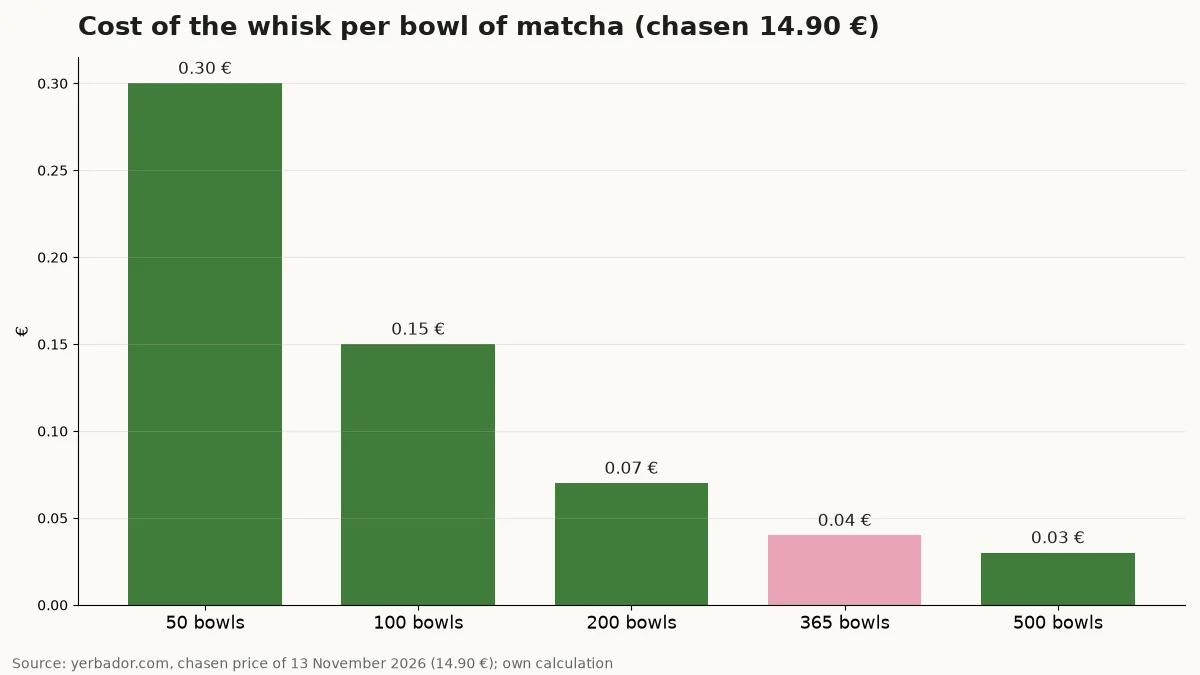
No one can honestly promise you a number of bowls; bamboo, water and habits all differ. The point of the chart is narrower: the gap between the first bar and the last one is not the bamboo. It is the rinse, the soak and where the whisk spends the night.
What to buy when the old one goes
Prices from yerbador.com, 13 November 2026, in euro, shipped from the EU.

| Item | What it is for | Price |
|---|---|---|
| Chasen — bamboo matcha whisk | The part you replace | 14.90 € |
| Chashaku — bamboo scoop | Two heaped scoops ≈ 2 g | 5.90 € |
| Matcha bowl NIWA | Wide bowl, rounded corner — kind to prongs | 23.90 € |
| Sakuro Matcha Finest, 40 g tin | Everyday ceremonial grade from Shizuoka | 23.90 € |
Not sure which powder belongs in a bowl and which belongs in a cake, read ceremonial vs culinary matcha before you order.
If you run a café and go through whisks the way the rest of us go through sponges, the tea itself is worth buying by the kilo: Sakuro Finest works out at roughly 108.90 € per kg net and Excellence at about 156.60 € per kg net — an indicative conversion at the NBP rate of 13 November 2026, with the binding offer sent by Ewelina at [email protected] or +48 515 025 329.
FAQ
Can I wash a matcha whisk with washing-up liquid?
No. Bamboo is porous and holds the fragrance, so the next bowl tastes of detergent. There is also nothing to dissolve — matcha is not greasy. Warm water and thirty seconds, straight after you drink, removes all of it.
Can a chasen go in the dishwasher?
No. The combination of 60 °C-plus water, detergent and a long drying cycle swells the fibres and loosens the thread at the base. A whisk that has been through a dishwasher once usually sheds prongs for the rest of its short life.
How long should a bamboo whisk last?
There is no honest single answer — it depends on the bamboo, your water and whether the whisk is used once a day or twenty times a shift. Judge it by condition, not by the calendar: broken inner prongs, splinters or mould mean replace; a few gaps in the outer ring do not.
Do I need a whisk holder?
It helps and it is not essential. A kusenaoshi keeps the fan open while the whisk dries, which slows the shape loss. Standing the whisk upright on the end of its handle does the same job for free, as long as air can reach the prongs.
My whisk has black spots at the base of the prongs. Can I save it?
No. Those specks are mould inside the fibre, under the thread, where rinsing does not reach. Replace it and change the habit that caused it — almost always a damp whisk left in a drawer, a box or the tin.
Discover our TOP products!





Your dream figure




Discover new flavors






Yerba mate with tea





Accessories





Superfoods













Certified raw honeys from Poland





Check the current price
free shipping
Up to 90 days
free returns
24 H
shipping