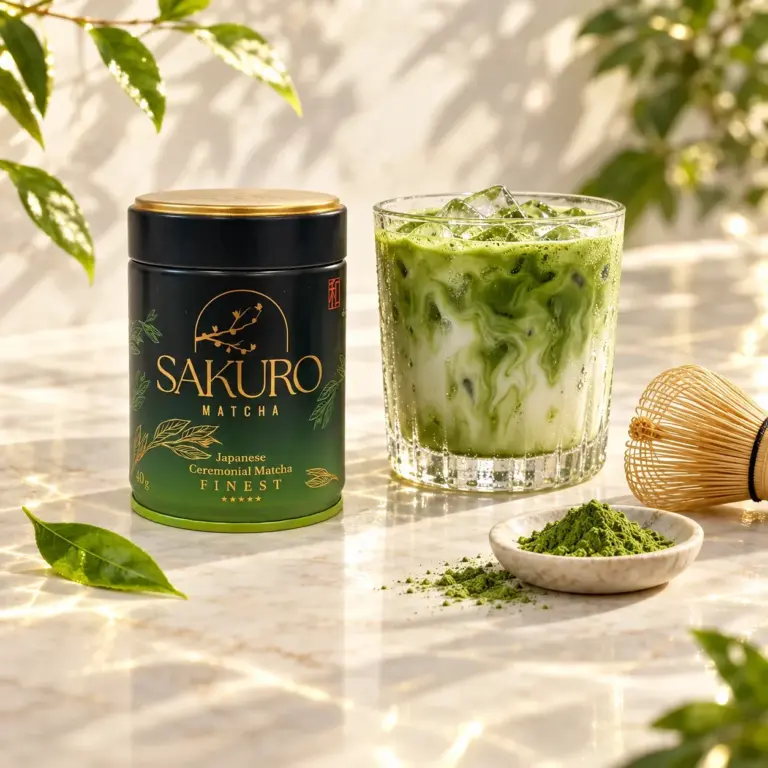

Matcha latte cost per cup: how to price matcha drinks in your café
2026-11-13
Most cafés price matcha by feel. They look at the flat white, add a euro, and hope. That holds up until the first kilo bag arrives and nobody on the team can say how many drinks it is supposed to cover.
The matcha latte cost per cup is not hard to work out — it is matcha, milk, a cup and a few cents of extras. What is hard is keeping that number steady across a week of shifts. Below: the formula, five drinks costed to the cent, and the three leaks that cost more than the tea itself.
What actually goes into the cup
Cost of goods for a matcha drink has four lines and nothing else:
matcha (g × price per g) + milk or water (ml × price per ml) + cup, lid, straw + syrup and extras, then add 3–5 % for waste.
That waste line is not padding. It covers the powder left in the sieve, the drink a customer sends back because it was lumpy, and the first latte of the morning that goes down the sink while someone dials in the whisk. Three per cent is a tidy bar; five per cent is normal.
What is not in this number: labour, rent, card fees, the dishwasher. Those come out of the gross profit, not the recipe. Keep them separate or you will never know which drink is actually carrying the menu.
What two grams of matcha really cost
Ceremonial matcha looks expensive in a 40 g tin and cheap in a kilo bag. The same powder, the same harvest — the only thing that changes is how you buy it. All prices checked on yerbador.com on 13 November 2026.
| How you buy it | Price | Per gram | Per 2 g serving | Servings per pack |
|---|---|---|---|---|
| Sakuro Matcha Finest, 40 g tin | €23.90 | €0.60 | €1.20 | 20 |
| Sakuro Matcha Excellence, 40 g tin | €26.90 | €0.67 | €1.35 | 20 |
| 3 × Finest 40 g (2+1 free) | €46.90 | €0.39 | €0.78 | 60 |
| Finest, 1 kg bag (wholesale) | ≈ €108.92 | €0.11 | €0.22 | 500 |
| Excellence, 1 kg bag (wholesale) | ≈ €156.57 | €0.16 | €0.31 | 500 |
Read that last column again. A kilo bag is five hundred servings, and it drops the tea in the cup from €1.20 to €0.22. No other decision on this page moves the number that far. The wholesale figures come from the Sakuro 2026 trade list — 480 zł/kg net for Finest, 690 zł/kg net for Excellence — converted at the NBP rate for 13 November 2026 (1 € = 4.4070 zł). Treat them as an indicative conversion; the binding offer comes from Ewelina.
Five drinks, costed to the cent
Here is a small matcha menu with the numbers filled in. The matcha is Finest bought by the kilo, at €0.109 per gram. Everything else uses example net purchase prices: milk €1.00/l, barista oat drink €1.60/l, coffee beans €18/kg, sparkling water €0.50/l, syrup €8/l, 300 ml cup with lid €0.10, 400 ml cup with lid and straw €0.14. Swap in your own invoice prices — the method is the point, not my milk supplier.
| Drink | Matcha | Milk / liquid | Cup & extras | Cost of goods |
|---|---|---|---|---|
| Hot matcha latte 300 ml, ceramic cup | 2 g — €0.22 | 200 ml dairy — €0.20 | — | €0.42 |
| Iced matcha latte 400 ml, takeaway | 3 g — €0.33 | 200 ml dairy — €0.20 | €0.14 | €0.67 |
| Oat matcha latte 300 ml, takeaway | 2 g — €0.22 | 200 ml oat — €0.32 | €0.10 | €0.64 |
| Dirty matcha (matcha + espresso) 300 ml | 2 g — €0.22 | 180 ml dairy + 7 g coffee — €0.31 | €0.10 | €0.62 |
| Matcha tonic 400 ml, takeaway | 2 g — €0.22 | 200 ml sparkling + 15 ml syrup — €0.22 | €0.14 | €0.58 |
Between the cheapest and the dearest drink on that list there are 25 cents. Between the dearest drink and a menu price of €5.50 there is everything else.
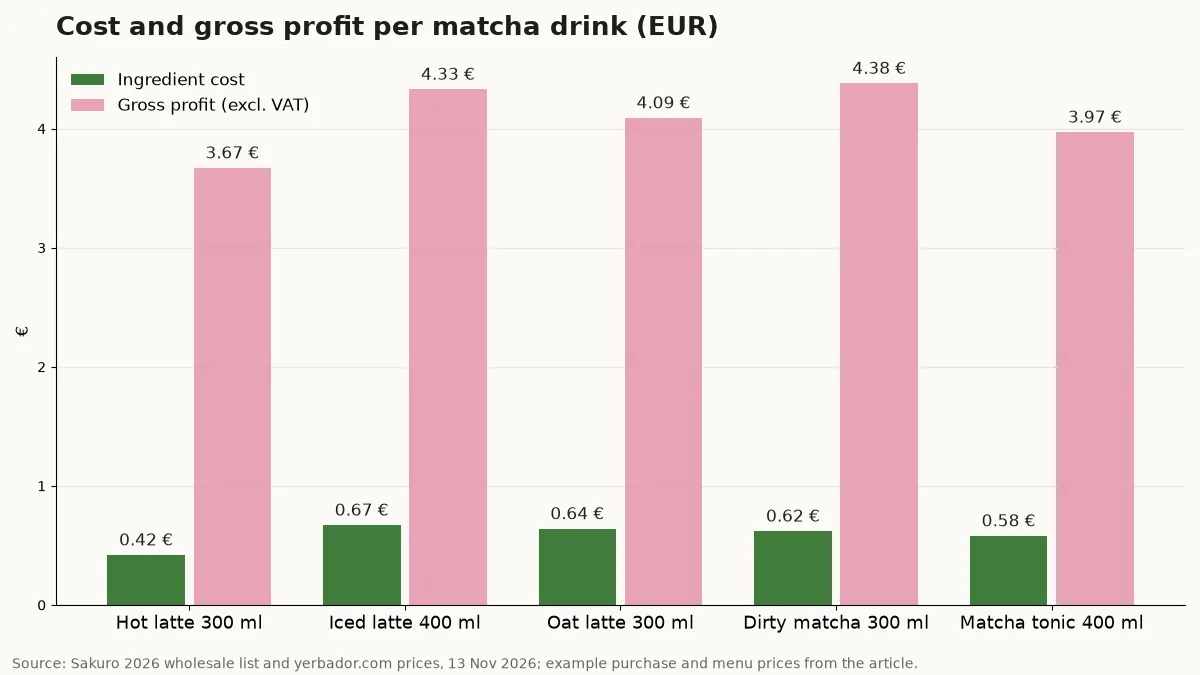
Now the half that pays the rent. Menu prices below include VAT at an example rate of 10 % — use your own rate, and remember you keep the menu price divided by 1 + VAT, not the menu price.
| Drink | Cost | Menu price (incl. VAT) | Net revenue | Gross profit | Cost as % of net |
|---|---|---|---|---|---|
| Hot matcha latte 300 ml | €0.42 | €4.50 | €4.09 | €3.67 | 10 % |
| Iced matcha latte 400 ml | €0.67 | €5.50 | €5.00 | €4.33 | 13 % |
| Oat matcha latte 300 ml | €0.64 | €5.20 | €4.73 | €4.09 | 14 % |
| Dirty matcha 300 ml | €0.62 | €5.50 | €5.00 | €4.38 | 12 % |
| Matcha tonic 400 ml | €0.58 | €5.00 | €4.55 | €3.97 | 13 % |
How to set the price on the board
Work backwards from the share, not forwards from the cost. Decide what portion of net revenue your drinks are allowed to eat — 10–15 % is comfortable for café drinks. At €0.67 of goods and a 13 % target, the net price is €5.15, so €5.50 on the board with VAT at 10 %. Multiplying the cost by four or five gets you to roughly the same place, which is why the old coefficient still works.
Take the VAT out first. Every figure in the right-hand columns above is net. A café that compares a VAT-inclusive menu price with a net invoice price will overestimate its margin by a tenth and wonder why the year does not add up.
Price matcha above the flat white, not below it. It takes longer: sift, measure, whisk, pour. Sixty to ninety seconds of hands-on work against twenty for an espresso drink. If your flat white is €4.20, matcha at €4.00 is not a friendly gesture — it is a slow drink sold at a fast drink price.
Decide what oat costs you. Barista oat runs well above dairy per litre. If you charge nothing extra for it and half your matcha drinkers order it — and in matcha they will — build the difference into the base price rather than running the lowest margin on your bestseller.
Where the margin leaks
Dose drift. A bamboo scoop eyeballed is 2 g on Monday morning and 3 g on Friday night. At twenty drinks a day that is the difference between 1.2 kg and 1.8 kg a month — roughly €65 a month, near enough €780 a year at the Finest wholesale rate. A 0.1 g scale on the bar costs a fraction of that.
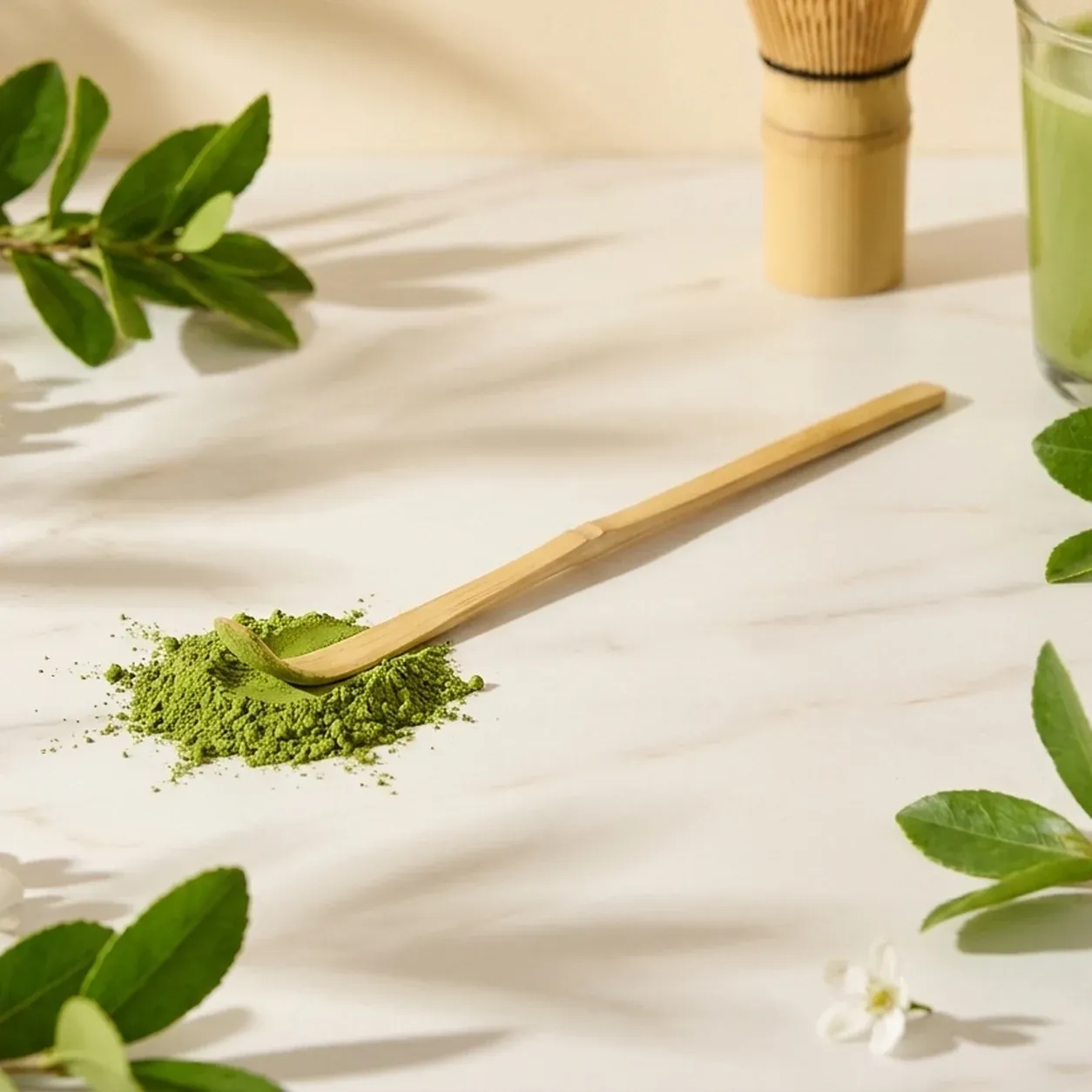
Remakes. Lumpy or bitter drinks come back, and a returned drink costs you twice. Sift 100 g at a time into a sealed container at the start of the shift, keep the water at 70–80 °C, and whisk properly with a bamboo chasen rather than a spoon.
Milk poured by eye. Free-pouring from a big jug leaves 20–40 ml in the bottom every time. Over a month on a busy bar that is litres into the sink.
The tin that went grey. Matcha oxidises once it is open. One tin or bag open at a time, closed between drinks, somewhere cool and dark. Powder that has faded from emerald to khaki cannot be rescued and will not sell twice.
Staff drinks and tastings. Count them. Five a day is 150 a month — 300 g of matcha that never reached the till.
How much you will get through, and buying by the kilo
Twenty matcha drinks a day at 2 g is 40 g a day, 1.2 kg a month. That is the number that decides whether you are a tin café or a kilo café. Below about 300 g a month, tins are fine. Above it, the kilo bag pays for itself within the first week.
Sakuro matcha is Japanese, ceremonial grade, from Shizuoka, and it ships in 1 kg bags from Poland — inside the EU, so no customs paperwork for European cafés. Indicative wholesale prices, converted at the NBP rate of 13 November 2026: Finest about €108.92 per kg net, €0.22 per 2 g serving; Excellence about €156.57 per kg net, €0.31 per serving. Orders are placed in kilograms, with 5 % off from 3 kg and 10 % off from 5 kg.
Wholesale goes through one person: Ewelina — [email protected], +48 515 025 329. She sends the binding offer with current prices and terms for your order.
Not ready to commit to a kilo? The 2+1 pack — three 40 g tins of Finest for €46.90 gives you 120 g, about 60 drinks. Enough for a weekend on the specials board, to see what sells before you order by the kilo.
Questions café owners ask
How much does a matcha latte cost a café to make?
With ceremonial matcha bought by the kilo: about €0.42 for a 300 ml hot latte in a ceramic cup and €0.67 for a 400 ml iced one in a takeaway cup, at the example purchase prices above. Buy the same matcha in 40 g tins and the tea alone jumps from €0.22 to €1.20 a serving.
What should I charge for a matcha latte?
Set a target for cost of goods as a share of net revenue — 10–15 % works for café drinks — then divide your cost by that share and add VAT. Sense-check it against your own flat white: matcha takes three times as long to make, so it belongs above it on the board, not below.
Would a cheaper culinary grade save money?
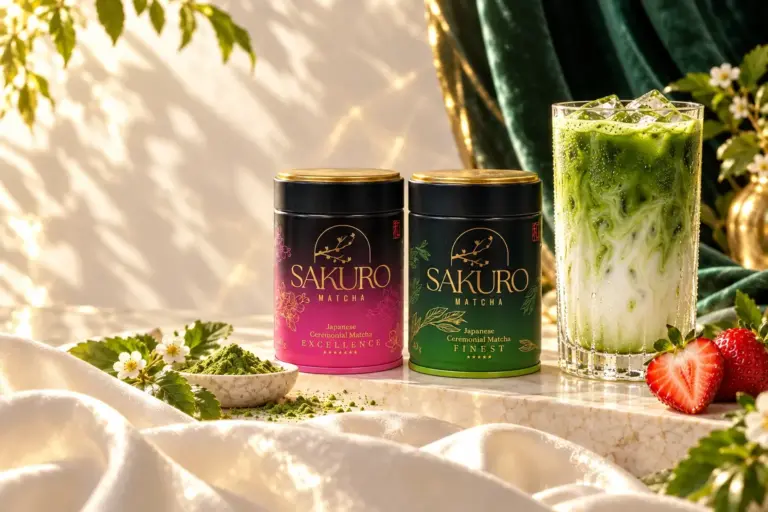
Not enough to matter, and it shows in the glass. The gap between the two Sakuro tiers is nine cents a cup at 2 g. A dull powder costs you remakes and the customers who order matcha because yours is green. Sakuro sells one thing: Japanese ceremonial matcha from Shizuoka, in two tiers — Finest for milk drinks, Excellence when it is whisked with water and drunk on its own.
Should I charge extra for oat drink?
Either charge for it or price the base drink as if everyone takes it. In the table above the oat latte costs €0.22 more to make than the dairy one. A surcharge of €0.30–0.50 is normal; so is folding it into the price and never arguing about it at the till.
How do I order matcha by the kilo?
Email Ewelina at [email protected] or call +48 515 025 329 with the grade and the number of kilos. She confirms the price, the discount band and the shipping details from Poland. Orders go out in 1 kg bags.
Discover our TOP products!
Your dream figure
Discover new flavors
Yerba mate with tea
Accessories
Superfoods


Certified raw honeys from Poland

Check the current price
free shipping
Up to 90 days
free returns
24 H
shipping